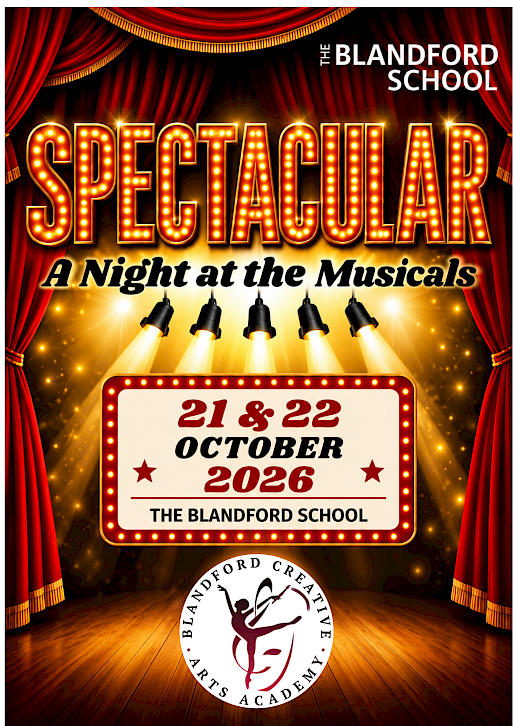
SPECTACULAR – A Night at the Musicals
Tickets are on sale now!
Join us for SPECTACULAR – A Night at the Musicals on Wednesday 21 and Thursday 22 October 2026.
Featuring performances from The Greatest Showman, Mary Poppins, Little Shop of Horrors, Annie, The Lion King, Matilda, Hamilton and more.
Don’t miss what promises to be a fantastic evening of music, dance and performance.
A Level Design
A Level Design
Subject Leader:
Mr D Luxon and Miss K Pettett
Exam Board:
AQA
Entry Requirements:
Grade 5 in GCSE Product Design, Art, Textile Design or Level 2 Merit in Engineering.
Why choose A Level 3D Design/Textile Design?
Three-dimensional is about looking, learning, thinking and communicating ideas. It inspires creative thinkers, problem solvers and people who enjoy making. Three-dimensional design is an ideal opportunity to explore ideas and develop skills and is a great first step for those who wish to follow a course in art and design at university. However, the balance of practical, academic and analytical skills is widely transferable and students intending to study courses unrelated to art and design find that it complements their other subject choices.
A course in three-dimensional design will enable you to select appropriate materials and learn how they fit together, develop an understanding of scale and experiment with texture and surface finish.
The textile design course offers the opportunity to develop skills over a broad range of textile and fashion techniques and applications, such as printing, weaving, knitting, mixed media, digital applications, surface design, embroidery and installation. Practical work is produced by researching and developing ideas using drawing, digital exploration, sketchbooks and work sheets, supported by critical evaluation and an awareness of contemporary and historical influences
A course in textile design will cover materials selection, embellishing, printing, dying, construction methods, knitting and weaving, embroidery, costume and fashion design.
What you will study in A Level 3D Design.
Project one: Year 12
6 to 8 weeks (approx.) are used for introducing basic skills, the formal elements and introducing the specification requirements including presentation of work and making connections with the work of others.
Project two: Year 12 and Year 13 Component 1
16 to 24 weeks (approx.)
-
Component 1 is a sustained and focused investigation in response to an issue, theme or idea identified and chosen by the student.
-
It is a practical body of work, which is supported by written material of between 1000 and 3000 words. (Annotations and notes do not form part of the word count.)
-
Work submitted for assessment must evidence coverage of all four assessment objectives, which are marked holistically.
-
The personal investigation will be assessed as a whole. Evidence of meeting the requirements of all the assessment objectives must be evident in the written and practical work.
-
There should be clear development of ideas and techniques based upon the students’ intentions.
-
Component 1 is not a portfolio and should not contain additional material or projects that are not related to the student’s personal investigation.
-
Presentation of work can be physical or digital sketchbooks, boards, models or a combination of all these approaches.
Project three: Year 13 Component 2
10 to 12 weeks (approx.)
-
Component 2, The externally set assignment (ESA) provides students with the opportunity to demonstrate their ability to develop and explore ideas relevant to an externally set starting point.
-
Students are required to realise their intentions in an outcome or series of outcomes during the period of supervised time.
-
Only work produced during the period of preparatory study and within the 15 hours of supervised time may be submitted for assessment.
-
Work produced during the preparatory period and the 15 hours of supervised time, will be marked holistically.
How You will be assessed in A Level 3D Design.
|
Component 1: Personal investigation |
Component 2: Externally set assignment |
|
What's assessed |
What's assessed |
|
Assessed |
Assessed |
|
Non-exam assessment (NEA) set and marked by the centre and moderated by AQA during a visit to the centre. Visits will normally take place in June. |
Non-exam assessment (NEA) set by AQA, marked by the centre and moderated by AQA during a visit to the centre. Visits will normally take place in June. |
Progression and Careers linked to 3D Design.
-
Possible degree options
Possible career options
Studying a three-dimensional design related degree at university will give you all sorts of exciting career opportunities, including:
-
Architecture
-
Model making
-
Ceramics
-
Product design
-
Film and TV set design
-
Set design
-
Interior design
-
Sculpture
-
Jewellery design
-
Theatre set design
-
Landscape architecture
• Architect
• Jewellery designer
• Ceramicist
• Landscape architect
• Design consultant
• Model maker
• Exhibition designer
• Product designer
• Environmental designer
• Teacher
• Furniture designer
• Toy designer
• Interior designer • Set designer
-
Progression and Careers linked to Textile Design
|
Possible degree options |
Possible career options Studying a textile design related degree at university will give you all sorts of exciting career opportunities, including: |
|
• Constructed textiles • Contemporary textiles • Costume design • Digital textiles • Fashion design • Fashion promotion/merchandising • Footwear design • Printed textiles • Sportswear design • Surface design • Textile design • Textile science and technology • Theatre design |
• Textile technologist • Colour trender or stylist • Costume designer • Creative director • Digital textiles designer • Fashion designer • Fashion illustrator • Fashion journalist • Fashion stylist • Interior designer • Museum/gallery conservator • Pattern cutter • Retail buyer • Teacher or lecturer • Textile designer • Theatre designer • Upholsterer • Wallpaper designer |
Additional Information
Please do not hesitate to contact me at The Blandford School if you require further information DLuxon@blandfordschool.org.uk
Further information on the course can be found at:
https://www.aqa.org.uk/subjects/art-and-design/as-and-a-level/art-and-design-7201.
This course is co-taught with Textiles.