Our Curriculum
Our Curriculum
Welcome to The Blandford School curriculum, designed to inspire curiosity, build confidence and support every student to succeed.
Our curriculum provides a broad, balanced and ambitious education, combining academic rigour with engaging learning experiences. Across each Key Stage, students are encouraged to develop their knowledge, skills, independence and critical thinking, providing strong foundations for their next steps and a lifelong love of learning.
You can explore our curriculum by selecting the individual subject areas below. Each section provides information about what students will study and how their learning develops throughout their time at The Blandford School.
If you would like to find out more about any aspect of our curriculum or how it is delivered, please contact Duncan Smith, Deputy Headteacher, at dsmith@blandfordschool.org.uk.
Parents and carers have the right to withdraw their child from all or part of the Religious Education (RE) curriculum. If you are considering this, please contact Duncan Smith, Deputy Headteacher, at dsmith@blandfordschool.org.uk to discuss the request before submitting it in writing.
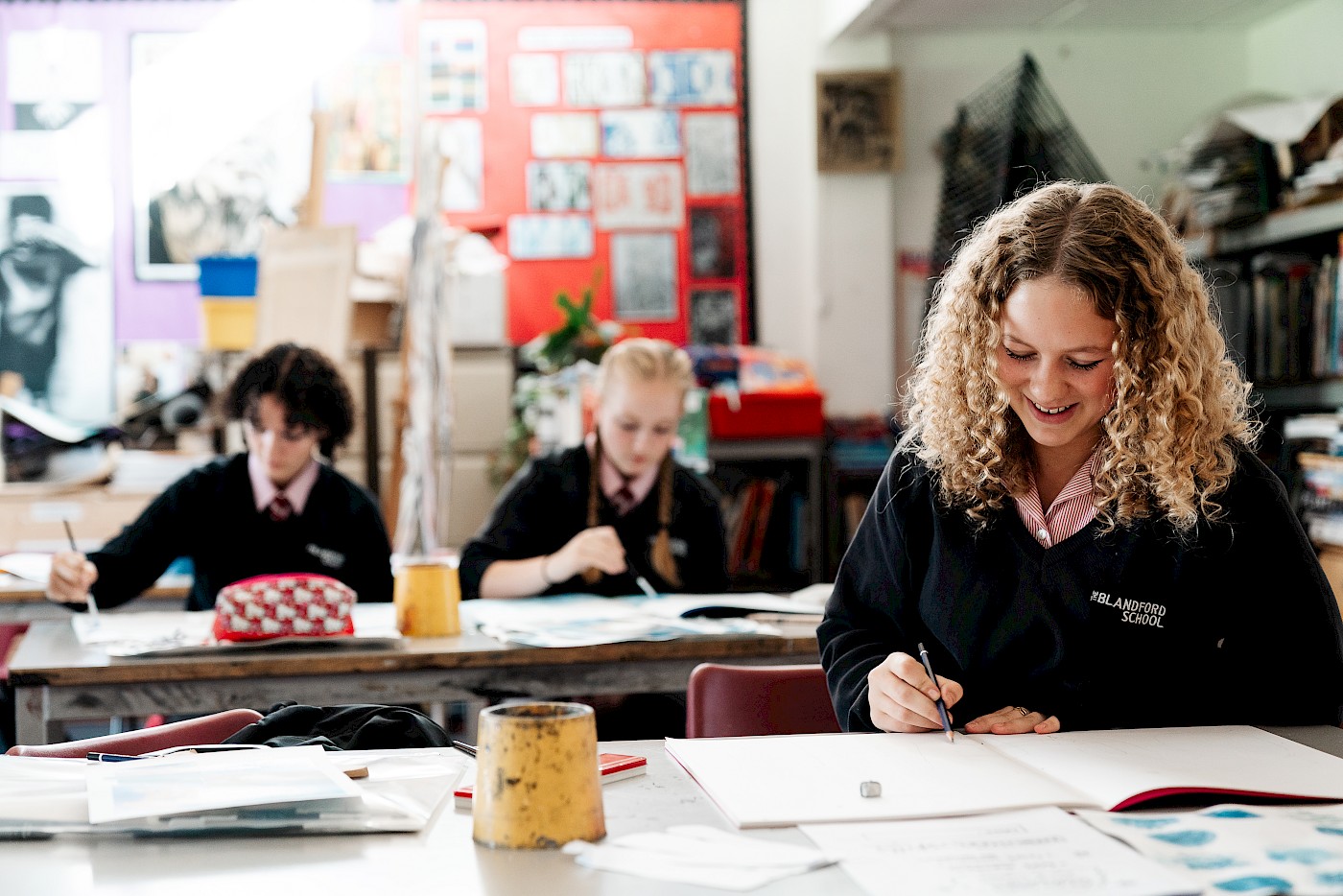
Our vision for learning and curriculum reflects our core vision for education. All members of the school community should show respect, show high levels of effort, have a positive attitude and show perseverance.
Intent
It is our intent to offer a broad and balanced curriculum for all students, providing the opportunity to study the range of EBACC subjects, while also offering a wide range of appropriate qualifications. We believe this alongside strong pastoral care means students leave us ready for the next stage of their lives, whether that be 6th Form, College, Apprenticeships, University or Employment.
Our curriculum is built on a strongly held belief that effective learning takes place when research based methods of instruction, engagement, challenge, feedback and questioning lead to knowledge and skill acquisition and the development of key characteristics, such as resilience, self-motivation, honesty, integrity and care. Therefore, our curriculum:
· Will secure a joy for learning
· Will be inclusive and support all children to do more than they thought possible
· Will discover and develop children’s talents through variety and innovation
· Will build resilience
· Will empower children to make informed decisions
· Will be delivered by experts
· Will be broad, balanced and stretching
· Will be rich in knowledge and skills, secured through application, developing understanding
· Will link together and blend to provide for rounded young people
· Will allow children to seek meaning and achieve personal growth
· Will educate children about diversity and empower them to challenge discriminatory beliefs and behaviours
· Will be progressive across the key stages so that it logically builds knowledge, skills and understanding by stage
Implementation
Our curriculum is delivered through a wide variety of activities and opportunities, this includes:
Timetabled lessons – All students follow a structured timetable of lessons. All subjects produce plans of the units to be covered and the knowledge and skills that should be developed by each point.
Tutorial / Personal Development programme – The tutorial programme is planned by HOY and covers a wide range of knowledge and skills, alongside the development of character and culture.
Tutor periods – Throughout the year the timetable is suspended across the school for tutor periods to take place, providing more extended learning time within the tutorial programme.
Assemblies – Assemblies cover a range of themes and topics, they are delivered by HOY, SLT, students, external providers and other staff.
SRE lessons – Sex and relationships education is covered via RE lessons, the tutorial programme and additional sessions as appropriate.
Parental engagement – We are keen to engage with parents, ensuring they have access to information so that they know what their child is learning about and when. We also engage through written reports and parents’ evenings as well as information evenings at key points including starting school, meet the tutor evening, GCSE Options, GCSE exams and post 16 options.
Options choices – We believe students should retain as broad a curriculum as possible for as long as possible, therefore students do not begin GCSE options until Year 10. All students have access to the same range of courses, although additional guidance is provided to match ability and interests to choices. All students are expected to study at least one EBACC subject.
Drop down days – Sessions when students are taken off timetable for special events.
Presentations by external providers – In partnership with a range of external providers we offer additional sessions to students, this will include contact with employers, theatre productions about drugs and alcohol and engagements with the police regarding e-safety.
Educational trips and visits – The school offers a wide range of trips and visits both in this country and abroad.
Work Related Learning Week – In Year 10 all students are ‘off timetable’ for one week, during this time they will be involved in visits, activities and presentations to develop employability skills.
Extra-curricular clubs and activities – The school is proud of offer a wide range of extra-curricular activities, the lists of these is published each term. Students are encouraged to take part.
Careers guidance – All students receive careers guidance through subject lessons, the tutorial programme and assemblies / presentations. They can also attend special events for things like apprenticeships as well as requesting one to one careers support.
Post 16 opportunities – Alongside their subject choices students also engage in a wide range of other activities, this includes independent study, young enterprise, Duke of Edinburgh’s Award, MOOC’s, work experience, road safety and progression provision.
Impact
The impact of the curriculum should be for students to achieve well both academically and in other ways. This will be measured through examination results, destinations data, student voice, parental voice and other outcomes.
We aim for every single student to leave TBS at either 16 or 18 with the requisite abilities, skills and qualifications to both pursue a careers of their choice and play and full and positive role in society.
Language of the Curriculum - Definitions
What we mean by ‘curriculum’. The curriculum is the knowledge and skills that students are expected to learn as they progress through the school. The curriculum includes every learning experience a student has throughout their time at The Blandford School. This is provided through lessons as well as through our wider curriculum.
What we mean by ‘learning’. Learning is the alteration in the long-term memory. If a student has committed subject content to their long-term memory and this can then be used both in the subject and in other areas of life then this has been learned.
What we mean by ‘knowledge’. Knowledge is the sum of everything a student knows. It is the facts and information acquired from the curriculum and life-experience. This is embedded in the long-term memory as a network of accessible memories.
What we mean by ‘subject knowledge’. Subject knowledge is the subject content or information gained from a specific subject, such as maths, which is committed to long-term memory.
What we mean by ‘skill’. Skill is the ability to do something well which is acquired through direct experiences and practice.
What we mean by ‘wider curriculum’. Our wider curriculum contributes significantly to a student’s knowledge. It includes learning experiences which take place outside of traditional one hour subject specific lessons.
What we mean by ‘progress’. Progress means knowing more, remembering more and applying more.
Content
At The Blandford School the National Curriculum Programmes of Study 2014 detail the minimum subject content (or subject knowledge) that is taught at Key Stage 3 (year 7 – 9). The examination specifications detail what needs to be covered at Key Stage 4 (years 10 – 11) although this should never remain exclusive. All subjects and year groups lay out their plans for the content and intended knowledge and skills throughout the curriculum, this is freely shared with parents / carers and is available on our website.
Subject: Year 7
|
Year |
Autumn Term |
Spring Term |
Summer Term |
Resources |
|||
|
7 |
Unit / Topic Covered |
Intended Outcomes (Knowledge and Skills) |
Unit / Topic Covered |
Intended Outcomes (Knowledge and Skills) |
Unit / Topic Covered |
Intended Outcomes (Knowledge and Skills) |
Useful resources / websites parents can access to support learning and progress. |
|
Personal development through reading. These books are examples of class reading materials and topics covered. Being Miss Nobody – selective mutism, bullying, cyberbullying, and the pressures and anxieties which young people face at school and online. |
|||||||
|
Promote positive learning behaviours Understanding and celebrating diversity Recognising and preventing bullying Digital literacy and staying safe online. Bold voices. What is careers education. Introduction to Unifrog Basic CPR and AED. Assessing a casualty Anti social behaviour Managing transition to secondary school. Managing anxiety Awareness of current affairs |
1 TBS Way 2 Physical Health 3 Relationships family & friends 4 Careers 5 First aid 6 Citizenship 7 Mental Health & Wellbeing 8 Online Safety 9 News |
Promote positive learning behaviours Alcohol, vaping & tobacco, FGM Facts and risks Healthy Lifestyles – maintaining a balance.Dental health What makes a healthy relationship. Coping with change; bereavement, divorce and separation. Soft skills Interests profile Calling the emergency services Understanding of how British Values – Democracy and The Rule of Law apply in everyday life. What is mental heath? Social media and mental health Managing anxiety. MHST assembly Safer internet Day Awareness of current affairs |
|
Promote positive learning behaviours Growing up – physical and mental changes. Understanding menstruation Unifrog – dream job. Careers assembly Bleeding and shock – provide first aid Any of:Extremism, Road Safety, Water safety, County Lines, Knife Crime Child exploitation Numeracy PD activities based around finance Managing your digital footprint and it’s future impact Digital literacy and digital footprints. Follow up e safety assembly Awareness of current affairs |
https://camhsdorset.org/about-camhs/mental-health-support-teams-mhsts# https://teentips.co.uk/wellbeing-hub/ JAAQ: The new mental health platform https://www.saferinternetday.org/ https://www.ceop.police.uk/Safety-Centre/ https://www.sja.org.uk/what-we-do/first-aid-in-schools/ https://pshe-association.org.uk/ https://www.bbc.co.uk/newsround Other resources and training provided by: Dorset and Wilts police, Project Evolve, Sexual Health Dorset, REACH (drug and alcohol service) Mental health surveys will also be conducted in school |
|
Our Year 7 Personal Development curriculum is designed to equip students with the knowledge, skills, and confidence they need to thrive both in and beyond school. Covering essential topics such as diversity and inclusion, life skills, online safety, first aid, healthy relationships and mental health, the programme supports students in developing a deeper understanding of themselves and the world around them. Through engaging lessons, assemblies and workshops which include real-life scenarios, students explore how to build respectful relationships, manage their wellbeing, and make informed decisions. By focusing on these key areas, we help students become more resilient, responsible, and prepared for their 7-year TBS journey and for the challenges of adulthood.
Subject: Year 8 2025-2026
The Year 8 Personal Development curriculum is designed to help students build essential life skills, deepen their understanding of themselves and others, and prepare for the wider world. Through a rich programme of reading and themed lessons, students explore key social and emotional topics such as bullying, peer pressure, mental health, friendships, identity, and personal safety. Units focus on diversity and racism, life skills, online safety, careers, first aid, and citizenship, helping pupils challenge stereotypes, understand political systems, and make informed, responsible choices. They also learn about physical and mental wellbeing, healthy relationships, and sexuality and consent, developing respect and empathy for others. Careers education is embedded throughout, supported by resources such as Unifrog and “Job of the Week,” encouraging students to discover their strengths, explore future pathways, and build employability skills. Practical sessions on first aid and discussions around money management and risk further equip students for independence.
|
Year |
Autumn Term |
Spring Term |
Summer Term |
||||
|
Unit / Topic Covered |
Intended Outcomes (Knowledge and Skills) |
Unit / Topic Covered |
Intended Outcomes (Knowledge and Skills) |
Unit / Topic Covered |
Intended Outcomes (Knowledge and Skills) |
Useful resources / websites parents can access to support learning and progress. |
|
|
Reading – there is a shared reading programme across the year; with a variety of themes being covered in the literature being read. Themes include: bullying, cyber-bullying, peer pressure, anxieties, friendships, growing up, gender identity, child exploitation, grief, mental health etc |
|||||||
|
8 |
|
Challenging gender stereotypes Gambling: the facts Managing risk: looking after your personal safety Media literacy: interpreting information on the internet Job of the Week Unifrog – Careers Treasure hunt Basic life support Political systems Parliament Liberties British values |
|
Addictive substances: alcohol Healthy lifestyles: exercising for physical and mental wellbeing Healthy lifestyles: taking responsibility for your physical health Understanding marriage Spotting unhealthy and abusive relationships Job of the Week Soft skills Unifrog -Careers terminology Unifrog - Career competencies Business Breakfast Asthma Rules, laws & the justice system Public institutions |
|
Sexuality and gender identity: an introduction Consent: what is it and why is it essential? Mental health: talking about our emotions Self-esteem and confidence Job of the Week GCSE choices Bath University Trip Asthma Money, budgeting, managing risk |
https://camhsdorset.org/about-camhs/mental-health-support-teams-mhsts# |
The Year 9 Personal Development programme is designed to empower students with the knowledge, skills, and self-belief needed to flourish both inside and outside the classroom. Covering key themes such as diversity and inclusion, digital safety, first aid, practical life skills, and mental wellbeing, the curriculum helps students gain a stronger understanding of themselves and the world around them. Through engaging lessons, assemblies, and reading books that draw on real-life experiences, students explore how to build healthy relationships, care for their mental and emotional health, and make responsible decisions. By developing these important skills, students become more confident, compassionate and resilient as they move towards choosing their option subjects and the next stages of their personal growth.
|
Year 9 will read a range of books throughout the year. These will vary between tutor groups due to the number of books. Each book will be read as a class using ruler reading, key concepts will be discussed as a class. Reading will be modelled by the teacher but students will also take turns reading aloud using a variety of methods. Novels will include discussion around bullying, transitioning, radicalisation and mental health. |
|||||||
|
Year 9 |
Autumn Term |
Spring Term |
Summer Term |
||||
|
Unit / Topic Covered |
Intended Outcomes (Knowledge and Skills) |
Unit / Topic Covered |
Intended Outcomes (Knowledge and Skills) |
Unit / Topic Covered |
Intended Outcomes (Knowledge and Skills) |
Useful resources / websites parents can access to support learning and progress. |
|
|
Personal development SMSC British Values SRE Drugs/alcohol Radicalisation Health and wellbeing |
Mental health: developing coping strategies |
To understand the importance of mental health and what it means to have good mental health |
Social influences: Young people and gangs |
Understanding how society can influence young people and how to protect against this |
Financial choices: Budgeting |
Understand how to budget your finances |
https://www.theguardian.com/education/universityguide https://nationalcareers.service.gov.uk/ |
|
Self-esteem and confidence |
Understand peer pressure and how to deal with it including your own self-esteem |
Family life and parenthood |
Understanding what it means to be a parent |
Sex and consent online |
To understand the law regarding consent |
||
|
Tackling Peer Pressure |
Develop knowledge of how to cope with peer pressure |
Relationships and conflict |
Understanding how to resolve social conflict |
Sex, relationships and the media |
Understand how to manage relationships |
||
|
Recognising and preventing Discrimination |
To understand the importance of eradicating discrimination |
Addictive substances: Illegal drugs |
Understand the effects of drugs and the consequences |
Healthy lifestyles: Self-examination and vaccination |
Understanding what it means to have a healthy lifestyle & being able to self-examine |
||
|
Healthy Lifestyles: Achieving balance |
Understand risk and the effect of a balanced lifestyle on the body |
Radicalisation/extremism |
Develop understanding of world issues |
Challenging gender stereotypes |
To be comfortable with challenging stereotypes |
||
|
Road safety |
To be safe when travelling to & from school |
County Lines |
Understand how county lines work and the impact on young people’s lives |
Practicing safe sex |
Practice safe sex |
||
|
RE Orthodox Judaism |
To develop understanding of religion |
RE Quakers |
To develop understanding of religion |
Anti-social behaviour and rule of law |
To understand the impact of anti-social behaviour |
||
|
Contraception Session delivered by DORSET HEALTHCARE UNIVERSITY NHS FOUNDATION TRUST Session November or January depending on teaching group |
|||||||
|
Wellbeing check-in with mindful activities and NHS 5 steps to well being |
Wellbeing check-in with mindful activities and NHS 5 steps to well being |
Wellbeing check-in with mindful activities and NHS 5 steps to well being |
|||||
|
Project Evolve – Online safety |
E – safety |
Develop knowledge of E-Safety and digital footprints |
Media Literacy: Interpreting information in the media (Fake news) |
To be able to understand information found on the internet & to recognise that not all information on the internet is accurate |
County Lines |
To understand the risk and dangers of involvement with county lines |
|
|
First Aid |
First aid training |
TO develop knowledge of Basic Life Support (CPR and AED) |
First aid training |
To develop understanding of how to treat Choking |
First aid training |
To develop understanding of how to treat a head injury |
|
|
Careers |
Autumn Term |
Spring Term |
Summer Term |
Unifrog |
|||
Our Year 10 Personal Development curriculum is designed to equip students with the knowledge, skills, and confidence they need to thrive both in and beyond school. Covering essential topics such as diversity and inclusion, life skills, staying safe online, first aid, and mental health, the programme supports students in developing a deeper understanding of themselves and the world around them. Through engaging lessons, assemblies and workshops which include real-life scenarios, students explore how to build respectful relationships, manage their wellbeing, and make informed decisions. By focusing on these key areas, we help students become more resilient, responsible, and prepared for their upcoming examinations and for the challenges of adulthood.
|
Year |
Autumn Term |
Spring Term |
Summer Term |
||||
|
Unit / Topic Covered |
Intended Outcomes (Knowledge and Skills) |
Unit / Topic Covered |
Intended Outcomes (Knowledge and Skills) |
Unit / Topic Covered |
Intended Outcomes (Knowledge and Skills) |
Useful resources / websites parents can access to support learning and progress. |
|
|
Reading – there is a shared reading programme across the year; with a variety of themes being covered in the literature being read. Themes include: bullying, racism, cyber-bullying, peer pressure, anxieties, friendships, growing up, gender identity, child exploitation, grief, mental health etc |
|||||||
|
8 |
|
Challenging prejudice and discrimination Managing risk: unsafe and emergency situations Staying safe online: protecting your personal data Exploring careers Personal SWOT analysis Chest Pain - Recognise, provide help to and seek help for a casualty with chest pain Criminal Exploitation Drive, Threat, Soothe cycle |
|
Navigating social influence and pressure. Changing relationships: managing your feelings. The impact of relationships Coming out. Choosing and accessing contraception Soft skills Local labour market information Apprenticeships Bleeding and shock – ensure safety of themselves and others, provide first aid and reassurance to casualties, seek medical help if required. Understanding of how British Values – Democracy and The Rule of Law apply in everyday life. Managing anxiety Safer internet Day |
|
Effectively managing revision University terminology. Exploring careers of interest. Your choices at 16. Work Related Learning Week CPR and basic first aid Hate crime and Public Sexual Harassment & Pornography Numeracy activities to introduce students to: Risk, Investments, Gambling, Insurance Managing your digital footprint and it’s future impact |
https://camhsdorset.org/about-camhs/mental-health-support-teams-mhsts# https://teentips.co.uk/wellbeing-hub/ https://www.saferinternetday.org/ https://www.ceop.police.uk/Safety-Centre/ https://www.sja.org.uk/what-we-do/first-aid-in-schools/ https://pshe-association.org.uk/ JAAQ: The new mental health platform Other resources and training provided by: Dorset and Wilts police, Project Evolve, Sexual Health Dorset, REACH (drug and alcohol service) Mental health surveys will also be conducted in school |
Our Year 11 Personal Development curriculum is designed around the knowledge, skills, and confidence students need to thrive both in and beyond school as well as preparing them for examinations and post-16 options. Covering essential topics such as diversity and inclusion, life skills, staying safe online, first aid, and mental health, the programme supports students in developing a deeper understanding of themselves and the world around them. Through engaging lessons and assemblies, students explore how to build respectful relationships, manage their wellbeing, and make informed decisions about their future and life after GCSEs. By focusing on these key areas, we help students become more respectful and resilient, and build the foundations for success in adult life.
|
Year |
Autumn Term |
Spring Term |
Summer Term |
||||
|
Unit / Topic Covered |
Intended Outcomes (Knowledge and Skills) |
Unit / Topic Covered |
Intended Outcomes (Knowledge and Skills) |
Unit / Topic Covered |
Intended Outcomes (Knowledge and Skills) |
Useful resources / websites parents can access to support learning and progress. |
|
|
Revision and exam preparation – there is dedicated time across the year for students to work on revision techniques, exam preparation and reflection upon their own progress. Mental Health and Wellbeing content in relation to exam pressure and managing workload to be shared across the year in assemblies, workshops and focus groups facilitated by Dorset MHST. Literacy skills will be encouraged and developed through a revision based reading programme, focussing on reading set texts for English, and other subject specific reading materials. Careers appointments will be offered to all students to support post 16 plans and applications |
|||||||
|
11 |
|
Know your rights: the Equality Act 2010 Gambling: the facts Gambling: risks, consequences, and safety Staying safe online: misinformation and extremism online Post-16 choices; moving on Vocational, academic and occupational pathways Bone, muscle and joint injuries Political systems Parliament Liberties |
|
Illegal drugs: risks, consequences, and support Substance addiction: how to seek help Managing our health: services and support Navigating conflict in relationships Rights and responsibilities: marriage and civil partnerships Application forms Enterprise and employability skills Recognising fractures Rules, laws & the justice system Public institutions |
|
Understanding pornography Understanding consent & intimacy, online and offline Sexual Health; understanding and preventing STIs Revisiting mental health. How to stay on top of Yr11 workload. How to manage expectations and post-16 choices Well-being. Stress and anxiety Looking after yourself Money, budgeting, managing risk |
https://www.unifrog.org/ - careers, pshe & more https://camhsdorset.org/about-camhs/mental-health-support-teams-mhsts# https://pshe-association.org.uk/ https://www.sja.org.uk/get-advice/first-aid-lesson-plans/ JAAQ: The new mental health platform https://club.teentips.co.uk/login/ Well being hub https://www.kooth.com/ Kooth online mental health support / counselling |
Year 12 Pastoral Curriculum 2026 2027
|
Week A AM (30 mins) |
1:1s |
Week B AM (30 mins) |
1:1s |
|
|
Monday |
Admin, Week Ahead, News (+Flexible) |
9am-9.15am |
Admin, Week Ahead, News (+Flexible) |
9am-9.15am |
|
Tuesday |
PD session – A Level Mindset etc – in form rooms |
8.50-9.15am |
PD session – A Level Mindset etc – in form rooms |
N/A |
|
Wednesday |
Personal Development/Progression – Unifrog, MOOCS etc. |
N/A |
Assembly DAT (The Well) |
8.50-9.15am |
|
Thursday |
Assembly DAT (The Well) |
8.50-9.15am |
Quiz – form rooms |
N/A |
|
Friday |
Quiz (The Well? - TBC) |
8.50-9.15am |
CORE R.E. (Drama Studio) |
8.50-9.15am |
Overview of Y12 Tutorial Programme
The pastoral plan is designed to meet the needs of our students in the Sixth Form. We aim to be broad and balanced, providing opportunities to develop our students holistically as well as preparing them for life beyond TBS. Within this we aim to provide careers advice, UCAS preparation as well as sessions on modern events and PSHE. We regularly update the plan as and when necessary and use a range of resources to keep the sessions updated and relevant.
|
Term |
Primary focus for Year 12 tutor reg |
|
Autumn term first half |
Thinking and behaving like a Sixth Former
|
|
Autumn term second half |
Beyond the curriculum
|
|
Spring term first half |
Focus on the future : work experience
|
|
Spring term second half |
Focus on the future : academic success
|
|
Summer term first half |
Getting ready for Y13
|
|
Summer term second half |
|
Key
|
PSRE |
|
British Values |
|
Gatsby benchmarks |
Tutor Periods 2026 2027
|
Date |
Year 12 |
|
Monday 7th September 2026 |
P1 Administration and Introductory Project |
|
Thursday 24th September 2026 |
P2 Violence against Women and Girls |
|
Wednesday 18th November 2026 |
P3 Sex Ed – Relationships OR UK Parliament Week if possible |
|
Friday 18th December 2026 |
P4 and 5 Christmas Quiz |
|
Friday 8th January 2027 |
P2 Revision – Barry Williams |
|
Thursday 25th March 2027 |
P1 Microaggressions |
|
Tuesday 2nd May 2027 |
P5 UCAS/Apprenticeship Applications, next steps |
|
Friday 18th June 2027 |
P3 Y13 Transition |
|
Tuesday 6th July 2027 |
P2 Y13 Transition |
|
Wednesday 21st July 2027 |
P5 Y13 Transition |
Tutorial Programme 2026 2027
|
Week |
Resources |
|
|
1 |
|
|
|
2 |
|
|
|
3 |
|
|
|
4 |
|
|
|
5 |
|
|
|
6 |
|
|
|
7 |
|
|
|
HALF TERM |
||
|
8 |
|
|
|
9 |
|
|
|
10 |
|
|
|
11 |
|
|
|
12 |
|
DAT (Rangan Chatterjee) |
|
13 |
|
DAT |
|
14 |
|
|
|
CHRISTMAS HOLIDAY |
||
|
15 |
|
DAT (Rangan Chatterjee) |
|
16 |
|
DAT Netsixthform LAN/BEL – Auschwitz visit students. |
|
17 |
|
|
|
18 |
|
|
|
19 |
|
DAT (Rangan Chatterjee) Netsixthform |
|
20 |
|
|
|
21 |
|
|
|
22 |
|
Netsixthform |
|
23 |
|
DAT (Rangan Chatterjee) |
|
24 |
|
DAT |
|
25 |
|
DAT (Rangan Chatterjee) |
|
26 |
|
DAT |
|
EASTER HOLIDAY |
||
|
27 |
|
DAT (Rangan Chatterjee) |
|
28 |
|
|
|
29 |
|
|
|
30 |
|
DAT |
|
31 |
|
|
|
32 |
|
DAT |
|
33 |
|
DAT (Rangan Chatterjee) |
|
34 |
|
|
|
35 |
|
Bath Uni external |
|
36 |
|
Bath Uni external |
|
37 |
|
|
Year 13 Pastoral Curriculum
|
Week A AM (30 mins) |
1:1s |
Week B AM (30 mins) |
1:1s |
|
|
Monday |
Personal Development/Progression – Unifrog, MOOCS etc. |
N/A |
Assembly (LAN) - The Well |
8.50-9.15am |
|
Tuesday |
Personal Development/Progression – Unifrog, MOOCS etc. |
N/A |
PSRE session (TBC) – the Well |
8.50-9.15am |
|
Wednesday |
Assembly (LAN) - The Well |
8.50-9.15am |
Personal Development/ Progression – Unifrog, MOOCS etc. |
N/A |
|
Thursday |
Quiz (Tutor rooms) |
N/A |
Quiz (The Well) |
8.50-9.15am |
|
Friday |
Admin, Week Ahead, News (+Flexible) |
9am-9.15am |
Admin, Week Ahead, News (+Flexible) |
9am-9.15am |
* Y13 mentoring should involve 120 mins of mentoring per cycle (6 sessions ). These should be determined by the tutor and communicated to REN & LAN. Notes to be recorded in Unifrog.
Weekly assemblies – celebrating success, sharing key reminders
Overview of Y13 Tutorial Programme
|
Term |
Primary focus for Year 13 |
|
Autumn term first half |
|
|
Autumn term second half |
|
|
Spring term first half |
|
|
Spring term second half |
|
|
Summer term first half |
|
|
Summer term second half |
N/A |
Key
|
PSRE |
|
British Values |
|
Gatsby benchmarks/Progression |
Tutor Periods 2025/26
|
Date |
Year 13 |
|
Monday 8th September ’25 – Period 1 |
Assembly – Making a new ending : the year ahead |
|
Thursday 25th September ’25 – Period 2 |
Progression – UCAS, Apprenticeships etc. |
|
Tuesday 18th November ’25- Period 3 |
Financial health and wellbeing – Financial independence post-TBS (LAN launching Sixth Form to Y11) |
|
Thursday 18th December ’25 – Period 5 |
Christmas Quiz |
|
Thursday 8th January ’26 – Period 2 |
Mental Health (MHST) |
|
Thursday 26th March ’24 – Period 1/Period 2 |
Year group photo |
|
Thursday 17th June ’24 – Period 2 |
STUDY LEAVE |
|
Wednesday 7th July ’24 – Period 2 |
STUDY LEAVE |
|
Friday 23rd July ’22 – Period ‘24 |
STUDY LEAVE |
Tutorial Programme – week by week
|
Week |
Resources |
|
|
1 |
Transition Y12 to Y13
|
https://www.netsixthform.co.uk/resources/view/the-leap-from-year12-to-year-13 https://www.netsixthform.co.uk/resources/view/turning-it-around-in-year-13-video Booklet pages 3-6 |
|
2 |
Progress with “Next Steps”
|
Booklet pages 7-9 https://www.netsixthform.co.uk/resources/view/next-steps-1-considering-an-apprenticeship |
|
3 |
|
https://www.netsixthform.co.uk/resources/view/not-going-to-university-brief-guide A Level Mindset Netsixthform |
|
4 |
Supercurricular – MOOCs Linking Supercurricular to the Personal Statement |
|
|
5 |
Mental Health (WMHD) |
https://www.netsixthform.co.uk/resources/view/mental-health-feeling-overwhelmed-video |
Subject: Art
Subject Leader: Ms Laura Parsons
Contact email: Lparsons@blandfordschool.org.uk
Subject statement:
Art and Design is there to engage, inspire and challenge students, for them to develop the knowledge, understanding and skills to experiment, invent and create their own works of art. As students’ progress at The Blandford School, they will be able to think critically and develop a more rigorous understanding of art and design in the world around them.
Lower Years
How we assess your child’s progress in the lower years:
In KS3 there is an emphasis on refining and developing practical skills so that students can communicate their ideas and improve basic skills including drawing, painting and mixed media approaches. Students will be assessed on their drawing and presentation, evidence of their knowledge and understanding, their development of skills using a range of materials and the quality of their outcomes created.
The following topics are covered in each year:
Year 7: The Formal Elements, Themes in Art (Still Life, Figures, Landscape and Portraiture) and Popular Culture.
Year 8: Art History (focus on Cubism and Surrealism), Natural Forms and Portraiture.
Year 9: Illustration, Urban Landscapes and Food.
Lower Years Curriculum Overview
|
Autumn Term |
Spring Term |
Summer Term |
|||||
|
Year |
Unit / Topic Covered |
Intended Outcomes (Knowledge and Skills) |
Unit / Topic Covered |
Intended Outcomes (Knowledge and Skills) |
Unit / Topic Covered |
Intended Outcomes (Knowledge and Skills) |
Useful resources / websites parents can access to support learning and progress |
|
7 |
The Formal Elements The aim of this module is to teach, develop and refine students understanding of the formal elements in art and their ability to record their ideas visually. They will consider why the formal elements are important along with fundamental skills including drawing, mark-making and painting. |
Knowledge Knowledge of different artists and how they use the formal elements in their work. Line, Tone, Colour and Shape covered in depth. Pattern, Texture and Composition also explored. Knowledge and understanding of the term Abstract Art. Development of skills to include; How to use a pencil correctly and to create different types of line/tones Basic colour theory How to analyse an artist work and recognise the formal elements Skill development in a range of materials To be able to build a composition using the formal elements |
Themes in Art The aim of this module is to teach, develop and refine students understanding of four key themes that recur within Art History and beyond. They will analyse, explore and create their own work around the themes of Still Life, Figures, Landscapes and Portraiture. They will explore how different artists have used the formal elements and develop skills in a range of materials experimenting with mixed media approaches. |
Knowledge Knowledge of different artists and how they use the themes of Still Life, Figures, Landscapes and Portraiture. Artists may include Giacometti, Matisse and/or Deb Weiers. Knowledge and recognition of the formal elements and the theme categories. Development of skills to include; To develop skills in observational drawing How to layout and present an artist research page in sketchbook To be able to compare and contrast artwork and analyse others work Skills in a range of materials including watercolour painting techniques, collage and mixed media approaches |
Popular Culture The aim of this module is to teach, develop and refine students’ skills in the development of a project. Students will learn about the art movement Pop Art and how it has been influential in modern culture, including consumerism, advertising and entertainment. Students will be given the chance to refine their skills by creating a series of personal outcomes within this module. |
Knowledge Knowledge of different pop culture artists, for example Roy Lichtenstein, Peter Blake and David Irvine Understanding of what popular culture is today and how we can take these themes and develop them in our own artwork Development of skills to include; Artist sketchbook pages, well presented, clear titles and analysis of others work To be able to create work in the style of an artist Skills in 3D relief construction and realisation To refine skills in a range of materials |
-Pinterest for images and ideas -Google searches and images -Tate kids website -YouTube for how-to videos -Draw with Rob online -BBC bitesize |
|
8 |
Art History ‘isms’ |
Knowledge Knowledge of art history movements and how these have affected modern art, craft and design Recognise and understand the art movements Fauvism, Cubism and Surrealism and their key features Knowledge and recognition of the formal elements Development of skills to include; How to use colour theory to express emotion Develop skills in drawing from different viewpoints Development of drawing from imagination Planning and realising intentions to create a final composition |
Natural Forms The aim of this module is to teach, develop and refine our students ability to explore a project title in Art. The project Natural Forms is open-ended and students will explore a range of ideas and relevant artists work along with developing drawing skills with 1st and 2nd hand observational studies. Students will gain an opportunity to work more independently by selecting and developing a project themselves from the topic of Natural Forms, e.g. wildlife, the ocean, flowers, insects etc. |
Knowledge Knowledge of different artists and how they work within the title of Natural Forms, such as Rosalind Monks, Tamara Phillips and/or Georgia O’Keeffe. Knowledge and recognition of the formal elements Development of skills to include; How to crop and enlarge To develop skills in a range of materials including paint, pastel, pencil and collage How to present artist analysis and own ideas 3D making skills |
Portraiture The aim of this module is to teach, develop and refine students’ skills in creating mixed media artwork based on the theme of Portraiture. Students will take inspiration from a range of artists and illustrators to create their own outcomes in a range of materials, including printmaking, painting and collage. |
Knowledge Knowledge of a range of portrait artists which may include Julian Opie and/or Sarah Beetson To know what a self-portrait is. To consider the effects of social media and society on modern art Development of skills to include; Sketchbook presentation To build upon portrait drawing skills Refine skills in outlining, cutting and painting To explore and develop skills in printmaking |
-Pinterest for images and ideas -Google searches and images -Tate kids website -YouTube for how-to videos -Draw with Rob online -BBC bitesize |
|
9 |
Illustration The aim of this module is to teach, develop and refine students’ ability to use their imagination and own ideas to create original artworks. Illustration is all around us and students will be able to recognise and use narratives to explore this term further. Presentation, mixed media and creative lettering will play a big part throughout this unit, developing sketchbook and presentation skills |
Knowledge Knowledge and understanding of the term illustration Knowledge of different illustrators and artists, and how they create artwork that tells a story Knowledge and understanding of the illustration techniques micrography and blackout poetry To understand and use limited colour in their own work Development of skills to include; Creative lettering and how to mix words and imagery more creatively Development of drawing from their imaginations and creating their own original ideas To experiment with a range of materials and increase proficiency in use of watercolour, collage and pencil. |
Urban Landscape The aim of this module is to teach, develop and refine students’ skills in artist analysis and exploration. Using the theme of landscape, modern architecture and street art, students will explore the project as a GCSE project would run with opportunities for artist analysis, use of arrange of materials and particularly different painting techniques including watercolour wash, impasto and stencilling. They will develop their own ideas, produce drawing evidence and the create a final outcome based on local architecture/landscape. This is a good opportunity for students to understand how the GCSE Art project may run. |
Knowledge Knowledge of a range of urban landscape artists including modern street artist Banksy and others such as Ian Murphy, Neil whitehead and Leonid Afremov Knowledge of local architecture and how artists and architects develop their ideas Knowledge of one-point perspective in technical drawing Development of skills to include; Explore a range of painting techniques including wet wash, stencilling and impasto Refine drawing skills with architectural studies of local/famous buildings To be able to create artwork in the style of an artist |
Food Again, following a GCSE style project, the aim of this module is to teach, develop and refine students’ skills to understand how to create a fully explored journey of a project title from start to finish. The starting point is the broad topic of ‘food’. After looking at a range of artists, students will select materials and media to suit their personal preferences. Drawing tasks will further their own ideas and they will be given the opportunity to work more independently, refining their own ideas to create a personal response. |
Knowledge Knowledge of artists such as Wayne Thiebaud, Ron Magnes and Ben Frost and how they adapt the theme of Food in their artwork Knowledge and understanding of the term consumerism and how it plays a big part in our society Development of skills to include; Refinement of drawing skills using tone, scale and observation Refinement of applying colour in a range of materials including pencil, pen and paint Development of own ideas to create more original outcomes Develop skills in 3D relief work when designing final outcomes |
-Pinterest for images and ideas -Google searches and images -Tate kids website -YouTube for how-to videos -Draw with Rob online -BBC bitesize |
Key Stage 4
Exam board: AQA (https://www.aqa.org.uk/subjects/art-and-design/gcse/art-and-design-8201-8206)
How we assess your child’s progress in Key Stage 4:
In KS4 students will be build upon the practical skills taught at KS3. There will be more emphasis on students developing their own individual ideas, undertaking their own research and responding to a range of resources independently. Students opting for Art GCSE will have the opportunity to explore a range of processes, techniques and materials to generate different kinds of visual outcomes. Students will develop skills in painting, drawing, mixed media, 3D development and printmaking. The Art GCSE consists of two components; a portfolio (60%) and an externally set assignment (40%) at the end of the course which involves a set preparatory time followed by a timed 10-hour exam.
The following topics are covered in each year:
Year 10: Portfolio projects The Ocean followed by a second unit to be confirmed
Year 11: completion of Portfolio ‘Landmarks’ sustained project, leading to January-April Externally Set Assignment (titles set by exam board AQA)
Key Stage Four Curriculum Overview
|
Autumn Term |
Spring Term |
Summer Term |
|||||
|
Year |
Unit / Topic Covered |
Intended Outcomes (Knowledge and Skills) |
Unit / Topic Covered |
Intended Outcomes (Knowledge and Skills) |
Unit / Topic Covered |
Intended Outcomes (Knowledge and Skills) |
Useful resources / websites parents can access to support learning and progress |
|
10 |
AQA GCSE Art PORTFOLIO (Component One) Workshop – Welcome to GCSE Art, sketchbook use and layout, expectations. Project title - The Ocean Students will create evidence in their sketchbooks. Students will investigate the theme ‘The Ocean’. Students will explore 2D skills including drawing, painting, printmaking and collage. Acrylic paint workshop, watercolours workshop and printmaking workshops – linking to Ocean theme. Students will develop ideas to form own investigations to plan personal response ideas. |
Knowledge -Knowledge of a range of artists including current artist Tamara Phillips -Knowledge and recognition of the formal elements in art work -Knowledge of the assessment objectives and how the GCSE course runs Development of skills to include; - visual mind-maps, creative lettering and sketchbook presentation - analysis and knowledge of artist work - acrylic and watercolour painting skills and techniques - mixed media approaches - printmaking skills - skills in collage techniques and textured relief work - development and generation of own ideas - personal response planning skills |
AQA GCSE Fine Art PORTFOLIO (Component One) 2nd project ‘TBC Students will develop a second project following the Assessment Objectives as before. Students will create evidence in sketchbook. They must show evidence of artist research, a range of materials experiments, drawing, their own idea development and a final, personal outcome. (mock exam for personal outcomes) |
Knowledge -Knowledge of a range of artists and designers -Knowledge and recognition of the formal elements in art work -Knowledge of the assessment objectives and how the GCSE course runs Development of skills to include; -independent exploration of ideas and selecting appropriate materials for intentions -mixed media -photography - drawing with different media and observational skills -range of painting techniques and styles -collage/texture/3D outcomes -artist analysis and knowledge of artist work - personal response planning skills |
AQA GCSE Fine Art PORTFOLIO (Component One) Extend Portfolio projects. Students will focus on A01-4 depending on individual assessment checklists. Drawing workshops. |
Knowledge -Continue to build on knowledge from explorations in two portfolio projects so far Development of skills to include; -independent skills in developing own ideas and how to further experiments and explorations of themes |
-Pinterest for images and ideas -Google searches and images -YouTube for how-to videos -BBC bitesize -AQA website (exam board) - The Art Teacher website (grade examples and tips) |
|
11 |
AQA GCSE Fine Art PORTFOLIO (Component One) Return to Portfolio projects from Year 10 and extend explorations leading to personal pathways of investigation and personal responses. Students will find and analyse new artists during their investigation, take photographs, find imagery and develop their own ideas. Students will select and use a range of different materials and techniques relevant to their intentions. This will culminate in a Year 11 mock before Christmas where students will complete Personal responses linked to their themes. A04 focus. Deadline for Coursework projects will be after the Christmas break. |
Knowledge
Development of skills to include;
-mixed media -photography -drawing skills in different materials -range of painting techniques and skills - collage/texture/ 3D outcomes -artist analysis and knowledge -annotation, reflection and target setting -1st and 2nd hand drawing skills |
Externally Set Assignment ESA (Component Two) The ESA starting points/themes are available to schools from January 2nd. Students will be given the ESA as soon as possible in January. Students choose ONE theme from seven set starting points from AQA. Students will have a preparatory period to develop their ESA project following the same structure as the portfolio, but under a time frame. This will culminate in 10 hours of supervised time where students are expected to create a personal response (AO4) for this project. The teacher will structure the focus of lessons to ensure students all have individual evidence for A01, A02 and A03. Students will plan for A04 prior to the 10 hours. |
Knowledge
Development of skills to include; - selecting and using materials, techniques and skills relevant to intentions for their independent ESA projects - students can chose from any media and processes to experiment with and explore through their theme |
Externally Set Assignment ESA (Component Two) The ESA 10 hours of supervised time will be scheduled end of April/early May. Deadline for all moderated marks to be sent to AQA = May 31st. After the 10 hours supervised time students cannot return to the ESA project. |
Knowledge
Development of skills to include; - selecting and using materials, techniques and skills to produce a final, personal response to their ESA starting point - students can chose from any media and processes to create their final outcome |
-Pinterest for images and ideas -Google searches and images -YouTube for how-to videos -BBC bitesize -AQA website (exam board) - The Art Teacher website (grade examples and tips) |
Key Stage 5
Exam board: AQA (http://www.aqa.org.uk/subjects/art-and-design/as-and-a-level/art-and-design)
How we assess your child’s progress in Key Stage 5:
In KS5 students will be build upon the practical skills taught at KS4. Students opting for Art A-Level will have the opportunity to explore and investigate a range of processes, techniques and materials to develop their own projects and themes. Students will develop skills in and knowledge of art history, annotation, questioning and research. The Art A-Level consists of two components; Personal Investigation (60%) and an Externally Set Assignment (40%) at the end of the course which involves a set preparatory time followed by a timed 15-hour exam.
The following topics are covered in each year:
Year 12: Skills and knowledge-based workshops leading to a range of final pieces based on Surrealism and Imagination. Personal Investigations begin where students discuss and chose their themes and areas of investigation.
Year 13: Completion of Personal Investigations through a range of outcomes. Externally Set Assignment in Feb-April – topics and themes set by exam board AQA.
Key Stage 5 Curriculum Overview
|
Autumn Term |
Spring Term |
Summer Term |
|||||
|
Year |
Unit / Topic Covered |
Intended Outcomes (Knowledge and Skills) |
Unit / Topic Covered |
Intended Outcomes (Knowledge and Skills) |
Unit / Topic Covered |
Intended Outcomes (Knowledge and Skills) |
Useful resources / websites parents can access to support learning and progress |
|
12 |
AQA ART A-LEVEL Workshops Students will produce a skills-based sketchbook of experiments and investigations with a range of materials from September – February. Each week students will explore a new technique, material and/or process. Each week a response will be set for students to complete in their independent study time. Students will also be introduced to a range of themes from art history and will explore a range of traditional, 20th century and contemporary artists work and meaning. |
Knowledge
Development of skills to include;
|
AQA ART A-LEVEL Personal Investigation (from February Half Term) They will independently choose and explore themes in art, led from materials, techniques and ideas introduced in Autumn Term. Students must choose and explore a range a materials to work with, evaluating and critically analysing their investigation throughout. |
Knowledge
Development of skills to include;
|
AQA ART A-LEVEL Personal Investigation Students will continue to respond to their personal investigation, working in sketchbooks and outside of them – creating art works in response to their investigations. Students must choose and explore a range a materials to work with, evaluating and critically analysing their investigation throughout. |
Knowledge
Development of skills to include;
Any other media and process relevant to intentions |
-Pinterest for images and ideas -Google searches and images -YouTube for how-to videos -AQA website (exam board) - The Art Teacher website (grade examples and tips) -Save My Exams website (tips and revision) |
|
13 |
AQA ART A-LEVEL Personal Investigation Students will continue to respond to their personal investigation, creating art works in response to their investigations. Four weeks put aside to produce a written response to personal investigation, from 1000-3000 words. Any outstanding work to be completed and photographed to support personal investigation. |
Knowledge
Development of skills to include;
Any other media and process relevant to intentions |
AQA ART-ALEVEL Externally Set Assignment (from 1st February) students must choose from a starting point, set by the exam board, to create a body of evidence to explore and investigate their chosen theme in art. Students will have a preparatory period to explore artists work, experiment with materials and develop their own, personal development of the starting point. |
Knowledge
Development of skills to include; - selecting and using materials, techniques and skills relevant to intentions for their independent ESA projects - students can chose from any media and processes to experiment with and explore through their theme |
AQA ART-ALEVEL Externally Set Assignment The ESA 15 hours of supervised time will be scheduled for early May. After the 15 hours supervised time students cannot return to the ESA project. |
Knowledge
Development of skills to include; - selecting and using materials, techniques and skills to produce a final, personal response to their ESA starting point - students can chose from any media and processes to create their final outcome |
-Pinterest for images and ideas -Google searches and images -YouTube for how-to videos -AQA website (exam board) - The Art Teacher website (grade examples and tips) -Save My Exams website (tips and revision) |
Subject: Business Studies
Subject Leader: Mr Richard Opalka
Contact email: ROpalka@blandfordschool.org.uk
The Business Studies curriculum at key stages 4 and 5 provides students with a comprehensive understanding of organisations and their management, within a broader economic, social and environmental context. Courses cover a variety of topics including marketing, finance, ethics and innovation; whilst also fostering important transferable skills such as leadership and teamwork. Students are encouraged to think critically, developing the key skills of analysis, application and evaluation.
Key Stage 4
|
Exam board: OCR (http://www.ocr.org.uk/qualifications/gcse-business-j204-from-2017/) How we assess your child’s progress in Key Stage 4: At the end of Year 11 the students sit two 90 minutes examinations, each worth 50% of the overall grade. Students will be assessed throughout the two year course to monitor their progress and help develop their examination skills. The following topics are covered in each year: Year 10: Business Activity Marketing People Year 11: Operations Finance External influences |
Key Stage Four Curriculum Overview
|
Year |
Autumn Term |
Spring Term |
Summer Term |
||||
|
Unit / Topic Covered |
Intended Outcomes (Knowledge and Skills) |
Unit / Topic Covered |
Intended Outcomes (Knowledge and Skills) |
Unit / Topic Covered |
Intended Outcomes (Knowledge and Skills) |
Useful resources / websites parents can access to support learning and progress. |
|
|
10 |
Unit 1 Business Activity
|
To build their knowledge, application, analysis and evaluative skills ready for the final exams. |
Unit 2 Marketing 2.1 Role of marketing 2.2 Market research 2.3. Market segmentation 2.4. The marketing mix Unit 3 People 3.1. Human resources 3.2. organisational structures 3.3. Communication 3.4. Recruitment |
To build their knowledge, application, analysis and evaluative skills ready for the final exams. |
Unit 3 People continued 3.5. Motivation 3.6. Training 3.7. Employment Law Extra (Start Y11 work) Unit 4 Operations 4.1. Production processes 4.2. Quality of goods 4.3. Sales processes 4.4. Consumer Law |
To build their knowledge, application, analysis and evaluative skills ready for the final exams. |
www.ocr.org.uk and follow the links for GCSE Business Studies Course textbook Course revision guide Seneca learning https://app.senecalearning.com/login Embedded in all lessons through our worksheets e.g. article on Costa Coffee in marketing (2.1). other examples include article on driving school and article on Ikea as a global company Past papers |
|
11 |
Unit 4 Operations continued 4.5. Location 4.6. Working with suppliers Unit 5 Finance 5.1. Role of finance function 5.2. Sources of finance 5.3. Revenue and costs 5.4. Break-even 5.5. Cash flow |
To build their knowledge, application, analysis and evaluative skills ready for the final exams. |
Unit 6 Influences 6.1. Ethical and environmental considerations 6.2. Economic climate 6.3. Globalisation Unit 7 Interdependence REVISION |
To build their knowledge, application, analysis and evaluative skills ready for the final exams. |
REVISION |
To build their knowledge, application, analysis and evaluative skills ready for the final exams. |
www.ocr.org.uk and follow the links for GCSE Business Studies Course textbook Course revision guide Seneca learning https://app.senecalearning.com/login Embedded in all lessons through our sorksheets e.g. articles on ethics and the environment (6.1). Other examples include the article on the need for legislation and the article on ethical and environmental considerations Past papers |
Key Stage 5
Level 2
Exam board: OCR (http://www.ocr.org.uk/qualifications/by-type/cambridge-technicals/cambridge-technicals-2012/)
How we assess your child’s progress in Level 2:
This course is assessed solely through coursework, with students completing ten different units of work.
The following topics are covered in each year:
Year 12:
Business purposes
Business organisations
Financial forecasting
People in organisations
Marketing
Verbal and non-verbal communication
Training and employment
Customer relations
Business online
Business ethics
Level 2 Curriculum Overview
|
Year |
Autumn Term |
Spring Term |
Summer Term |
||||
|
Unit / Topic Covered |
Intended Outcomes (Knowledge and Skills) |
Unit / Topic Covered |
Intended Outcomes (Knowledge and Skills) |
Unit / Topic Covered |
Intended Outcomes (Knowledge and Skills) |
Useful resources / websites parents can access to support learning and progress. |
|
|
12 |
Teacher 1: Unit 11: Business online Teacher 2: Unit 3: Financial forecasting Teacher 3: Unit 12: Business ethics Teacher 4: Unit 10 Customer relations and Unit 6 Verbal and non-verbal communication in business |
All units are coursework units so the intended outcome is to teach the theory effectively so that all students can access all criteria at pass, merit and distinction level with an aspirational target of all students achieving distinction grades. |
Teacher 1: Unit 1: Business purposes Teacher 2: Unit 2: Business organisations Teacher 3: Unit 5: The marketing mix Teacher 4: Unit 10 Customer relations and Unit 6 Verbal and non-verbal communication in business |
All units are coursework units so the intended outcome is to teach the theory effectively so that all students can access all criteria at pass, merit and distinction level with an aspirational target of all students achieving distinction grades. |
Teacher 1: Unit 1: Business purposes Teacher 2: Unit 8: Training and employment Teacher 3: Unit 4: People in organisations Teacher 4: Unit 10 Customer relations and Unit 6 Verbal and non-verbal communication in business |
All units are coursework units so the intended outcome is to teach the theory effectively so that all students can access all criteria at pass, merit and distinction level with an aspirational target of all students achieving distinction grades. |
https://www.ocr.org.uk/qualifications/cambridge-technicals/business-2016-suite/#level-3 See unit guides for each specific unit taught. Various case studies, websites and articles for different units |
Cambridge Technical Extended Certificate or Diploma in Business (Level 3)
How we assess your child’s progress in Cambridge Technical:
This course is assessed through a mix of external exams and coursework, with the students completing ten different units.
The following topics are covered in each year:
Year 12:
The business environment
Customers and communication
Marketing and market research
The principles of project management
Working in business
Year 13:
Business decisions
Change management
Delivering a business project
Marketing strategy
Marketing campaign
Cambridge Technical Curriculum Overview
|
Year |
Autumn Term |
Spring Term |
Summer Term |
||||
|
Unit / Topic Covered |
Intended Outcomes (Knowledge and Skills) |
Unit / Topic Covered |
Intended Outcomes (Knowledge and Skills) |
Unit / Topic Covered |
Intended Outcomes (Knowledge and Skills) |
Useful resources / websites parents can access to support learning and progress. |
|
|
12 |
Teacher 1 and 2: Unit 1 The Business Environment (examined unit) Teacher 3: Unit 4 – Customers and Communication (coursework unit) |
To build their knowledge, application, analysis and evaluative skills ready for the final exams. To ensure that all coursework is fully completed by all students, with a target of all achieving distinction grades on the coursework. |
Teacher 1 and 2: Finish Unit 1 and sit exam early January Teacher 3: Finish Unit 4 and submit coursework for February moderation. Teacher 1: Unit 5 – Marketing and Market Research (coursework unit) Teacher 2: Unit 16 – Principles of project Management (coursework unit) Teacher 3: Unit 2 – Working in Business (examined unit) |
To build their knowledge, application, analysis and evaluative skills ready for the final exams. To ensure that all coursework is fully completed by all students, with a target of all achieving distinction grades on the coursework. |
Teacher 1: Unit 5 – Marketing and Market Research (coursework unit). To finish for moderation in June. Teacher 2: Unit 16 – Principles of project Management (coursework unit). To finish for moderation in June. Teacher 3: Unit 2 – Working in Business (examined unit). To finish for examination in May. |
To build their knowledge, application, analysis and evaluative skills ready for the final exams. To ensure that all coursework is fully completed by all students, with a target of all achieving distinction grades on the coursework. |
https://www.ocr.org.uk/qualifications/cambridge-technicals/business-2016-suite/#level-3 See unit guides for each specific unit taught. Various case studies, websites and articles for different units Worksheets for all units, particularly exam based units. Past papers |
|
13 |
Teacher 1: Unit 3 Business decisions (examined unit) Teacher 2: Unit 15 Change Management (examined unit) Teacher 3: Unit 22 Delivering a business project (double unit coursework) |
To build their knowledge, application, analysis and evaluative skills ready for the final exams. To ensure that all coursework is fully completed by all students, with a target of all achieving distinction grades on the coursework. |
Teacher 1: Unit 3 Business decisions (examined unit). Examined in early January Teacher 2: Unit 15 Change Management (examined unit). Examined in early January. Teacher 3: Unit 22 Delivering a business project (double unit coursework) Teacher 1: Start Unit 6 – marketing Strategy (coursework unit) Teacher 2: Start Unit 7 – Marketing Campaign (coursework unit) |
To build their knowledge, application, analysis and evaluative skills ready for the final exams. To ensure that all coursework is fully completed by all students, with a target of all achieving distinction grades on the coursework. |
Teacher 1: Unit 6 – marketing Strategy (coursework unit). Moderation in June. Teacher 2: Unit 7 – Marketing Campaign (coursework unit). Moderation in June. Teacher 3: Unit 22 Delivering a business project (double unit coursework) |
To build their knowledge, application, analysis and evaluative skills ready for the final exams. To ensure that all coursework is fully completed by all students, with a target of all achieving distinction grades on the coursework. |
https://www.ocr.org.uk/qualifications/cambridge-technicals/business-2016-suite/#level-3 see unit guides for each specific unit taught. Various case studies, websites and articles for different units Worksheets for all units, particularly exam based units. Past papers |
A Level
Exam board: Edexcel (https://qualifications.pearson.com/en/qualifications/edexcel-a-levels/business-2015.html)
How we assess your child’s progress in A Level:
The students sit three exams at the end of the two year course. We will regularly assess students throughout the two years to monitor their progress and to help develop the key examination skills.
The following topics are covered in each year:
Year 12:
Marketing and people
Managing business activities
Year 13:
Business decisions and strategy
Global business
A Level Curriculum Overview
|
Year |
Autumn Term |
Spring Term |
Summer Term |
||||
|
Unit / Topic Covered |
Intended Outcomes (Knowledge and Skills) |
Unit / Topic Covered |
Intended Outcomes (Knowledge and Skills) |
Unit / Topic Covered |
Intended Outcomes (Knowledge and Skills) |
Useful resources / websites parents can access to support learning and progress. |
|
|
12 |
Unit 1: Marketing & People (Teacher 1)
Unit 2: Managing Business Activities (Teacher 2)
|
To build their knowledge, application, analysis and evaluative skills ready for the final exams. |
Unit 1: Marketing & People (Teacher 1) Meeting customer needs
Unit 2: Managing Business Activities (Teacher 2)
|
To build their knowledge, application, analysis and evaluative skills ready for the final exams. |
Unit 3: Business Decisions and Strategy (Teacher 2)
Unit 4: Global business (Teacher 1)
|
To build their knowledge, application, analysis and evaluative skills ready for the final exams. |
www.edexcel.org.uk and follow links for A-level Business specification A Revision guide Seneca learning https://app.senecalearning.com/login Use of a selection of Business case studies and articles from the Business Review magazine Embedded in all lessons through our worksheets and the use of past papers. Seneca learning Tutor2u |
|
13 |
Unit 3: Business Decisions and Strategy (Teacher 2)
Unit 4: Global Business (Teacher 1)
|
To build their knowledge, application, analysis and evaluative skills ready for the final exams. |
Unit 3: Business Decisions and Strategy (Teacher 2)
Unit 4: Global Business (Teacher 1)
|
To build their knowledge, application, analysis and evaluative skills ready for the final exams. |
REVISION |
To build their knowledge, application, analysis and evaluative skills ready for the final exams. |
www.edexcel.org.uk and follow links for A-level Business specification A Revision guide Seneca learning https://app.senecalearning.com/login Use of a selection of Business case studies and articles from the Business Review magazine Embedded in all lessons through our worksheets and the use of past papers. Seneca learning Tutor2u |
Subject: Child Development
Subject Leader: Mrs V Moore
Contact email: djohnson@blandfordschool.org.uk or ktraynor@blandfordschool.org.uk
Child Development helps students understand the physical, intellectual, emotional, and social development of children from birth to five years old. It gives an insight into how children grow and learn, the importance of play, health and nutrition, and how to support children’s needs at different stages. Students gain valuable knowledge and practical skills that can be applied to everyday life as well as to careers in health, education, and childcare.
This course is ideal for anyone interested in working with children in the future, such as in teaching, nursing, midwifery, social care, early years education, or other related professions. It encourages problem-solving, research, and independent learning, while also developing empathy, responsibility, and awareness of the needs of others.
Key Stage 4
Exam board: OCR Cambridge OCR Level 1/Level 2 Cambridge National in Child Development specification
How we assess your child’s progress in Key Stage 4:
The OCR Cambridge National in Child Development is assessed through a combination of written exams and coursework (called non-examined assessments, or NEAs):
-
Exam Unit (R057: Health and Wellbeing for Child Development)
-
A written paper set and marked by OCR.
-
Tests knowledge of factors that affect child development, reproduction, antenatal care, and health considerations.
-
Worth 40% of the final grade.
-
NEA Coursework Unit 1 (R058: Create a Safe Environment and Understand the Nutritional Needs of Children)
-
A practical assignment set by OCR and marked by the teacher.
-
Students show how to create safe environments for children and plan nutritional requirements.
-
Worth 30% of the final grade.
-
NEA Coursework Unit 2 (R059: Understand the Development of a Child from One to Five Years)
-
A practical assignment set by OCR and marked by the teacher.
-
Involves carrying out a child study to observe and evaluate developmental milestones.
-
Worth 30% of the final grade.
Overall, assessment is a balance of theory and practical application, giving students the chance to demonstrate both their knowledge and their skills.
Key Stage Four Curriculum Overview
|
Year |
Autumn Term |
Spring Term |
Summer Term |
||||
|
Unit / Topic Covered |
Intended Outcomes (Knowledge and Skills) |
Unit / Topic Covered |
Intended Outcomes (Knowledge and Skills) |
Unit / Topic Covered |
Intended Outcomes (Knowledge and Skills) |
Useful resources / websites parents can access to support learning and progress. |
|
|
10 |
RO58 Coursework Equipment and nutritional needs of children from birth to 5 years old, |
|
RO58 Coursework Equipment and nutritional needs of children from birth to 5 years old, |
|
RO59 Development of the Child 1-5 |
intellectual and Social Development
|
|
|
11 |
RO59 Development of the Child 1-5 |
intellectual and Social Development
|
RO57 Exam Health and Wellbeing for Child Development |
Male/female reproductive systems |
R057 Exam Health and Well Being for Child Development |
|
Government website NHS website for child safety |
Subject: Dance
Subject Leader: Miss Emily Wright
Contact email: EWright@blandfordschool.org.uk
Subject statement:
Dance explores creative interpretation of physical movement and storytelling. Through a range of styles, students will develop self-awareness and physical control. Students have opportunities to enjoy working together in teams to develop performance work and challenge themselves as they build confidence in expressing themselves. Skills developed in Dance are core to a successful future of self-awareness and communication with the world around us.
Lower Years
How we assess your child’s progress in the lower years:
Students are assessed through rehearsal, performance and evaluation stages of a variety of projects.
Assessment is in reference to the BTEC Assessment Outcomes and prepare students for the option at Key Stage 4.
The following topics are covered in each year:
Year 7:
Cops and Robbers – foundation skills in Dance
Michael Jackson – practitioner and genre study
Musical Theatre – expressing storytelling through Dance
Year 8:
Bollywood and African – world Dance and exploration of historic and cultural Dance
Street Dance – practitioner and genre study
Musical Theatre – building on Year 7 – expressing storytelling through ensemble choreography
Year 9:
Swansong – practitioner study in preparation for BTEC theory
Emancipation of Expressionism – practitioner study in preparation for BTEC theory
Cartoons – solidifying skills and foundations in Dance
Lower Years Curriculum Overview
|
Year |
Autumn Term |
Spring Term |
Summer Term |
Useful resources/ websites parents can access to support learning and progress. |
|||
|
Unit/Topic Covered |
Intended Outcomes (Knowledge and Skills) |
Unit/Topic Covered |
Intended Outcomes (Knowledge and Skills) |
Unit/ Topic Covered |
Intended Outcomes (Knowledge and Skills) |
||
|
Yr 7 |
Cops & Robbers Careers - Building upon life skills throughout Year 7. Communication, cooperation and confidence. |
Laying Foundations Learning choreography, action content, stage directions, characterisation. Performing to an audience. |
Michael Jackson Careers - Introduction of professional practitioner. Links to Component 2 at KS4. |
Mental skills Movement memory, confidence, commitment, concertation. Performing to an audience. |
Musical Theatre SMSC – Learning through stories that reflect social, historical, and cultural themes. |
Expressive Skills Facial expression, focus, projection, spatial awareness, sensitivity to others, phrasing, musicality. Performing to an audience. |
Microsoft Teams Music for each assessment will be uploaded onto the Year 7 Dance TEAMS. Students can practice at home. |
|
Yr 8 |
Bollywood & African SMSC - Learning about the cultural and historical origins of African and Indian dance. |
Dance Culture Understanding dance from other cultures e.g. -African -Bharatanatyam -Bollywood Performing to an audience. |
Street Dance Careers – Building upon knowledge of different styles. SMSC - Learning about the cultural and historical origins of Street Dance. |
Physical Skills Alignment, balance, control, coordination, extension, flexibility, isolation, posture. Performing to an audience. |
Musical Theatre SMSC – Learning through stories that reflect social, historical, and cultural themes. |
Expressive Skills Facial expression, focus, projection, spatial awareness, sensitivity to others, phrasing, musicality. Performing to an audience. |
Microsoft Teams Music for each assessment will be uploaded onto the Year 8 Dance TEAMS. Students can practice at home. |
|
Yr 9 |
Swansong SMSC – Learning about issue of human rights and oppression. |
Practitioner 1 - Christopher Bruce Relationships, unison, canon, mirroring, action/reaction, contact, contrast, narrative. Performing to an audience. |
Emancipation of Expressionism SMSC - Exploring themes of liberation, self-expression, and breaking free from constraints. |
Practitioner 2 - Boy Blue Origin of Hip Hop, motif and motif development, ASDR (action, space, dynamics, relationships). Performing to an audience. |
Cartoons Careers – Building upon knowledge of different styles. |
Solidifying Foundations Actions, dynamics, space, relationships, characterisation, stimulus, choreography, communication, cooperation and confidence. Performing to an audience. |
Microsoft Teams Music for each assessment will be uploaded onto the Year 9 Dance TEAMS. Students can practice at home. |
Key Stage 4
Exam board: Edexcel (https://qualifications.pearson.com/en/qualifications/btec-tech-awards/performing-arts-2022.html)
How we assess your child’s progress in Key Stage 4:
Component 1 – Exploring Performing Arts – practical exploration of Dance process including a reflective log.
Component 2 – Developing Skills in Dance – Creating choreography for performance and reflective writing.
Component 3 – Responding to externally set brief – creative stimulus analysis and response through choreography.
The following topics are covered in each year:
Year 10:
-
Getting to Know You - Technique workshops and independent response to stimulus
-
Exploration of Professional Dance – Understanding repertoire and practitioners
-
Creating Choreography – Devising choreography in an ensemble
Year 11:
-
Performing Dance – performance standards and skills
-
Responding to Brief – justifying creative analysis and developing performance work.
Key Stage Four Curriculum Overview
|
Year |
Autumn Term |
Spring Term |
Summer Term |
Useful resources/ websites parents can access to support learning and progress. |
|||
|
Unit/ Topic Covered |
Intended Outcomes (Knowledge and Skills) |
Unit/ Topic Covered |
Intended Outcomes (Knowledge and Skills) |
Unit/ Topic Covered |
Intended Outcomes (Knowledge and Skills) |
||
|
10 |
Getting to know you (Introduction to the course) |
-Technique workshops -ASDR exploration -Skill improvement (Physical, Expressive, Technical, Mental) PD – Building trust, confidence, respect. |
C1 – Exploring the Performing Arts SMSC – Exploring modern day dance work, with a focus on style, culture, theme, stimulus. |
-Professional Dance -Written report -Practical exploration of the creative and production process |
Creating choreography for performance. C2 - Developing Skills and Techniques in the Performing Arts PD – Further develop technical skills, group work, resilience as a performer. |
-Choreographic processes -Performance to audience -Focus on performance -Workshops -Written reflection of skills -Reflective writing (strengths and areas for development) |
Microsoft Teams All PP and resources are uploaded to the Year 10 Dance TEAMS after each lesson. Live performance trips are hugely encouraged. |
|
11 |
C2 - Developing Skills and Techniques in the Performing Arts continued. PD – Further develop technical skills, group work, resilience as a performer. |
-Focus on performance -2 minutes of repertoire -Written evaluation |
C3 – Responding to Brief SMSC – Responding to a stimulus, choreographing to a brief. PD – Teamwork, communication, independence, creativity. |
-Choreography -Applying skills learnt -Stimulus exploration -Performance to audience -Written evaluation in three milestones |
C3 – Responding to a brief continued. SMSC – Responding to a stimulus, choreographing to a brief. PD – Teamwork, communication, independence, creativity. |
-Choreography -Applying skills learnt -Stimulus exploration -Performance to audience -Written evaluation in three milestones |
Microsoft Teams All PP and resources are uploaded to the Year 11 Dance TEAMS after each lesson. Live performance trips are hugely encouraged. |
Subject: Design and Technology
Subject Leader: Mr Dave Luxon
Contact email: DLuxon@blandfordschool.org.uk
Subject statement:
The Design and Technology curriculum provides students with a unique opportunity to develop their practical and design skills in 3D Design, Textiles, Engineering and Food. The aim of the course is that students learn to think and create as Designers, Engineers and Chefs/Caterers in their own right, but also learn to value the role that design plays in the enrichment their lives. Students are introduced to a broad range of different materials and techniques such as metal work, jewellery design, interior design, electronics, carpentry and culinary techniques which they will learn to use with increasing confidence, creativity and imagination.
Lower Years
How we assess your child’s progress in the lower years:
Students will be assessed at the start of each lesson using silent starters to check previous understanding of theory topics or practical skills and misconceptions. Students will also be assessed throughout the lesson via questioning to check their understanding following teacher inputs and to help determine what each child's next steps in learning should be. They will also be assessments after each module; either assessing practical work or via a written test, to enable us to provide parents with regular inputs on how their child is progressing in Design.
The following topics are covered in each year:
Year 7:
Engineering – Miniature deckchair mobile phone stand
3D Design – USB Lamp
Textile Design –
Food 1 – Introduction to food, nutrients and seasonality. Practical knife skills and using the cooker.
Food 2 - Reducing food waste, cooking methods and nutritional needs of different groups of people
Year 8:
Engineering – Sheet metal desk tidy
3D Design – Interior design
Textile Design –
Food 1 – Understanding dough – bread and pastry. Function of ingredients and sensory analysis
Food 2 - Understanding cheese and sauces, food labelling and recipe amendment for specific diets
Year 9:
Engineering – multi-metal bottle opener
3D Design – Jewellery design and make.
Textile Design –
Food 1 – Food Science
Food 2 - Planning, preparing and cooking meals for specific groups of people
Lower Years Curriculum Overview
The year is split into 5 rotations of approximately 7 to 8 weeks.
Please note, your child may not follow the rotation plan below in order, but they will cover all rotations by the end of the year.
|
Year |
Rotation 1 |
Rotation 2 |
Rotation 3 |
Rotation 3 |
Rotation 3 |
Useful resources / websites parents can access to support learning and progress. |
|||||
|
Unit / Topic Covered |
Rotation 1 |
Unit / Topic Covered |
Intended Outcomes (Knowledge and Skills) |
Unit / Topic Covered |
Intended Outcomes (Knowledge and Skills) |
Unit / Topic Covered |
Intended Outcomes (Knowledge and Skills) |
Unit / Topic Covered |
Intended Outcomes (Knowledge and Skills) |
||
|
7 |
Engineering Focus - Folding Aluminium Deckchair Phone Holder |
|
7.2 Knife Skills 7.5 Using equipment 2.5 Fruit 3.3 Washing up 1.6 Micronutrients 2.4 Potatoes and vegetables 1.3 Macronutrients – Protein 1.4 Macronutrients – fats and oils 1.5 Macronutrients – carbohydrates 3.2 Where do bacteria come from? 7.4 Using the cooker 5.3 Using seasonal food
|
- Understand safe working practices in the Food room - Understand the importance of washing up - Know the sections of the eatwell guide and be able to explain why it is important to have a balanced diet - understand safe working practises with sharp knives and how to prepare vegetables in a range of different ways - Know the basic equipment used in the Food room - Use knife skills to prepare a fruit salad, understand enzymic browning - Be able to explain what foods contain vitamins and minerals and why they are important in the diet - using the hob and practising knife skills to make a vegetable soup - use their understanding of balanced diets to plan a pizza toast based on the eatwell guide - Use the grill and understand dextrinization (pizza toast practical) - Understand how to use the oven (flapjack) - Understand the function of ingredients in flapjack - Understand the rubbing in method (function of ingredients) - Understand what is meant by seasonal foods and what foods are in season - Using the oven, seasonal fruits (fruit crumble practical) - seasonal foods – curried root vegetable strew recipe - Understand where our food comes from and plan a dish (curry) using grown and caught / reared foods |
Textiles – Learning to use the sewing machine/ making a bookmark |
|
Mid Unit Assessment
1.3 Macronutrients – Protein 1.4 Macronutrients – fats and oils 1.5 Macronutrients – carbohydrates 1.8 Nutritional needs for different groups of people |
- Understand what happens to our food waste and how we can reduce food waste - Practical activity – frittata using leftover vegetables - practical activity – cooking methods - stir fry - practical activity – cooking methods – stuffed baked potatoes - gain a more in depth knowledge of sources of protein and plan a dish using protein complementation - practical activity – vegan bean burger using protein complementation - gain a more in depth knowledge of fats and oils and learn how to amend recipes to reduce the fat content - Practical activity – cook amended recipe and evaluate the differences between high in fat and low in fat - gain a more in depth knowledge of carbohydrates and dietary fibre - understand the processes in making wholemeal bread - understand why different people have different nutritional needs - plan a pasta dish for children, adapt to meet the eatwell guide - plan and make a healthy lunch for a 5-year-old |
Design Focus – Multi Material Lamp |
|
AQA.org.uk NCFE.org.uk |
|
8 |
Engineering Focus – Folded Aluminium desk tidy |
Materials:
Literacy:
Skills
Evaluate:
|
Practical Assessment – Flatbread 7.12 Dough – Bread 4.1 Sensory evaluation 4.2 Sensory evaluation – tasting 4.3 Sensory evaluation – sensory tests and star profiles 6.3 – Functional and Chemical Properties of Food – Shortening 7.12 Dough – pastry 4.4 Costing food 6.1 Cooking of food and heat transfer 6.2 How cooking affects sensory and nutritional properties 7.6 Cooking methods |
Practical Assessment:
- Understand how to analyse a range of bread products - practical investigation - plain flour v wholemeal flour in soda bread - use a tasting word bank to design a pizza - practical activity (pizza) – making dough, making a sauce, rolling and shaping, using the oven - understanding the five different tastes, understanding the importance of smell - Understand the different sensory tests, use a star profile to evaluate jam tarts - practical activity – function of fat in pastry – testing shortcrust pastry with different types of fat - practical activity – lemon meringue pie (shortcrust pastry) - Understand how to cost food, whole recipe and per portion - understand the different methods of heat transfer and complete class activity – cooking popcorn in three different ways - Understand why we cook food and how the different cooking methods affect sensory and nutritional properties - Put the cooking methods into practise – group activity – cook potatoes in a number of different ways - understand how to apply the different cooking methods to food |
Textiles – Learning to use the sewing machine/ Shibori Dying |
|
Mid Unit Assessment 7.5 Using equipment – electrical equipment 7.11 Sauce making 2.6 Milk 2.7 Cheese and yoghurt 4.5 What’s on a label? 4.6 Traffic light labelling 1.8 Nutritional needs for different groups of people 4.7 Allergens |
- practical lesson – cheesecake (hand mixer and food processor) - Understand the different sauce making methods - Understand heat treatment processes for milk - practical activity – using milk and cheese, make a roux sauce – macaroni cheese - understand processes in cheese and yoghurt production - practical activity – make soft cheese and soda bread - understand why food labelling is important and what information is on a food label - make a ready meal sausage, mash and gravy with vegetables - Understand how to make packaging and include all mandatory information - plan and make a dish that is lower in salt than another dish – noodle dish – super noodles – ramen - Complete a sensory test on gluten free and lactose free food to compare to non gluten / lactose free foods - understand how to amend recipes for different dietary needs - practical activity – sweet and sour chicken amended for someone with type 2 diabetes - practical activity – turkey burgers amended for someone with CHD |
Design Focus – School shelter Architecture Project |
|
|
|
9 |
Engineering Focus – Multi Metal Bottle opener |
Skills
|
Food Science |
Protein Foams – making a whisked sponge (swiss roll). Understand the key terms – denature and coagulate Carbohydrate Gelatinisation – risotto and arancini practicals. Understand the key temperatures in gelatinisation. Be able to suggest recipe variations for the risotto / arancini Caramelisation – Understand the differences between sugars and starch. Know which ingredients can be caramelised. Suggest recipe ideas. Make caramelised onion and cheese tarts. Understand rolling and folding as a raising agent (puff pastry theory) Mini assessment on protein and carbohydrate Fats and oils Emulsification – how to make butter and mayonnaise. Get creative and design a sandwich to use your mayonnaise and butter in. Raising Agents Aeration and CO2 theory – fruit upside down cake practical. Bicarbonate of soda function – ginger biscuit investigation, including sensory analysis. Steam – theory and toad in the hole practical. End of unit assessment Written - fats and oils and raising agents. Practical – using an action plan in pairs to create a quesadilla and salad. |
Textiles – Learning to use the sewing machine/ block printing |
|
Preparation for KS4 Food |
Dietary related diseases Skeletal disease – Ricketts, osteoporosis, tooth decay theory - Amend chicken nugget recipe to make it more suitable for a small child (and avoid tooth decay – reduce the sugar and starch) - Cook amended chicken nugget recipe – food safety, raw meat and avoiding cross contamination Iron Deficiency Anaemia - Understand the symptoms - know how it can be prevented - Amend a recipe (Bolognese) to make it more suitable for someone suffering from iron deficiency anaemia - cook amended recipe Dietary needs of specific groups Adolescents - Nutritional needs - Action planning Elderly - 2-course menu (in pairs) - dovetailing British and International Cuisines - Research different cuisines Choose a 2-course menu in pairs - Write a dovetailed action plan - work in pairs to cook 2-course menu - complete nutritional analysis (traffic light food label) - complete costing for 2-course menu |
Project 2 – Pewter Cast Jewellery |
|
|
Key Stage 4
3D Design
Exam board: AQA (https://www.aqa.org.uk/subjects/art-and-design/gcse/art-and-design-8201-8206/subject-content/three-dimensional-design)
How we assess your child’s progress in Key Stage 4:
There are two components:
-
Component 1 Portfolio: 60% of your overall marks.
-
Component 2 Externally set assignment: 40% of your total marks.
The following topics are covered in each year:
Year 10:
Studying this GCSE will enable students to develop their design, prototyping, modelling and making skills with a broad range of area which could include architectural design, product design, jewellery interior design, environmental/landscape/garden design, and 3D digital design.
Students develop responses to a specific theme or starting point with the support of the teaching staff. Outcomes are developed in 2D and 3D which are heavily informed by investigations into the work of other practitioners.
Students who are happy to invest additional time and effort will enjoy greater success and their extra effort will influence positively on their final creative pieces.
Year 11: There are two components:
-
Component 1 Portfolio: produce a sustained project and a selection of further work that represents the course of study. This is worth 60% of your overall marks.
-
Component 2 Externally set assignment: there’s a separate externally set task paper for each title. It features seven tasks and you have to complete one of them. You get preparation time, plus ten hours of supervised time. This is worth 40% of your total marks.
3D Design Curriculum Overview
|
Year |
Autumn Term SEP-DEC |
Spring Term DEC-APR |
Summer Term APR-JUL |
||||
|
Unit / Topic Covered |
Intended Outcomes (Knowledge and Skills) |
Unit / Topic Covered |
Intended Outcomes (Knowledge and Skills) |
Unit / Topic Covered |
Intended Outcomes (Knowledge and Skills) |
Useful resources / websites parents can access to support learning and progress. |
|
|
10 |
Project Buildings: Three terms of workshop skill based. model making constructing surface treatment assembling modelling drawing materials clay wood metal plaster plastic found materials. Artists such as :- James Mcnabb – Wood Aneta Regel – Caly Metal – Eduardo Chillida -Metal Plaster – Max Ernst and Alberto Giacematt Plastic – 3 d Printing – Bruce Beasley |
Knowledge and understanding The way sources inspire the development of ideas relevant to three-dimensional design including: • how sources relate to historical, contemporary, cultural, social, environmental and creative contexts • how ideas, feelings, forms, and purposes can generate responses that address specific needs be these personal or determined by external factors such as the requirements of an individual client's expectations, needs of an intended audience or details of a specific commission. The ways in which meanings, ideas and intentions relevant to three-dimensional design can be communicated include the use of: • figurative and non-figurative forms of representation, stylisation, simplification, exaggeration, the relationship between form and surface embellishment, constructional considerations and imaginative interpretation • visual and tactile elements such as: • colour • line • form • tone • texture • space • proportion • decoration • scale • structure • shape • pattern. |
Project buildings Workshop skill based model making constructing surface treatment assembling modelling drawing materials clay wood metal plaster plastic found materials. |
Knowledge and understanding The way sources inspire the development of ideas relevant to three-dimensional design including: • how sources relate to historical, contemporary, cultural, social, environmental and creative contexts • how ideas, feelings, forms, and purposes can generate responses that address specific needs be these personal or determined by external factors such as the requirements of an individual client's expectations, needs of an intended audience or details of a specific commission. The ways in which meanings, ideas and intentions relevant to three-dimensional design can be communicated include the use of: • figurative and non-figurative forms of representation, stylisation, simplification, exaggeration, the relationship between form and surface embellishment, constructional considerations and imaginative interpretation • visual and tactile elements such as: • colour • line • form • tone • texture • space • proportion • decoration • scale • structure • shape • pattern. |
Component 1 In Component 1 and Component 2 s tudents are required to work in one or more area(s) of three-dimensional design, such as those listed below: a rchitectural design s culpture c eramics p roduct design j ewellery and body adornment i nterior design e nvironmental/landscape/garden design e xhibition design 3D digital design d esigns for theatre, film and television. They may explore overlapping areas and combinations of areas. In Component 1 (portfolio) students develop responses to initial starting points, project briefs or specified tasks and realise intentions informed by research, the development and refinement of ideas and meaningful engagement with selected sources. Responses will include evidence of drawing for different purposes and needs and written annotation. |
Component 1: Portfolio The content of the portfolio will be determined by the particular requirements and nature of the course of study undertaken. There is no restriction on the scale of work, media or materials used. The portfolio must include both: 1. A sustained project developed in response to a subject, theme, task or brief evidencing the journey from initial engagement with an idea(s) to the realisation of intentions. This will give students the opportunity to demonstrate, through an extended creative response, their ability to draw together different areas of knowledge, skills and/or understanding from across their course of study. 2. A selection of further work resulting from activities such as trials and experiments; skillsbased workshops; mini and/or foundation projects; responses to gallery, museum or site visits; work placements; independent study and evidence of the student’s specific role in any group work undertaken. The work submitted for this component will be marked as a whole. Students should carefully select, organise and present their portfolio and must ensure that it provides evidence of meeting all four assessment objectives. They must identify and acknowledge sources which are not their own and provide evidence of drawing activity (page 14) and written annotation (page 15). Work selected for the portfolio should be presented in an appropriate format and could include: mounted studies, sketchbooks, visual diaries, journals, design sheets, design proposals, models, maquettes, prototypes, storyboards, video, photographic or digital presentations, records of transient and site-specific installations. |
https://mcnabbstudio.com/about https://www.eduardochillida.com/en https://www.tate.org.uk/art/artists/alberto-giacometti-1159 |
|
11 |
Component 1 In Component 1 and Component 2 s tudents are required to work in one or more area(s) of three-dimensional design, such as those listed below: a rchitectural design s culpture c eramics p roduct design j ewellery and body adornment i nterior design e nvironmental/landscape/garden design e xhibition design 3D digital design d esigns for theatre, film and television. They may explore overlapping areas and combinations of areas. In Component 1 (portfolio) students develop responses to initial starting points, project briefs or specified tasks and realise intentions informed by research, the development and refinement of ideas and meaningful engagement with selected sources. Responses will include evidence of drawing for different purposes and needs and written annotation. |
Courses based on this specification should encourage students to: actively engage in the creative process of art, craft and design in order to develop as effective and independent learners, and as critical and reflective thinkers with enquiring minds develop creative, imaginative and intuitive capabilities when exploring and making images, artefacts and products become confident in taking risks and learn from experience when exploring and experimenting with ideas, processes, media, materials and techniques develop critical understanding through investigative, analytical, experimental, practical, technical and expressive skills develop and refine ideas and proposals, personal outcomes or solutions with increasing independence acquire and develop technical skills through working with a broad range of media, materials, techniques, processes and technologies with purpose and intent develop knowledge and understanding of art, craft and design in historical and contemporary contexts, societies and cultures develop an awareness of the different roles and individual work practices evident in the production of art, craft and design in the creative and cultural industries develop an awareness of the purposes, intentions and functions of art, craft and design in a variety of contexts and as appropriate to students’ own work demonstrate safe working practices in art, craft and design. |
Component 1 In Component 1 and Component 2 s tudents are required to work in one or more area(s) of three-dimensional design, such as those listed below: a rchitectural design s culpture c eramics p roduct design j ewellery and body adornment i nterior design e nvironmental/landscape/garden design e xhibition design 3D digital design d esigns for theatre, film and television. They may explore overlapping areas and combinations of areas. In Component 1 (portfolio) students develop responses to initial starting points, project briefs or specified tasks and realise intentions informed by research, the development and refinement of ideas and meaningful engagement with selected sources. Responses will include evidence of drawing for different purposes and needs and written annotation. Component 2 Jan 2nd Release day of the ESA |
Assessment objectives (AOs) are set by Ofqual and are the same across all GCSE Art and Design specifications and all exam boards. The exams and non-exam assessment will measure how students have achieved the following assessment objectives. AO1: Develop ideas through investigations, demonstrating critical understanding of sources. AO2: Refine work by exploring ideas, selecting and experimenting with appropriate media, materials, techniques and processes. AO3: Record ideas, observations and insights relevant to intentions as work progresses. AO4: Present a personal and meaningful response that realises intentions and demonstrates understanding of visual language. |
Component 2 Preparatory period – from 2 January Students and teachers can access the externally set assignments on 2 January (or as soon as possible afterwards) but not before. It is at the discretion of schools to plan when their students start work on their assignments after 2 January. Following receipt of the externally set assignment paper, students should select one starting point from which to develop their own work. Students may discuss their starting points with the teacher. Preparatory work may be presented in any suitable two- or three-dimensional format such as mounted sheets, sketchbooks, journals, design proposals, models and maquettes, digital or non-digital presentations. Students must stop work on their preparatory studies as soon as the first period of supervised time starts. There is no restriction on the scale of work, media or material used. Supervised time – 10 hours Following the preparatory period, students must undertake 10 hours of unaided focused study, under supervision. The first two hours of supervised time must be consecutive. Schools and colleges may timetable supervised sessions for the remaining eight hours at their own discretion. Students may refer to their preparatory work during the supervised time but must not add to it or amend it during the supervised time or between sessions. Students must not add to or amend work produced during the supervised time; either between sessions of supervised time or after the 10 hours of supervised time has been completed. Work produced in the supervised time must be clearly identified as such. Preparatory work and work produced during the supervised time must be kept under secure conditions between and following the supervised sessions. Work produced during the supervised time must be clearly identified as such. Only the preparatory work and the work produced within the 10 hours of supervised time can be submitted as assessment evidence for this component. Students must not have access to the internet during the 10 hours of supervised time. Students are allowed access to web-based applications, eg Adobe Creative Cloud, but all other internet access must be disabled. All work submitted for this component will be marked as a whole. Students may produce a single outcome or a series of related outcomes when realising their intentions in the supervised time. Outcomes may be evidenced in any two-dimensional, three-dimensional, digital or non-digital format. There is no restriction on scale of work, media or materials used. |
Assessment objectives (AOs) are set by Ofqual and are the same across all GCSE Art and Design specifications and all exam boards. The exams and non-exam assessment will measure how students have achieved the following assessment objectives. AO1: Develop ideas through investigations, demonstrating critical understanding of sources. AO2: Refine work by exploring ideas, selecting and experimenting with appropriate media, materials, techniques and processes. AO3: Record ideas, observations and insights relevant to intentions as work progresses. AO4: Present a personal and meaningful response that realises intentions and demonstrates understanding of visual language. |
Websites- (Design and technology AQA) School resources- PG-online resources and past papers can be found in SmartAssess Miss Pickett Books- Daydream education: Design and technology pocket poster revision guide. CGP design and technology AQA GCSE revision guide. Collins AQA GCSE design and technology ision guide. |
Textiles
Exam board: AQA (https://www.aqa.org.uk/subjects/art-and-design/gcse/art-and-design-8201-8206/subject-content/textile-design)
How we assess your child’s progress in Key Stage 4:
There are two components:
-
Component 1 Portfolio: 60% of your overall marks.
-
Component 2 Externally set assignment: 40% of your total marks.
The following topics are covered in each year:
Year 10:
Studying this GCSE will enable students to develop their design, prototyping, modelling and making skills with a broad range of area which could include fashion design and illustration, costume design, constructed textiles, printed and dyed textiles, surface pattern, stitched and/or embellished textiles, soft furnishings and/or textiles for interiors.
Students develop responses to a specific theme or starting point with the support of the teaching staff. Outcomes are developed in 2D and 3D which are heavily informed by investigations into the work of other practitioners.
Students who are happy to invest additional time and effort will enjoy greater success and their extra effort will influence positively on their final creative pieces.
Year 11:
-
Component 1 Portfolio: produce a sustained project and a selection of further work that represents the course of study. This is worth 60% of your overall marks.
-
Component 2 Externally set assignment: there’s a separate externally set task paper for each title. It features seven tasks and you have to complete one of them. You get preparation time, plus ten hours of supervised time. This is worth 40% of your total marks.
Textiles Curriculum Overview
|
Year |
Term 1.1 |
Term 1.2 |
Term 2.1 |
Term 2.2 |
Term 3.1 |
Term 3.2 |
||||||||
|
10 |
Unit / Topic Covered |
Intended Outcomes |
Unit / Topic Covered |
Intended Outcomes |
Unit / Topic Covered |
Intended Outcomes |
Unit / Topic Covered |
Intended Outcomes |
Unit / Topic Covered |
Intended Outcomes |
Unit / Topic Covered |
Intended Outcomes |
Useful resources / websites |
|
|
1.1 |
Baseline testing |
3 tests to check baseline levels in: drawing, researching and sewing. Marks will be averaged and will form the basis of the preditced grade. |
Aqa website, Pinterest Boards, V&A Museum, Tate Gallery, Canva, Student Art Guide, Youtube, |
|||||||||||
|
1.2 |
Project: Sense of Place |
AO2/3 Photography |
Project: Sense of Place |
AO3 Sketchbook |
Project: Sense of Place |
AO4 Sketchbook presentation |
Major project NEA: Earth From Above |
AO2/3 Photography |
||||||
|
2.1 |
AO1 Artist research |
AO3 Focussed drawing 1 |
AO3 Focussed drawing 2 |
AO1 Artist research |
||||||||||
|
2.2 |
AO2 techniques |
AO2 techniques |
All Aos final piece |
AO2 techniques |
||||||||||
|
3.1 |
Major project NEA: Earth From Above |
AO2/3 Photography |
Major project NEA: Earth From Above |
PPE 1 prep |
||||||||||
|
3.2 |
AO1 Artist research 1/ AO2 Artist techniques |
All Aos final outcome 1 |
||||||||||||
|
Year |
Term 1.1 |
Term 1.2 |
Term 2.1 |
Term 2.2 |
Term 3.1 |
Term 3.2 |
||||||||
|
11 |
Unit / Topic Covered |
Intended Outcomes |
Unit / Topic Covered |
Intended Outcomes |
Unit / Topic Covered |
Intended Outcomes |
Unit / Topic Covered |
Intended Outcomes |
Unit / Topic Covered |
Intended Outcomes |
Unit / Topic Covered |
Intended Outcomes |
Useful resources / websites |
|
|
1.1 |
Major project NEA: Earth From Above |
AO2 Sketchbook pages |
Major project NEA: Earth From Above |
AO2 techniques |
Aqa website, Pinterest Boards, V&A Museum, Tate Gallery, Canva |
|||||||||
|
1.2 |
All Aos final outcome 2 |
PPE 2 in November: 3D outcome 3 (AO4) |
||||||||||||
|
2.1 |
Controlled test |
AO1 Explore the themes |
Controlled test |
AO3 Drawing 2 |
Controlled test |
AO3 Drawing 3 |
||||||||
|
2.2 |
AO1 reserch artists |
AO2/3 Photography |
AO2 Sketchbook pages |
|||||||||||
|
3.1 |
AO3 Drawing 1 |
AO4 3D outcome 1 |
AO4 3D outcome 3 |
|||||||||||
Engineering
Exam board: WJEC (https://www.wjec.co.uk/qualifications/engineering-level-1-2/#tab_overview)
How we assess your child’s progress in Key Stage 4:
Unit 1 – Engineering Design
• 40% of the overall grade
• Internally assessed controlled assessment, taken in year 11
Unit 2 – Producing engineering Products
• 20% of the overall grade
• Internally assessed controlled assessment, taken in year 11
Unit 3 – Solving Engineering Problems
• 40% of the overall grade
• Externally set exam paper
• 90-minute exam
The following topics are covered in each year:
Year 10:
Practical Projects
-
Project 1 – Adjustable Spanner
-
Project 2 – USB articulated lamp.
Theory –
-
Material properties
-
Materials – metal, polymers, composites, smart and modern materials.
-
Material stock forms
-
Material testing methods
-
Engineering developments in structural design, mechanical design and electronic design.
-
Environmental impacts of Engineering.
-
Engineering processes.
-
Engineering drawings
-
Mathematical principles in Engineering
Year 11:
Unit 1 – Producing engineering Products
• Interpreting engineering information
• Plan engineering production
• Engineering equipment use
• Engineering processes
Unit 2 – Engineering Design
• Know how engineered products meet set requirements
• Design solution communication
• Design solution proposals
Unit 3 – Solving Engineering Problem
• Understand the effects of engineering achievements
• Understand the properties of materials
• Forming processes of engineering materials
• Solving engineering problems
Engineering Curriculum Overview
|
Year |
Autumn Term |
Spring Term |
Summer Term |
||||
|
Unit / Topic Covered |
Intended Outcomes (Knowledge and Skills) |
Unit / Topic Covered |
Intended Outcomes (Knowledge and Skills) |
Unit / Topic Covered |
Intended Outcomes (Knowledge and Skills) |
Useful resources / websites parents can access to support learning and progress. |
|
|
10 |
Theory – Unit 3 LO2 – Understanding of properties of materials, types of materials, material testing, selection of materials. LO1 – Understanding the effect of Engineering achievements Careers –covers engineering disciplines and is the only link to careers. SMSC – understanding the impact of Engineering on society and improving society. Moral implications of Engineering PD – understanding others needs. Practical Skills Project 1 – Adjustable spanner Measuring and marking out Accuracy and drawing reading. Use of basic tools and machinery Careers – understanding practical engineering jobs SMSC – PD – improving fine motor skills Practical skills 2 – Photo frame Brazing Sheet metal work |
Learning Outcomes: AC2.1 – Describe properties of material for products AC2.2 - Explanation of testing methods AC2.3 – Selection of materials for a specific purpose AC1.1 – Description of Engineering achievements AC1.2 – Explanation of the effects of engineering achievements AC1.3 – Explanation of environmental issues affecting engineering applications. AC1.1 interpret engineering drawings AC1.2 interpret engineering information AC3.1 use tools in production of engineering products AC3.2 use equipment in production of engineering products AC4.1 use engineering processes in production of engineered products |
Theory LO3 - know forming processes of engineering materials LO4 – Solving Engineering Problems Careers – links to engineering sectors. SMSC – moral, social and environmental issues associated with the use of materials and the extraction of and from their raw source. PD – linking of engineering to chemistry and other cross curricular links Practical skills 2 – Lamp Casting CADCAM use Material selection Careers – practical skills SMSC – working with others. PD - sharing |
Learning Outcomes: Unit 3 AC3.1 describe engineering processes AC3.2 describe applications of engineering Processes AC4.1 - Use of Maths to solve Engineering problems. AC 4.2 – Conversion between Isometric and 3rd Angle Orthographic drawings. 4.3 – Analyse situations for Engineering Problems 4.4 – Propose solutions for Engineering problems. AC1.1 interpret engineering drawings AC1.2 interpret engineering information AC3.1 use tools in production of engineering products AC3.2 use equipment in production of engineering products AC4.1 use engineering processes in production of engineered products |
Theory Unit 1 – LO1 know how engineered products meet requirements. Unit 2 Practice. Redesign of Lamp LO2 be able to communicate design solutions LO3 be able to propose design solutions Careers – use of machines in industry. Safe working in industry SMSC – understanding safe working practice. Social need for manufacturers to have QC and QA methods. PD – development of safe working practice and the safety needs of those working around them. Careers – direct link of how engineering industry projects are conducted. SMSC – environmental and moral considerations of material choice. Needs of others PD – working with others. Considering others needs Practical skills 3 Lamp |
AC1.1 identify features that contribute to the primary function of engineered products Features • Of component parts • Electrical components • Mechanical components • Properties of component materials AC1.2 identify features of engineered products that meet requirements of a brief Requirements • Aesthetic • Environment (where used) • ser/customer/client • Cost • Safety • Ergonomics • Size • Limits • Sustainability AC1.3 describe how engineered products function Function • How components interrelate AC2.1 draw engineering design solutions Draw (using British Standards) • 3rd angle orthographic projection • Isometric • Dimensions and associated symbols o Diameter, circumference, radius, height, depth, width • Conventions o Title block o Dimension lines o Extension lines o Centre lines o Metric units of measurement • Hidden detail AC2.2 communicate design ideas Communicate • Convey meaning • Using appropriate language • Logical structure • Presentation of information • Clarity of language and presentation • Use of appropriate terminology • Audiences (engineers, non-engineers) • Use of visual support, e.g. mock-ups, CAD AC3.1 develop creative ideas for engineered products Creative ideas. • Identify features of other engineered products • Generate ideas • Explore implementation of ideas AC3.2 evaluate options for design solutions Evaluate • Constraints • Design requirements • Fit for purpose • Best fit • Operating performance • Reliability Evaluation techniques • Total Design Model • SWOT analysis • Advantages and disadvantages AC3.3 produce design specifications Design specifications. • Clear communication • Demands/wishes • Using prepared templates • Using set criteria AC1.1 interpret engineering drawings AC1.2 interpret engineering information AC2.1 identify resources required AC2.2 sequence required activities AC3.1 use tools in production of engineering products AC3.2 use equipment in production of engineering products AC4.1 use engineering processes in production of engineered products AC4.2 evaluate quality of engineered products |
https://www.edfenergy.com/energy https://www.nasa.gov/audience/foreducators/index.html http://content.tfl.gov.uk/standard-tube-map.pdf http://www.legislation.gov.uk/ukpga/1974/37/contents http://www.hse.gov.uk/msd/mac/liftvid1.htm http://www.npl.co.uk/reference/measurement-units/si-base-units/
|
|
10 |
Theory – Unit 3 LO2 – Understanding of properties of materials, types of materials, material testing, selection of materials. LO1 – Understanding the effect of Engineering achievements Careers –covers engineering disciplines and is the only link to careers. SMSC – understanding the impact of Engineering on society and improving society. Moral implications of Engineering PD – understanding others needs. Practical Skills Project 1 – Adjustable spanner Measuring and marking out Accuracy and drawing reading. Use of basic tools and machinery Careers – understanding practical engineering jobs SMSC – PD – improving fine motor skills Practical skills 2 – Photo frame Brazing Sheet metal work |
Learning Outcomes: AC2.1 – Describe properties of material for products AC2.2 - Explanation of testing methods AC2.3 – Selection of materials for a specific purpose AC1.1 – Description of Engineering achievements AC1.2 – Explanation of the effects of engineering achievements AC1.3 – Explanation of environmental issues affecting engineering applications. AC1.1 interpret engineering drawings AC1.2 interpret engineering information AC3.1 use tools in production of engineering products AC3.2 use equipment in production of engineering products AC4.1 use engineering processes in production of engineered products |
Theory LO3 - know forming processes of engineering materials LO4 – Solving Engineering Problems Careers – links to engineering sectors. SMSC – moral, social and environmental issues associated with the use of materials and the extraction of and from their raw source. PD – linking of engineering to chemistry and other cross curricular links Practical skills 2 – Lamp Casting CADCAM use Material selection Careers – practical skills SMSC – working with others. PD - sharing |
Learning Outcomes: Unit 3 AC3.1 describe engineering processes AC3.2 describe applications of engineering Processes AC4.1 - Use of Maths to solve Engineering problems. AC 4.2 – Conversion between Isometric and 3rd Angle Orthographic drawings. 4.3 – Analyse situations for Engineering Problems 4.4 – Propose solutions for Engineering problems. AC1.1 interpret engineering drawings AC1.2 interpret engineering information AC3.1 use tools in production of engineering products AC3.2 use equipment in production of engineering products AC4.1 use engineering processes in production of engineered products |
Theory Unit 1 – LO1 know how engineered products meet requirements. Unit 2 Practice. Redesign of Lamp LO2 be able to communicate design solutions LO3 be able to propose design solutions Careers – use of machines in industry. Safe working in industry SMSC – understanding safe working practice. Social need for manufacturers to have QC and QA methods. PD – development of safe working practice and the safety needs of those working around them. Careers – direct link of how engineering industry projects are conducted. SMSC – environmental and moral considerations of material choice. Needs of others PD – working with others. Considering others needs Practical skills 3 Lamp |
AC1.1 identify features that contribute to the primary function of engineered products Features • Of component parts • Electrical components • Mechanical components • Properties of component materials AC1.2 identify features of engineered products that meet requirements of a brief Requirements • Aesthetic • Environment (where used) • ser/customer/client • Cost • Safety • Ergonomics • Size • Limits • Sustainability AC1.3 describe how engineered products function Function • How components interrelate AC2.1 draw engineering design solutions Draw (using British Standards) • 3rd angle orthographic projection • Isometric • Dimensions and associated symbols o Diameter, circumference, radius, height, depth, width • Conventions o Title block o Dimension lines o Extension lines o Centre lines o Metric units of measurement • Hidden detail AC2.2 communicate design ideas Communicate • Convey meaning • Using appropriate language • Logical structure • Presentation of information • Clarity of language and presentation • Use of appropriate terminology • Audiences (engineers, non-engineers) • Use of visual support, e.g. mock-ups, CAD AC3.1 develop creative ideas for engineered products Creative ideas. • Identify features of other engineered products • Generate ideas • Explore implementation of ideas AC3.2 evaluate options for design solutions Evaluate • Constraints • Design requirements • Fit for purpose • Best fit • Operating performance • Reliability Evaluation techniques • Total Design Model • SWOT analysis • Advantages and disadvantages AC3.3 produce design specifications Design specifications. • Clear communication • Demands/wishes • Using prepared templates • Using set criteria AC1.1 interpret engineering drawings AC1.2 interpret engineering information AC2.1 identify resources required AC2.2 sequence required activities AC3.1 use tools in production of engineering products AC3.2 use equipment in production of engineering products AC4.1 use engineering processes in production of engineered products AC4.2 evaluate quality of engineered products |
https://www.edfenergy.com/energy https://www.nasa.gov/audience/foreducators/index.html http://content.tfl.gov.uk/standard-tube-map.pdf http://www.legislation.gov.uk/ukpga/1974/37/contents http://www.hse.gov.uk/msd/mac/liftvid1.htm http://www.npl.co.uk/reference/measurement-units/si-base-units/ |
|
11 |
Half term 1 Unit 1 – practical assessment Based on Exam Board set brief – 2023/24 Bike clamp. |
LO1 know how engineered products meet requirements AC1.1 identify features that contribute to the primary function of engineered products. AC1.2 identify features of engineered products that meet requirements of a brief. AC1.3 describe how engineered products function. LO2 be able to communicate design solutions AC2.1 draw engineering design solutions. AC2.2 communicate design ideas. LO3 be able to propose design solutions. AC3.1 develop creative ideas for engineered products. AC3.2 evaluate options for design solutions. AC3.3 produce design specifications. |
Half term 2 – Unit 2 assessment Redesign of unit 1 as per design brief |
LO1 be able to interpret engineering information. AC1.1 interpret engineering drawings. AC1.2 interpret engineering information. LO2 be able to plan engineering production. AC2.1 identify resources required. AC2.2 sequence required activities. LO3 be able to use engineering equipment. AC3.1 use tools in production of engineering products. AC3.2 use equipment in production of engineering products LO4 be able to use engineering processes. AC4.1 use engineering processes in production of engineered products. AC4.2 evaluate quality of engineered products |
LO1 be able to interpret engineering information. AC1.1 interpret engineering drawings. AC1.2 interpret engineering information. LO2 be able to plan engineering production. AC2.1 identify resources required. AC2.2 sequence required activities. LO3 be able to use engineering equipment. AC3.1 use tools in production of engineering products. AC3.2 use equipment in production of engineering products LO4 be able to use engineering processes. AC4.1 use engineering processes in production of engineered products. AC4.2 evaluate quality of engineered products |
Useful Websites: |
Food and Nutrition
Exam board: AQA (http://www.aqa.org.uk/subjects/food/gcse/food-preparation-and-nutrition-8585)
How we assess your child’s progress in Key Stage 4:
-
Written exam: 100 marks, 50% of GCSE
Non-Exam Assessment (coursework), 50% of GCSE
-
Task 1: Food investigation (30 marks)
-
Task 2: Food preparation assessment (70 marks)
The following topics are covered in each year:
Year 10:
GCSE Food Preparation and Nutrition specification sets out the knowledge, understanding and skills required to cook and apply the principles of food science, nutrition and healthy eating.
Food preparation skills are integrated into five core topics:
-
Food, nutrition and health
-
Food science
-
Food safety
-
Food choice
-
Food provenance.
Year 11:
-
Written exam:
-
1 hour 45 minutes, 100 marks, 50% of GCSE
Non-Exam Assessment (coursework), 50% of GCSE
-
Task 1: Food investigation (30 marks) Students' understanding of the working characteristics, functional and chemical properties of ingredients. Practical investigations are a compulsory element of this NEA task.
-
Task 2: Food preparation assessment (70 marks) Students' knowledge, skills and understanding in relation to the planning, preparation, cooking, presentation of food and application of nutrition related to the chosen task.
Food and Nutrition Curriculum Overview
|
Year |
Autumn Term |
Spring Term |
Summer Term |
||||
|
Unit / Topic Covered |
Intended Outcomes (Knowledge and Skills) |
Unit / Topic Covered |
Intended Outcomes (Knowledge and Skills) |
Unit / Topic Covered |
Intended Outcomes (Knowledge and Skills) |
Useful resources / websites parents can access to support learning and progress. |
|
|
10 |
Chapter 1 – Nutrients
Chapter 2 – Nutritional Needs and Health
|
- Function of nutrients - sources of nutrients - deficiency and excess - protein complementation - protein complementation - antioxidants - Functions of water in the body - Excess and deficiency of water - understand balanced diets, the eatwell guide - Planning balanced meals – young children (1-4), children (5-12), teenagers, adults, elderly adults - vegetarians, coeliac, lactose intolerance, high-fibre diet, low-sugar diet, fat-reduced diet, low-salt diet - Functions of energy in the body - Main sources of energy in the diet - Deficiency and excess of energy - Amount of energy needed for everyday life stages - Nutritional information and data - Dietary guidelines - Obesity - Cardiovascular disease - Skeletal disease - Iron deficiency anaemia - Type 2 diabetes |
Chapter 3 - Cooking of food and heat transfer
Chapter 4 - functional and chemical properties of food
|
- Reasons why Food is cooked - Different methods of transferring heat to food - conduction, convection, radiation - Different methods of cooking - How to prepare and cook fruits and vegetables (including fresh herbs) to conserve their nutritional value - Structure of proteins - Denaturation - Coagulation - Gluten - Gluten and pastry making - How foams are formed - Gelatinisation - Dextrinisation - Caramelisation - Chemical structure of fats - Plasticity - Shortening - Aeration - Emulsification - How butter is made - What happens when you heat fats and oils? - Why are raising agents used? - What is a raising agent? - How do raising agents work? - Air - Carbon dioxide - bicarbonate of soda, yeast - Steam |
Chapter 5 - Food spoilage and contamination - Micro-organisms and enzymes The signs of food spoilage Micro-organisms in food production Bacterial contamination Theory: Chapter 6 - Principles of food safety - Buying and storing food Preparing, cooking and serving food MOCK NEA2 Chapter 8 - British and International cuisines - Traditional cuisines Chapter 9 Sensory evaluation |
- What are micro-organisms? - Which micro-organisms can spoil food and make it unsafe to eat? - What conditions do micro-organisms need in order to live and multiply? - What are enzymes? - How enzymes affect food - Enzymic browning - How moulds affect foods -How yeasts affect foods - Micro-organisms used in the production of different food products - Micro-organisms used in the production of cheese - Blue cheeses - Moulds used in cheese making - Micro-organisms used in the production of bread - Micro-organisms used in the production of yoghurt - Food poisoning - What happens to the body when you have food poisoning Main types of bacteria that cause food poisoning - campylobacter, E.coli, salmonella, listeria, staphylococcus aureus - How do bacteria grow and multiply? - How do foods become contaminated with bacteria - How to control and prevent bacterial contamination - Buying food - Food safety advice when buying food - What to look for when buying different types of food - Food storage - Food safety principles (rules) when preparing, cooking and serving food - Preventing cross contamination - Preparing food - Controlling microbial growth and multiplication - Storing food - Cooking, cooking down and serving food - Food probes - Definition of cuisine - Features and characteristics of cuisines from Britain and other countries - How senses influence food choice - sight, smell, taste, touch, hearing - How we taste food - Sensory testing methods used to evaluate food products - Preference tests - Discriminatory tests - Grading tests - How to set up a food tasting panel |
|
|
11 |
NEA1 – Up until October ½ term (final deadline) NEA2 Starts 1st November Theory: Chapter 6 - Principles of food safety - Buying and storing food Preparing, cooking and serving food Chapter 7 Factors affecting food choice - Factors that influence food choice - Food choices - Food labelling and marketing influences |
- Buying food - Food safety advice when buying food - What to look for when buying different types of food - Food storage - Food safety principles (rules) when preparing, cooking and serving food - Preventing cross contamination - Preparing food - Controlling microbial growth and multiplication - Storing food - Cooking, cooking down and serving food - Food probes - Factors that may influence what we choose to eat - Healthy eating and Physical Activity Level (PAL) - Lifestyle, income, time available to prepare and cook food - Cost of food - Time of day and eating habits - Availability of food and seasonality - Enjoyment, celebrations, preferences, occasion and social aspects of food - Food choices related to religion and culture - Christianity, Hinduism, Islam, Judaism, Rastafarianism, Sikhism - Food choices related to ethical and moral beliefs - Food choices related to food intolerances and allergies - Lactose intolerance - Coeliac disease - Allergens - Why food labels are used and how they influence food choice - What the law says about food labelling - How to interpret nutrition information on a food label - How food marketing influences food choice |
NEA2 Continued NEA2 Practical Exams – date TBC Chapter 10 Environmental impact and sustainability - Food sources - Food and environment - Sustainability of food Chapter 11 - Processing and Production - Food Production - Technological developments associated with better health and food production |
- Where and how ingredients are grown, gathered, reared and caught - Growing crops - Intensive farm ing - plants - Organic farming - Rearing livestock - Intensive farming - livestock - Genetically modified food - Gathering wild foods - Catching (hunting) wild animals - Seasonal foods: plant crops - Seasonal foods: animal foods - The environmental issues associated with food - The production of meat and dairy foods - Food processing and manufacturing - Food packaging - Transportation of food and food miles - The reasons for buying locally produced food - The carbon footprint of food - Food waste - Food security - The sustainability of food production - The primary stages of food processing and production - How wheat is turned into flour - Animal foods - Primary processing - preparing milk ready for sale - The secondary stages of food processing and production - Secondary processing: turning wheat into flour and pasta - Secondary processing: turning milk into yoghurt - Secondary processing: turning fruit into jam - Nutritional modification - Fortification - Additives |
Preparation for exam |
||
Food and Cookery
Exam board: NCFE (https://www.ncfe.org.uk/technical-education/schools-14-16/v-certs/food-cookery/)
How we assess your child’s progress in Key Stage 4:
-
Written exam:
-
1 hour 30 minutes, 80 marks, 40% of GCSE
Non-Exam Assessment (coursework), 60% of GCSE
The following topics are covered in each year:
Year 10:
Food preparation skills are integrated into five core topics:
-
Health and safety relating to food, nutrition and the cooking environment
-
Food legislation and food provenance
-
Food groups, key nutrients and a balanced diet
-
Factors affecting food choice
-
Food preparation, cooking skills and techniques
-
Recipe amendment, development and evaluation
-
Menu and action planning for completed dishes
Year 11:
-
Written exam:
-
1 hour 30 minutes, 80 marks, 40% of GCSE
Non-Exam Assessment (coursework), 60% of GCSE
-
Task 1: Amend a recipe
-
Task 2: Plan, prepare and cook a 2 course meal
-
Task 3: Cook and evaluate a meal for someone with a specific dietary requirements
Food and Cookery Curriculum Overview
|
Year |
Autumn Term |
Spring Term |
Summer Term |
||||
|
Unit / Topic Covered |
Intended Outcomes (Knowledge and Skills) |
Unit / Topic Covered |
Intended Outcomes (Knowledge and Skills) |
Unit / Topic Covered |
Intended Outcomes (Knowledge and Skills) |
Useful resources / websites parents can access to support learning and progress. |
|
|
10 |
Unit 1 – Principles of Food safety, food nutrition and food choice 1. Health and safety relating to food, nutrition and the cooking environment 2. Food legislation and food provenance 5. Food preparation, cooking skills and techniques |
1.1 Safe and hygienic working practices relating to the individual and the cooking environment 1.2 Potential hazards and risks in the cooking environment 1.3 Hazard Analysis and Critical Control Point (HACCP) 1.4 Minimising risk in the cooking environment 1.5 Safe and hygienic working practices when using cooking equipment and utensils 2.1 The Food Standards Agency and food safety legislation 2.2 Food provenance 2.2.1 Grown 2.2.2 Reared 2.2.3 Caught 5.1 Key stages and the purpose of a recipe 5.2 The characteristics and function of ingredients 5.3 Preparation skills 5.4 Cooking techniques and skills NCFE Level 1/2 Technical Award in Food and Cookery (603/7014/2) 20 DRAFT/Version 1.0 November 2021 Visit ncfe.org.uk Call 0191 239 8000 5.5 Presentation skills to include garnishing and decoration |
2. Food legislation and food provenance 3. Food groups, key nutrients and a balanced diet 6. Recipe amendment, development, and evaluation |
2.3 Food transportation 2.4 Food processing 2.4.1 Why food is processed 2.4.2 Advantages of processed food 2.4.3 Disadvantages of processed food 2.5 Food manufacturing 2.5.1 Why food is manufactured 2.5.2 Advantages of manufactured food 2.5.3 Disadvantages of manufactured food 3.1 Food groups 3.2 The components of a balanced diet 3.2.1 Proportions of the food groups 3.2.2 UK government healthy eating tips 6.1 Recipe amendment 6.1.1 Amending and developing recipes 6.2 Evaluating completed dishes |
3. Food groups, key nutrients and a balanced diet 4. Factors affecting food choice 7. Menu and action planning for completed dishes |
3.3 Nutrients 3.3.1 Sources and functions of macronutrients 3.3.2 Sources and functions of micronutrients 3.3.3 Sources and functions of minerals 3.3.4 Sources and functions of water 3.4 Nutrient imbalances 3.5 Fibre 3.6 Nutritional requirements for different groups of people 3.7 Food-related health conditions 3.7.1 Health conditions 3.7.2 Intolerances 3.7.3 Allergies 3.8 Nutritional information on food labels 4.1 Social factors 4.2 Environmental factors 4.3 Seasonality 7.1 Interpreting a customer brief 7.2 Menu planning 7.3 Action planning 7.4 Evaluating the planning and outcome of completed dishes against the requirements of a customer brief |
www.foodafactoflife.org.uk |
|
11 |
Unit 2 Developing Preparation and Cooking Skills September – Controlled assessment brief released 1ts half term – preparation for controlled assessment, recap knowledge learnt in year 10. - Controlled assessment practice – 2 hour research time - controlled assessment recap 2nd half term – Controlled Assessment – Task 1 Controlled Assessment – Task 2a (off timetable practical exam) Controlled Assessment – Task 2b |
Teacher not to give brief to students until time to start controlled assessment AO1, AO2, AO3, AO4, AO5 – recap and refresher of knowledge covered - Students to have an understanding of how to produce effective research on a given topic in a controlled amount of time (2 hours) - students to have an understanding of the 8 tasks of the controlled assessment - practical activities to reflect skills useful for given brief - Students amend a recipe (AO1, AO2, AO3) - Students prepare and cook their amended recipe (AO4) - students evaluate their amended recipe (AO3, AO5) |
Controlled Assessment - Task 3a Controlled Assessment – Task 3b (off timetable practical exam) Controlled Assessment – Task 3c Controlled Assessment – Task 4a (off timetable practical exam) Controlled Assessment – Task 4b Controlled assessment above to be completed in timed conditions. AO1, AO2, AO3 Revision tasks to be set alongside controlled assessment work |
- students produce menu and action plan for a two course meal (AO1, AO2) - students prepare and cook their two course menu (AO4) - students evaluate their two course menu (AO3, AO5) - students prepare and cook a dish suitable for someone with a food related health condition (AO4) - students evaluate their dish for someone with a food related health condition (AO3) |
FINAL DEADLINE FOR CONTROLLED ASSESSMENT 30th APRIL AO1, AO2, AO3 Revision preparation for externally assessed exam |
||
Key Stage 5
Exam board: AQA (https://www.aqa.org.uk/subjects/art-and-design/as-and-a-level/art-and-design-7201/specification-at-a-glance)
How we assess your child’s progress in Key Stage 5:
Component 1: Personal investigation – 60%
Component 2: Externally set assignment – 40%
The following topics are covered in each year:
Year 12:
Project one: 6 to 8 weeks (approx.) are used for introducing basic skills, the formal elements and introducing the specification requirements including presentation of work and making connections with the work of others.
Project two: 14 to 16 weeks (approx.) are used to enable students to develop a personal project, which covers the requirements of Component 1 on a smaller scale. Full coverage of the assessment objectives and the conclusion with a resolved outcome, referencing the work of others is considered. Although ideas may springboard from this project or the weeks of mini skills building workshops.
Project three: Year 12 and Year 13 Component 1 16 to 24 weeks (approx.)
-
Component 1 is a sustained and focused investigation in response to an issue, theme or idea identified and chosen by the student.
-
It is a practical body of work, which is supported by written material of between 1000 and 3000 words. (Annotations and notes do not form part of the word count.)
-
Work submitted for assessment must evidence coverage of all four assessment objectives, which are marked holistically.
-
The personal investigation will be assessed as a whole. Evidence of meeting the requirements of all the assessment objectives must be evident in the written and practical work.
-
There should be clear development of ideas and techniques based upon the students’ intentions.
-
Component 1 is not a portfolio and should not contain additional material or projects that are not related to the student’s personal investigation.
Presentation of work can be physical or digital sketchbooks, boards, models or a combination of all these approaches.
Year 13:
-
Component 2, The externally set assignment (ESA) provides students with the opportunity to demonstrate their ability to develop and explore ideas relevant to an externally set starting point.
-
Students are required to realise their intentions in an outcome or series of outcomes during the period of supervised time.
-
Only work produced during the period of preparatory study and within the 15 hours of supervised time may be submitted for assessment.
-
Work produced during the preparatory period and the 15 hours of supervised time, will be marked holistically.
Key Stage 5 Curriculum Overview
|
Year |
Autumn Term |
Spring Term |
Summer Term |
||||
|
Unit / Topic Covered |
Intended Outcomes (Knowledge and Skills) |
Unit / Topic Covered |
Intended Outcomes (Knowledge and Skills) |
Unit / Topic Covered |
Intended Outcomes (Knowledge and Skills) |
Useful resources / websites parents can access to support learning and progress. |
|
|
12 |
3.6,3.7 AQA Specification WORKSHOPES Component 1 Project 1 – Workshops 3D Design Metal work Interior design Product Design 3D digital design Textiles fashion design • fashion textiles • costume design • digital textiles • printed and/or dyed fabric and materials • domestic textiles and wallpaper • constructed textiles • art textiles • installed textiles SMSC – Diversity of Artists and Designers. awareness of the relationship between three-dimensional design and Textiles and urban, rural or other settings. How images and artefacts relate to social, environmental, cultural and/or ethical contexts, and to the time and place in which they were created. historical and contemporary developments and different styles and genres PD – Building on drawing skills, technical skills and presentation through sketchbooks and personal thoughts. Careers – Introduction to career options in 3 D Design and Textiles Literacy – Vocabulary support in website. Artists/ Designers list to support. Keywords and definition support. Report required of 500 words required at the end of the workshops. |
Appreciation of solid, void, form, shape, texture, colour, decoration, surface treatment, scale, proportion, structure, rhythm and movement the safe use of a variety of appropriate tools and equipment understanding of working methods, such as model-making, constructing and assembling relevant materials, processes, technologies and resources continuity and change in different styles, genres and traditions relevant to three-dimensional design Awareness of the elements of textile design, such as shape, line, scale, colour, texture, pattern, contrast and/or repetition in relation to the chosen area(s) of textile design understanding of a variety of textile methods, such as: fabric printing, mono-printing, relief printing, screen printing and laser printing; tie-dye and batik; spraying and transfer; fabric construction; stitching, appliqué, patchwork, padding, quilting and embroidery. relevant materials, processes, technologies and resources how images and artefacts relate to social, environmental, cultural and/or ethical contexts, and to the time and place in which they were created continuity and change in different styles, genres and traditions relevant to textile design . |
Component 1 Project 2 Natural Forms Variety of techniques and materials Ideas developed in sketchbooks Students will research into relevant artists and designers |
appreciation of the relationship of form and function and, where applicable, the ability to respond to a concept, work to a brief, theme or topic, or answer a need in the chosen area(s) of three-dimensional design awareness of intended audience or purpose for their chosen area(s) of three-dimensional design how ideas, feelings and meanings can be conveyed and interpreted in images and artefacts created in the context of their chosen area(s) of three-dimensional design a working vocabulary and specialist terminology that is relevant to their chosen area(s) of three-dimensional design. Careers – Introduction to career options in 3 D Design and Textiles SMSC – Diversity of Artists and Designers. awareness of the relationship between three-dimensional design and Textiles and urban, rural or other settings. How images and artefacts relate to social, environmental, cultural and/or ethical contexts, and to the time and place in which they were created. historical and contemporary developments and different styles and genres PD – Evidence of a creative/personal journey which would show the development, refinement and recording of ideas. Literacy – Vocabulary support in website. Artists/ Designers list to support. Keywords and definition support. Report required of 1000 words required at the end of the workshops Careers – Introduction to career options in 3 D Design and Textiles |
Component 1 Project 2 Natural Forms Variety of techniques and materials Ideas developed in sketchbooks Students will research into relevant artists and designers Variety of techniques and materials Ideas developed in sketchbooks Students will research into relevant artists and designers Prep for PPE Year 12 PPE Year 12 Natural forms Final outcome |
appreciation of the relationship of form and function and, where applicable, the ability to respond to a concept, work to a brief, theme or topic, or answer a need in the chosen area(s) of three-dimensional design awareness of intended audience or purpose for their chosen area(s) of three-dimensional design how ideas, feelings and meanings can be conveyed and interpreted in images and artefacts created in the context of their chosen area(s) of three-dimensional design a working vocabulary and specialist terminology that is relevant to their chosen area(s) of three-dimensional design. Ability to respond to an issue, concept or idea, working to a brief or answering a need in the chosen area(s) of textile design Appreciation of the relationship of form and function and, where applicable, the constraints of working to a brief Awareness of intended audience or purpose for their chosen area(s) of textile design how ideas, feelings and meanings can be conveyed and interpreted in images and artefacts created in the chosen area(s) of textile design Final outcome to produce work which provides evidence of their ability to work independently within specified time constraints, developing a personal and meaningful response which addresses all the assessment objectives and leads to a finished outcome or a series of related finished outcomes. |
file:///C:/Users/kpettett.BLANDFORDSCHOOL/Desktop/AQA-ART-AND-DESIGN-DIGITAL-LIBRARY.pdf https://www.tate.org.uk/art/black-identities-and-art https://www.nsead.org/resources/anti-racist-art-education/ https://www.vam.ac.uk/info/teachers-resources-for-secondary-schools-and-colleges https://www.impressions-gallery.com/ https://www.britishmuseum.org/learn/schools https://nationalcraftanddesign.org.uk/whatson https://www.aqa.org.uk/resources/art-and-design/as-and-a-level/art-and-design/teach/subject-specific-vocabulary https://www.ucas.com/explore/career-path/8.1?assessmentId= |
|
13 |
Component 1 Project 2 Natural Forms Variety of techniques and materials Ideas developed in sketchbooks Students will research into relevant artists and designers Variety of techniques and materials Ideas developed in sketchbooks Students will research into relevant artists and designer Component 2 Feb Release date Component 2: Externally set assignment Separate question papers will be provided for each title. Each question paper will consist of a choice of eight questions to be used as starting points. Students are required to select one . Students will be provided with exam papers on 1 February, or as soon as possible after that date Preparatory period – from 1 February Following receipt of the paper students should consider the starting points and select one. Preparatory work should be presented in any suitable format, such as mounted sheets, design sheets, sketchbooks, workbooks, journals, models and maquettes. Supervised time – 15 hours Following the preparatory period, students must complete 15 hours of unaided, supervised time. The first three hours of the supervised time must be consecutive. In the 15 hours students must produce a finished outcome or a series of related finished outcomes, informed by their preparatory work. Students must stop work on their preparatory work as soon as the first period of supervised time starts. Students may refer to their preparatory work in the supervised time, but it must not be added to or amended. Preparatory work and the work produced during the supervised time must be kept secure in between sessions of supervised time. The work produced during the supervised time must be clearly identified as such. Students must identify and acknowledge sources which are not their own. Annotation and/or notes should use appropriate specialist vocabulary and be legible with accurate use of language so that meaning is clear. At the end of the 15 hours of supervised time all the work submitted for this component must be kept secure. Preparatory work and the work produced during the 15 hours of supervised time will be assessed together, as a whole, against all four assessment objectives. Students will be assessed on their ability to work independently, working within the specified time constraints, and developing a personal and meaningful response. There is no restriction on the scale of work produced. Students should carefully select, organise and present work to ensure that they provide evidence which meets the requirements of all four assessment objectives. Students must not have access to the internet during the 15 hours of supervised time. Students are allowed access to web-based applications, eg Adobe Creative Cloud, but all other internet access must be disabled. The guidelines set out in the JCQ document ‘Instructions for the conduct of examinations’ must be followed. |
appreciation of the relationship of form and function and, where applicable, the ability to respond to a concept, work to a brief, theme or topic, or answer a need in the chosen area(s) of three-dimensional design and Textiles awareness of intended audience or purpose for their chosen area(s) of three-dimensional design and Textiles how ideas, feelings and meanings can be conveyed and interpreted in images and artefacts created in the context of their chosen area(s) of three-dimensional design a working vocabulary and specialist terminology that is relevant to their chosen area(s) of three-dimensional design and Textiles First outcome, second outcome and Final outcome Completed Sketchbooks and Essay Assessment objectives (AOs) are set by Ofqual and are the same across all A-level Art and Design specifications and all exam boards. The assessments will measure how students have achieved the following assessment objectives: AO1: Develop ideas through sustained and focused investigations informed by contextual and other sources, demonstrating analytical and critical understanding. AO2: Explore and select appropriate resources, media, materials, techniques and processes, reviewing and refining ideas as work develops. AO3: Record ideas, observations and insights relevant to intentions, reflecting critically on work and progress. AO4: Present a personal and meaningful response that realises intentions and, where appropriate, makes connections between visual and other elements. |
Continued personal meaning project set from the AQA Board. |
Assessment objectives (AOs) are set by Ofqual and are the same across all A-level Art and Design specifications and all exam boards. The assessments will measure how students have achieved the following assessment objectives: AO1: Develop ideas through sustained and focused investigations informed by contextual and other sources, demonstrating analytical and critical understanding. AO2: Explore and select appropriate resources, media, materials, techniques and processes, reviewing and refining ideas as work develops. AO3: Record ideas, observations and insights relevant to intentions, reflecting critically on work and progress. AO4: Present a personal and meaningful response that realises intentions and, where appropriate, makes connections between visual and other elements. |
Continued personal meaning project set from the AQA Board. Outcome produced in the 15 hour Exam Completed Research in the form of the individual |
Component 2: Externally set assignment What's assessed Response to an externally set assignment - 7201/X, 7202/X, 7203/X, 7204/X, 7205/X, 7206/X Assessed Preparatory period + 15 hours supervised time 96 marks 40% of A-level Non-exam assessment (NEA) set by AQA, marked by the centre and moderated by AQA during a visit to the centre. Visits will normally take place in June. |
s
Subject: Drama
Subject Leader: Ms Anna Clements
Contact email: AClements@blandfordschool.org.uk
Subject statement:
Through Drama, students develop a sense of identity and community through collaborative working. Students are challenged in a variety of ways to reflect on their ability communicate effectively with others, developing skills in understanding themselves and the diverse range of people they will encounter throughout their lives. From creative problem solving to critical analysis, Drama spans the skills students need to contribute positively to their community in future.
Lower Years
How we assess your child’s progress in the lower years:
Students are assessed against criteria derived from the GCSE specification to show a clear journey of progress from year 7 through to year 11. Assessments happen during rehearsal, performance and evaluation stages of each project.
There are four areas of criteria that need to be fulfilled throughout Key Stage 3 that are defined by Edexcel GCSE requirements:
-
AO1 Create and develop ideas to communicate meaning for theatrical performance
-
AO2 Apply theatrical skills to realise artistic intentions in live performance
-
AO3 Demonstrate knowledge and understanding of how drama and theatre is developed and performed
-
AO4 Analyse and evaluate their own work and the work of others
The following topics are covered in each year:
Year 7:
-
Spy School – core skills for Drama through the mystery crime genre. (devising)
-
Silent Movies – developing control in physical communication. (devising)
-
Musical Theatre – exploring vocal and physical expression through a key performance genre. (scripted)
Year 8:
-
Speak up! - public speaking and storytelling to support personal communication skills. (devising)
-
Clowning – developing physical control and audience relationship (devising)
-
Midsummer Night’s Dream – introduction to Shakespeare in performance. (scripted)
Year 9:
-
DNA by Dennis Kelly – introduction to set text and characterisation. (scripted)
-
Theatre In Education – creative exploration of current social issues (devising)
-
Blood Brothers by Willie Russell – Deeper exploration of characterisation and stage space. (scripted)
Lower Years Curriculum Overview
|
Year |
Autumn Term |
Spring Term |
Summer Term |
||||
|
Unit / Topic Covered |
Intended Outcomes (Knowledge and Skills) |
Unit / Topic Covered |
Intended Outcomes (Knowledge and Skills) |
Unit / Topic Covered |
Intended Outcomes (Knowledge and Skills) |
Useful resources / websites parents can access to support learning and progress. |
|
|
7 |
Spy School Devising drama using conventions. Intro to Drama skills and crime mystery genre. Careers – key life skills referenced throughout Y7. Communication, co-operation, confidence, concentration CROSS CURRICULAR with DANCE |
Tableau and CASTLE acronym Physical and vocal expression Basic group working skills – turn taking, listening, compromising Mime Slow Motion Chorus movement Cross cutting Thought Tracking Stage combat |
SILENT MOVIES CROSS CURRICULAR with DANCE |
Physicalising storytelling Mime Core genre of creative expression. Basic group working skills developed through teamwork roles and performance skills |
MUSICAL THEATRE CROSS CURRICULAR with DANCE |
Knowledge of a key genre in performance. Combining physical and vocal skills to create character Audience awareness Communication to audience and group members |
|
|
8 |
SPEAK UP! Expressive voice work for storytelling and speeches. Careers – public speaking, NVC and self presentation CROSS CURRICULAR with DANCE and ENGLISH (Oracy) |
Folktales from around the world. Reimagining stories for stage Vocal expression Use of gesture and physicality speaking alone and respecting my voice. |
Clowning CROSS CURRICULAR with DANCE |
Mime Jacques LeCoq technique Comedic timing Mirroring Suspending disbelief ‘the magic of theatre’ |
A Midsummer Night’s Dream Cross-curricular – literacy based work and contextual understanding of British historical period. |
Elizabethan England Thrust staging The Globe theatre Historic literature. Shakespearean language |
|
|
9 |
Performance from Text – DNA SMSC – Themes of DNA include bullying, gangs, peer pressure and responsibility |
Introduction to GCSE Set Text Context Physical Skills Vocal Skills Characterisation Hot-Seating |
T.I.E SMSC – Exploring social issues relating to peers and using research to evidence performance content and presenting solutions to community problems. |
Augusto Boal – Forum theatre Stimuli Thought Tracking Slow Motion Narration Cross-cutting Physical Theatre Target Audience |
Blood Brothers SMCS – themes of blood brothers include inequality, social class, nature vs nurture, superstition, actions and consequences |
Working from script Levels, proxemics and staging choices. Power transference Characterisation Marking the Moment. |
|
Key Stage 4
Exam board: Edexcel (http://qualifications.pearson.com/en/qualifications/edexcel-gcses/drama-2016.html)
How we assess your child’s progress in Key Stage 4:
Students are assessed throughout the various projects in the GCSE programme.
Component 1 – 40% - Devising performance and portfolio – internally marked and externally moderated.
Component 2 – 20% - Scripted performance – externally marked
Component 3 – 40% - Written Exam on DNA(set text) and Live Theatre Evaluation - externally marked.
The following topics are covered in each year:
Year 10:
-
Genres – core genres in the theatrical world from Greek Theatre to contemporary physical theatre (devising)
-
DNA – further set text study (scripted)
-
Production Elements – Technical knowledge of production, appraisal of professional design and realising design ideas.
-
Devising Component 1 – exploring stimulus and forming structure and style.
-
Devising Component 1 – developing ideas and building dramatic work/ preparing for PPE on DNA.
-
Devising Component 1 – performance and assessment (July)
Year 11:
-
Script work – component 2 – Foundation work on text / Component 3 – set text exam practice
-
Script Component 2 – Preparing scripted performance for exam. / Component 3 – live theatre exam practice
-
Script Component 2 – Performance and assessment (February)
-
Live Theatre Evaluation and DNA revision in preparation for final written paper in May.
Key Stage Four Curriculum Overview
|
Year |
Autumn Term |
Spring Term |
Summer Term |
||||
|
Unit / Topic Covered |
Intended Outcomes (Knowledge and Skills) |
Unit / Topic Covered |
Intended Outcomes (Knowledge and Skills) |
Unit / Topic Covered |
Intended Outcomes (Knowledge and Skills) |
Useful resources / websites parents can access to support learning and progress. |
|
|
10 |
STYLES AND GENRES Greek Theatre Brecht Berkoff Stanislavski Frantic Assembly DNA – set text study Script analysis Directing skills Design |
Developing knowledge and skills to employ certain genre specific features into devising work in preparation for Component 1. Developing skills for acting with scripts. Building knowledge of how a writer communicates through text and how an actor and director communicate through action. Component 2+3 |
Theatre Production 16 lesson project learning about design elements – lighting, sound, set, costume Each unit will cover: The language Appraisal of professional design Application of knowledge to DNA directors vision. Devising from stimulus C1 mini project – Developing performance material from a stimulus considering conventions, style and form |
Developing vocabulary to be able to describe, analyse and evaluate design choices made in Live Theatre – Comp 1 +3 Workshops introducing stimulus for the start of devising performance exam. A range of stimulus are explored using drama conventions to provide building blocks to the devised work. Component 1. |
Devising process and performance EXAM PERFORMANCE: JULY PORTFOLIO 1st DRAFT: JULY |
Students will develop and perform their devising work in line with the specification guidance from Edexcel. Students will complete a portfolio detailing the devising process and evaluating the impact of their performance choices. Component 1 |
https://qualifications.pearson.com/en/qualifications/edexcel-gcses/drama-2016.html https://www.bbc.co.uk/bitesize/subjects/zbckjxs DNA by Dennis Kelly |
|
11 |
Scripted performance work |
Deeper development of script working skills and creation of a scripted performance piece. Students will focus on two extracts from a pre 2000 play. – Component 2 |
Scripted performance exam Written exam preparation |
Visiting examiner for the performance of scripted work. A date will be booked for February. Component 2 Further study of the set text ‘DNA’ by Dennis Kelly and practice paper questions for both section A and B |
Written exam preparation |
Written exam takes place on 14th May Between Easter and Exam date, students will practice exam questions and full papers. |
|
Subject: Economics
Subject Leader: Mr Richard Opalka
Contact email: ROpalka@blandfordschool.org.uk
Subject statement: Students will learn how economic principles and policies affect individuals, households, firms, governments and overall societal well-being and sustainability. They will analyse real-world issues like climate change, poverty and inequality, applying economic models to help solve problems. This will help develop critical thinking, logical reasoning and problem solving skills. They will also learn that the subject is constantly changing and evolving, such as the real world in which it is based, develops and changes.
Key Stage 5
Exam board: Edexcel https://qualifications.pearson.com/en/qualifications/edexcel-a-levels/economics-a-2015.html) How we assess your child’s progress in Key Stage 5: The students will sit three exams at the end of Year 13. The following topics are covered in each year: Year 12: The nature of economics How markets work Market failure Government intervention Aggregate demand and supply National income Economic growth Macroeconomic objectives Year 13: Business growth and objectives Revenues and costs
Market structures The labour market Government intervention International economics Poverty and inequality Emerging and developing markets The financial sector The role of the state
Key Stage 5 Curriculum Overview
Year Autumn Term Spring Term Summer Term
Unit / Topic Covered Intended Outcomes (Knowledge and Skills) Unit / Topic Covered Intended Outcomes (Knowledge and Skills) Unit / Topic Covered Intended Outcomes (Knowledge and Skills) Useful resources / websites parents can access to support learning and progress.
12 Unit 1 1.1. Nature of Economics 1.2. How markets work 1.3. Market Failure 1.4. Government intervention To build their knowledge, application, analysis and evaluative skills ready for the final exams. Unit 2 2.1 Measures of economic performance 2.2. Aggregate Demand 2.3. Aggregate Supply 2.4. National income 2.5. Economic growth To build their knowledge, application, analysis and evaluative skills ready for the final exams. Unit 2 continued 2.6. Macroeconomic objectives Revision for PPE’s Start Year 13 course Unit 4 – Development Economics To build their knowledge, application, analysis and evaluative skills ready for the final exams. www.edexcel.org.uk and follow links for A-level Economics specification A www.tutor2u.net www.studentroom.co.uk Articles from the Economic Review and other sources Embedded in all lessons through the use of worksheets, newspaper articles, past papers etc
13 Unit 3 3.1. Business growth 3.2 Business objectives 3.3. Revenues and costs 3.4. Market structure 3.5. Labour market 3.6. Government intervention To build their knowledge, application, analysis and evaluative skills ready for the final exams. Unit 4 4.1. International economics 4.2. Poverty and inequality 4.3. Emerging and developing markets 4.4. Financial sector 4.5. Role of the state Revision To build their knowledge, application, analysis and evaluative skills ready for the final exams. REVISION To build their knowledge, application, analysis and evaluative skills ready for the final exams. www.edexcel.org.uk and follow links for A-level Economics specification A www.tutor2u.net www.studentroom.co.uk Articles from the Economic Review and other sources Embedded in all lessons through the use of worksheets, newspaper articles, past papers etc
Subject: English
Subject Leader: Mr Dan Tovey
Contact email: DTovey@blandfordschool.org.uk
At The Blandford School, we aim to develop young people who are adept at thinking for themselves: who can both communicate effectively, and gain a sharp insight into what is being communicated to them. This begins with giving students a grasp of the fundamentals of the English language – its rules and how they are applied. More importantly, however, we believe in enabling students to apply those fundamentals creatively in a range of contexts. We offer students the opportunity to read a wide range of texts: both fiction and non-fiction, traditional and modern. Ultimately, we want students to read for pleasure and with a critical eye, to enhance their understanding of the world around them.
Lower Years
How we assess your child’s progress in the lower years:
Students are assessed formatively at the start of each lesson to determine their understanding of spelling, punctuation, and grammar rules, so that gaps in their knowledge can be filled. Throughout lessons, their understanding of previous learning, and the learning taking place in that lesson is also measured. Once per fortnight, students have a Writing Resilience lesson where they write for an extended period of time. Teachers gauge the performance of the class to inform teaching in the next Writing Resilience session. Students also complete six summative assessments in a year – testing reading and writing three times each. These assessments are used to inform the progress measures reported to parents. In Year 7 and the first half of Year 8, students’ reading ability is tested via comprehension and a short piece of analysis; from the second half of Year 8 onwards, students are tested on their ability to write essays.
The following topics are covered in each year:
Year 7:
Utopias and Dystopias (with a study of Animal Farm)
Exploring Non-Fiction
A Monster Calls (novel study)
Writing Stories
Animal Poems
An Introduction to Shakespeare (and Romeo and Juliet)
Year 8:
Needle (novel study)
Writing Gothic Fiction
Lark (novel study)
Much Ado About Nothing (play study)
It’s Hard to Be a… (non-fiction about identity)
Desert Island Writing
World War 1 Literature (with a study of poetry and Journey’s End)
Year 9:
The History of Tragedy (with a study of The Crucible and Tess of the D’Urbervilles)
Crime and Punishment Non-Fiction
Long Way Down (novel study)
Writing Detective Fiction
Tension and Suspense (study of extracts)
An Introduction to GCSE English (pre-reading exam texts ready for future study)
Lower Years Curriculum Overview
|
Year |
Autumn Term |
Spring Term |
Summer Term |
||||
|
Unit / Topic Covered |
Intended Outcomes (Knowledge and Skills) |
Unit / Topic Covered |
Intended Outcomes (Knowledge and Skills) |
Unit / Topic Covered |
Intended Outcomes (Knowledge and Skills) |
Useful resources / websites parents can access to support learning and progress. |
|
|
7 |
Utopia/Dystopia Poems showing early utopic visions: Land of Cockagyne and Paradise Lost. Animal Farm. SMSC/PD Explicit teaching of morality of decisions made by characters in the novels. Law and Order within a dystopian and utopian world. Viewpoint – explored through the narrative structure of the novel Exploring presentation of people’s versions of utopia and dystopia. Understanding of society and how societies are created. Knowledge of law and order and the importance of this in society. Consideration of their own societal values and what is important to them. Wider reading looking at the world they live in – awareness of current affairs. Careers Exploration of different roles within society. Linking writing to careers – understanding how English fits into wider world. Careers displays in all classrooms. |
Reading: The rationale is to introduce the concepts of the genre: utopias/dystopias. Alongside this, we introduce the skills of inference, explanation and quotation. We should cover how to select a good quote. We should begin to consider the difference between connotations and denotations. We also should consider character development, and developing students’ ability to map changes in characters. Writing: 6 specific sentences types from the writing resilience booklet must be taught. Students must learn the principle of showing not telling. They also need to be taught how to structure description by breaking down a scene into macro and micro details. |
Students study a range of non-fiction texts all about exploration and explorers.
Students study the novel A Monster Calls with a focus on how metaphor and symbolism is used.
Students learn how to structure and write a narrative. SMSC/PD Explicit vocabulary teaching of: injustice, prejudice, discrimination, poverty, abuse and fairness. Exploration of different forms of discrimination – racism, homophobia, classism, ageism, anti-Semitism. Exploration of forms of injustice – bullying, homelessness, poverty and trickery. Exploration of other cultures through the poetry. Exploring the morality and right and wrong in short stories. Careers Concepts of editorial writing - sharing opinions via writing. Introducing concept of debate. Careers display in all classrooms. |
This unit teaches students to identify points of view in writing, and to identify a range of different non-fiction forms and their conventions. They will look at how the same information can be presented differently based upon point of view and form.
6 specific sentence types from the writing resilience booklet must be taught. Students learn how to change texts from one form to another.
Students revisit reading skills from the first term. This time, there is an explicit emphasis on approaching metaphors and symbols in a text.
Students must be taught the basic components of a story: setting, character, plot (exposition, complication, climax). Students must also be taught about different ways stories can begin (with exposition, in media res, with dialogue). + 6 specific sentences types from the writing resilience booklet must be taught. |
1. Animal Poems Poems on animals. 2. Introduction to Shakespeare Students are taught the historical context of Shakespeare and study Romeo and Juliet. SMSC/PD Concepts of gender and identity. Some issues with animal cruelty are touched upon. As this unit teachers choose their own individual text to teach – the personal development will be unique to each text. Careers Concept of speeches and purpose within society. Careers display in all classrooms. |
The rationale is to teach students the core mechanics of poetry. Students will be taught what syllables are, and the basics of rhythm and how this contributes to meaning. They will also be taught about the role voice/persona play in poetry. Poetic imagery and language will be covered with close attention to metaphor, and how students can infer meaning from this.
The rationale for this unit is to give students a grounding in Shakespeare. Students must be taught the historical context of Shakespeare’s life, and the theatre at the time. They should also be given some grounding in how language changes over time, with explicit reference made to syntax. The key differences between comedy and tragedy must be covered. Students must learn to track the plot of Shakespeare plays (when performed in their original language). The study of the play is centred on understanding plot and interpreting key themes. Writing: 6 specific sentences types from the writing resilience booklet must be taught. |
|
|
8 |
Students will read a variety of class gothic texts with a view to improving their own writing ability SMSC/PD Explicit vocabulary teaching of supernatural, superstition, omens Exploring ideas related to the supernatural and belief in this. Exploring the concept of sanity though literature. Careers Writing to describe – the concept of setting and how that is used in fiction writing and careers. Role of carers/social workers discussed.
Students will study Needle by Patrice Lawrence with a view to developing their ability to give evidence and evaluate their feelings on a text. SMSC/PD: Students will look at the care and justice system, as well as ideas about social justice and how these differ. Students will learn about the concept of Individualism and evaluate the consequences of decisions. |
Writing: 6 specific sentence types from the writing resilience booklet must be taught.
Utilise a wider range of punctuation (. ? ! , ‘) (Lang AO6) + 6 specific sentences types from the writing resilience booklet must be taught.
The purpose of this unit is to consolidate reading skills from Year 7. Students will practice their skills of making inferences and using quotations to support ideas. The new focus of this unit is to get students to begin to interpret. Students must evaluate how they feel about certain actions which characters take in the book. To access this, students need a grounding in characterization and the psychology of characters. We will teach students about character motivation and how this can drive action in a book. Students will wrestle with whether they feel that the motivation of a character is reasonable and justifies their actions – and start to consider what the writer’s message is. To aid with this, students also must be taught about unreliable narrators. This unit is designed to act as the final bridge before students are ready to answer essay questions. Their evaluations will always be about a given, set moment in a text. However, students will be taught to bring in their understanding of a text as a whole to help justify their interpretations. For this, they will be taught about referencing and paraphrasing – on top of the knowledge of quotations which they already possess. This is also the unit, now they are in Year 8, where we want to explicitly teach integrating quotes. The book has also been chosen for its thematic merits. It deals with issues of personal responsibility in a complex way. Part of the focus of this unit is to get students to develop their knowledge of ideas about individualism and personal responsibility. The start of the unit will deal with this and getting students to give their own opinions grounded in what they read. This will start with a quick study of The Ones Who Walk Away From Omelas, by Ursula Le Guin. Work on this story should be to reintroduce key reading concepts from Year 7 (inference, quotation, explanation) and lead to evaluative discussion work to build confidence and prepare students with the skills they will need later in the unit. |
1.Lark Students will study Lark by Anthony McGowan and the ideas about nature that are held within the novel. Students are first introduced to the concept of an essay with this book. SMSC/PD The book covers ideas about disability and our relationship with nature. 2.Much Ado About Nothing Students will study Much Ado About Nothing and the presentation of gender within this. They will cement what they have learnt about essay writing in this unit. SMSC / PD Explicit Vocabulary Teaching – rights, equality, oppression, patriarchy, misogyny, feminism Context – women rights explicitly taught Exploring presentation of women with Much Ado About Nothing Exploring the changing roles of women in society 3.Desert Island Writing Students will read a range of extracts about strandings and disasters as part of a unit which allows them to develop their writing. |
1.Reading: The purpose of this unit is to introduce essay skills, and develop independent thought. Students should regularly be asked to make their own minds up about characters, and themes in Lark. This can be done through the big questions. They should be taught about looking for patterns in a text, dealing with different kinds of evidence – both quotes, moments, structural details, and broad methods. This scheme is where we will start explicitly using and teaching ideas about theme and symbolism. We want to give students an introduction to essay writing in this unit, although we need not cover introductions or theses. Instead, the focus is on generating ideas, selecting evidence, and explanation. Students should learn how to develop analytical paragraphs: making a point about the presentation of something, using quotations to prove this and analysing. This builds on Year 7 as their ideas are no longer being gathered just from brief extracts, but from across a whole text. As such, students are expected to give more ideas. 2.Reading:
3. Writing: The writing parts of the unit should have a heavy emphasis on point of view and sensory details and how these can bring a sense of roundness to a narrative. The skills set out in the Year 7 narrative unit should be built upon adding these elements. Students should learn some of the more complex aspects of narrative writing that were not dealt with so much in Year 7, rather than simply focusing on character, plot, description and the art of showing, not telling. The following skills are outlined: how to select a perspective, how to create mood, how to use extended metaphors in writing, how to control pace. + 6 specific sentences types from the writing resilience booklet must be taught. |
1.It’s Hard to Be… Students will learn how to be persuasive, how to give and speech and then write one all about the struggles and injustices that they face as a young person growing up. SMSC / PD Covering ideas about vegetarianism and social responsibility. Looking at speeches on social justices. Articles on age-based discrimination. Non-Fiction texts related to women’s rights and equality. Understanding the concepts of equality in a modern society. Wider reading to develop knowledge and understanding of gender issues in a modern society. Careers Developing understanding of editorial writing - sharing opinions via writing. Developing concept of debate. 2.World War 1 Literature Literature text: Journey’s End Poetry: war poems Writing: Narrative SMSC/PD Moral and emotional issues to do with war are dealt with. Alcohol and substance abuse is tackled. Issues to do with masculinity and masking emotion covered. Careers Discussion of military roles. Careers display in all classrooms. |
1.Writing: 6 specific sentence types from the writing resilience booklet must be taught. This unit is primarily focused on writing. We want students to understand how to write engagingly and entertainingly. They need to be taught about the speech form in particular. They should revisit discursive techniques: examples, anecdote, rhetorical questions, hyperbole, emotive language. However, this year they are not just trying to create a structured argument, but to entertain too. 2.Reading: With the poetry, students should revisit ideas about form, rhythm, structure and metaphorical language from Year 7. However, elements of comparison and theme should be introduced and studied. The second half of this unit on Journey’s End is designed to mop up any skills that students need. Essay skills analysing character can be re-visited, along with the devising of thesis statements. Particular focus should be given to the dramatic form, teaching students about character motivation and conflict in detail. |
|
|
9 |
1.Long Way Down A study of the novel SMSC/PD Issues to do with knife crime and drugs are dealt with. Discussions of race. Looking at the impact that family can have upon life outcomes. Discussion of revenge and the flaws with seeking it. 2.Detective Fiction Students study The Speckled Band by Arthur Conan Doyle with a focus on the component parts of writing a detective story – something which they replicate in their own writing. |
Primarily, this unit should build upon the essay skills delivered in Year 8. As well as this, the unit is designed to give students an understanding of character development and the existence of the redemption arc in literature. Most importantly, this unit should focus on teaching students to write a whole and complete essay, which starts with a broad thesis and uses a range of points to prove this. Students will learn how to look out for symbolic details and begin to consider the writer’s message.
Students learn to write to a set genre, incorporating different generic features into a passage of writing. Students will learn how to create flawed protagonists, how to structure and sequence descriptions logically, and about writing with a limited perspective. 6 new-sentence types should be introduced and taught. |
Students look at reading and writing non-fiction centred on a topic. SMSC/PD An in-depth look at the purpose of prisons and the justice system. Concept of greed and morality of murder. Concepts of crime and punishment. The judicial system. Students look at issues centred on knife crime. Consideration of moral values. Wider reading to develop understanding. Careers The roles of the police and detectives. Different roles in journalism
Studying Greek tragedy and the form’s roots, then Tess of the D’Urbervilles SMSC/PD Discussion of issues such as sexual assault, coercion and victim blaming Looking at the roles and responsibilities of parents Looking at healthy relationships Developing understanding of Thomas Hardy and his role in shaping Dorset’s identity Looking at issues to do with countryside living Looking at the division which can exist between the law and concepts of morality Exploring poverty Careers Potential to look at roles within the legal system |
1. Reading: By the end of this unit, we want students to be able to understand that there are different text types in non-fiction: letter, open letter, article, speech, diary/memoir. We want students to be able to understand that non-fiction texts are written with a specific audience, purpose in mind and for students to identify and consider these things. We want students to be used to the idea of looking out for point of view in a text (even if it is not obvious) and to be able to identify this. We want students to consider the overall style of a text and patterns of language used to convey a view point. We want students to be able to compare view points. Writing: We want students to build on their previously learnt skills of constructing a coherent point of view on a subject. We want to improve students’ ability to argue by teaching them the key rhetorical concepts to apply to their arguments: pathos, ethos, logos, cosmos. We also want students to have some understand of a range of public debates surrounding crime to broaden cultural knowledge. + Cover 6 specific sentence types from the writing resilience booklet. 2.Reading: The rationale behind this unit is to give students a grounding in the conventions of tragedy in preparation for GCSE. Students will know what constitutes a tragedy and what makes a tragic character, with an understanding of catharsis, hubris, flaw, downfall. Students will develop their ability of understanding 19th Century texts with an understanding of complex, longer sentence structures. Most importantly, this unit should build on essay skills from earlier in the year. We will revisit how to select evidence, with a greater emphasis on engaging with textual moments and structuring points around these, rather than quotes. We will also develop skills of interpretation – how to look at the motivations behind the actions of characters and how these can be received in different ways. Writing: Cover 6 specific sentence types from the writing resilience booklet |
1. Tension/Suspense Students will study extracts, each with a different focus for creating tension and suspense. SMSC/PD Coverage will vary based upon the extract. 2. The Joy of Reading Students will look ahead at texts for GCSE with a focus on reading for understanding and pleasure. SMSC / PD Issues to do with identity will be covered in the unit. Careers The role of the writer within society will be covered. |
1. Reading: By the end of this unit, we want students to understand that literature is reliant on tension/suspense. Students should know the difference between these two terms, and be conscious that the terms do not just apply to mystery and horror texts, but are at play across all genres (whenever the reader is left waiting). Primarily, this unit is designed to teach students how to approach questions in Language Paper 1. Students will understand how to select quotations and analyse language. They will understand how to track the shifting tension in a text and writer’s focus in order to answer structure questions. Students will begin to understand how to critically evaluate the effect of the text; however, at this level, we will teach students to approach this just as a language question with an emphasis on quote analysis. Writing: After each extract, students will be encouraged to parrot the style of the extract explored. Students will build upon Year 7 and 8 work with narrative, but will be more directly working to develop their skills in creating tension and suspense. The emphasis will be on students setting up tension early on and building towards a reveal. + Cover 6 specific sentence types from the writing resilience booklet. 2. Reading: We want to ensure that students go into Year 10 with some knowledge of set texts. This should mean that students can make links and spot patterns and themes when we revisit and re-read the texts in Year 10. Students will eventually read the texts through twice with all, helping to combat the forgetting curve. Another rationale of this unit is to get students to engage with texts creatively, acting them out and journalling their reactions and emotions to key moments. We want students to enjoy and feel enthusiastic about the texts we study for GCSE. First encountering the texts in low stakes, fun way should enable this. |
|
Key Stage 4
Exam board: AQA (AQA | Subjects | English)
How we assess your child’s progress in Key Stage 4:
At the end of the GCSE, students sit two exam papers for English Language and two exam papers for English Literature. They also complete a Spoken Language Endorsement Exam.
Throughout this Key Stage, students are assessed formatively at the start of each lesson to determine their understanding of previous learning, so that gaps in their knowledge can be filled. The learning taking place in that lesson is also measured throughout the hour. Once per fortnight, students have a Writing Resilience lesson where they write for an extended period of time. Teachers gauge the performance of the class to inform teaching in the next Writing Resilience session. Across the two years, students sit at least one summative in-class assessment of each component of the GCSE. In Year 10, students sit a Language Paper 1 PPE and a hybrid Literature PPE (covering An Inspector Calls and A Christmas Carol). In Year 11, students sit Language Paper 1 and 2 PPEs in November; they sit Literature Paper 1 and 2 PPEs in February.
The following topics are covered in each year:
Year 10:
An Inspector Calls
GCSE Speaking Exams
Creative Writing (for AQA Language Paper 1 Section B)
Approaching Unseen Texts (for AQA Language Paper 1 Section A)
A Christmas Carol
Discursive Writing (for AQA Language Paper 2 Section B)
Approaching Unseen Non-Fiction (for AQA Language Paper 2 Section A)
Power and Conflict Poetry (half of the poems)
Year 11:
Macbeth
Power and Conflict Poetry (remainder of the poems)
Unseen Poetry
Revision of all Topics (February onwards)
Key Stage Four Curriculum Overview
|
Year |
Autumn Term |
Spring Term |
Summer Term |
||||
|
Unit / Topic Covered |
Intended Outcomes (Knowledge and Skills) |
Unit / Topic Covered |
Intended Outcomes (Knowledge and Skills) |
Unit / Topic Covered |
Intended Outcomes (Knowledge and Skills) |
Useful resources / websites parents can access to support learning and progress. |
|
|
10 |
Literature Unit: An Inspector Calls (Literature – Paper 2) Language Units: Language Paper 1 Language Unit: Spoken Language Endorsement SMSC/PD Explicit vocabulary teaching: Class, poverty, equality, socialism and capitalism, welfare, political parties, judgement, sin, hypocrisy. Exploration of capitalism and socialism in context and in relation to the play. Exploration of moral values. Exploration of presentation of poverty in 20th century. History of politics leading up to 1945 (changing systems, world war) Understanding how Britain has changed. Political concepts of communism, capitalism and socialism. Exploring moral values- morality play. Understanding society in term so class. Evaluation – understanding how texts are constructed to deliver meaning. Wider reading to develop understanding. Careers Creative careers – creative writing. Spoken language – how to interview and be interviewed. Giving presentations for purpose. |
Reading – Literature - Comprehension of the plot of AIC (Lit AO1) - Knowing and Understanding Tier 2 contextual vocabulary for AIC (Lit AO2, Lit AO3)
Writing – Literature
Reading Language:
Writing Language:
|
Literature Unit: A Christmas Carol Language Units: Language Paper 2 SMSC / PD Language texts – the issues of technology in modern society, comparing experiences in 19th century and present day Explicit vocabulary teaching: class, poverty, social responsibility and morality. Concept of morality explored through the character of Scrooge. Concept of change and personal growth. Political concepts of communism, capitalism and socialism. Exploring moral values- morality novel. Understanding society in term so class. Concepts of a Christian Christmas and beliefs. Careers Editorial style writing and its role. |
Reading Literature: - Comprehension of the plot of A Christmas Carol (Lit AO1) - Knowing and Understanding Tier 2 contextual vocabulary for A Christmas Carol (Lit AO2, Lit AO3)
Writing – Literature
Language Skills:
|
Literature Unit: Anthology and Unseen Poems SMSC/PD Concept of identify and time – Ozymandias. Identify and colonisation - Checking Out Me History Presentation of War/Propaganda – Charge of Light Brigade/Bayonet Charge Internal conflict and society’s attitude to war – War Photographer Identify and PTSD - Remains Understanding how warfare has changed through poetry. Thinking about the role of the individual in society and the impact they have. Concepts of propaganda. Role of technology in a modern society. Careers Understanding military careers through poetry – war photography as well as being a soldier. |
Reading – Literature
Writing Literature:
Reading Language: Reviewing term one skills plus
Writing Language: Reviewing term one skills plus:
) |
Rereading students’ literature texts with them – copies supplied by school. Quizzing students using knowledge organisers for literature texts English Language: https://www.bbc.com/bitesize/examspecs/zcbchv4 English Literature: https://www.bbc.com/bitesize/subjects/zckw2hv http://www.aqa.org.uk/exams-administration/exams-guidance/find-past-papers-and-mark-schemes (AQA Past Papers) https://www.youtube.com/user/dominicsalles/playlists (useful playlists for English Language) https://www.youtube/com/user/mrbruff/playlists (Useful playlists for papers) |
|
11 |
Literature Units: Macbeth Language Units: On going preparation through homework and in class starters SMSC Explicit Vocabulary teaching: supernatural, prophecy, ambition, Monarchy, regicide, treason. Exploration of gun powder plot - highlighting morality, treason, religious beliefs. Exploration of identity and manipulation. Exploring moral values and ambition. Exploration of the supernatural. Personal Development Exploring concepts of fate and free will. Concepts of treason and monarchy. Careers Careers displays in all classrooms. |
Reading – Literature Skills of term 3 Year 10 plus - Comprehension of the plot of Macbeth (Lit AO1) - Knowing and Understanding Tier 2 contextual vocabulary for Macbeth (Lit AO2, Lit AO3)
Writing – Literature
Language – Reading
Language Writing
|
Literature:
Language:
SMSC London – government control Prelude – power of natural world My Last Duchess – concept of identify and dangerous relationships Exposure – reality of war Storm in the Island – Northern Irish politics Poppies – parental relationships The Emigree – refugees Kamikaze – Japanese culture Personal Development Understanding the role of government Exploration of different cultures and societies. Understanding the concepts of power and conflict. Careers Role of poets in society. |
Reading Literature:
Writing Literature:
Language – Reading
Language Writing
|
Continuation of Revision Work from previous term. |
Same as previous term |
Rereading students’ literature texts with them – copies supplied by school. Quizzing students using knowledge organisers for literature texts English Language: https://www.bbc.com/bitesize/examspecs/zcbchv4 English Literature: https://www.bbc.com/bitesize/subjects/zckw2hv http://www.aqa.org.uk/exams-administration/exams-guidance/find-past-papers-and-mark-schemes (AQA Past Papers) https://www.youtube.com/user/dominicsalles/playlists (useful playlists for English Language) https://www.youtube/com/user/mrbruff/playlists (Useful playlists for papers PiXL Independent – AQA language/ AQA literature PiXL Language revision videos: https://vimeo.com/album/4764818 (pword: english2017!) PiXL Literature App Sparknotes – Macbeth CGP Revision guides – sold by English |
Key Stage 5
Exam board: AQA (http://www.aqa.org.uk/subjects/english/as-and-a-level/english-language-and-literature-7706-7707)
How we assess your child’s progress in Key Stage 5:
At the end of the course, students sit two exam papers. They also complete an NEA (coursework) study comparing a piece of fiction and non-fiction.
Throughout the course, students are assessed formatively at the start of each lesson to determine their understanding of previous learning, so that gaps in their knowledge can be filled. The learning taking place in that lesson is also measured throughout the hour. Across the two years, students sit at least one summative in-class assessment of each component of the A Level. In Year 12, students sit a Paper 1 PPE. In Year 13, students sit a Paper 1 and Paper 2 PPE.
The following topics are covered in each year:
Year 12:
Remembered Places (Non-Fiction about Paris)
Imagined Worlds (The Handmaid’s Tale)
Poetic Voices (Duffy)
Year 13:
Non-Examined Assessment (comparative study)
Writing About Society (The Kite Runner)
Dramatic Encounters (A Streetcar Named Desire)
Key Stage 5 Curriculum Overview
|
Year |
Autumn Term |
Spring Term |
Summer Term |
||||
|
Unit / Topic Covered |
Intended Outcomes (Knowledge and Skills) |
Unit / Topic Covered |
Intended Outcomes (Knowledge and Skills) |
Unit / Topic Covered |
Intended Outcomes (Knowledge and Skills) |
Useful resources / websites parents can access to support learning and progress. |
|
|
12 |
Teacher 1: Introductory Concepts Teacher 1: Introduction to Carol Ann Duffy Teacher 2: Handmaid’s Tale SMSC Family relationships and identity Role of Women through dystopian storyworld. Societal Values – through dystopian storyworld Exploration of Feminism Exploration of gender roles Personal Development Understanding of society and how societies are created. Knowledge of law and order and the importance of this in society. Consideration of their own societal values and what is important to them. Wider reading looking at the world they live in – awareness of current affairs. Developing understanding of feminism within modern society. Careers Explicit links made to the careers English can lead to. |
Introductory Concepts:
Introduction to Carol Ann Duffy
Handmaid’s Tale
|
Both Teachers: Paris Anthology SMSC Identify and memory. Exploration of culture shock and journeys. Exploration of accent and dialect and presentation of identify. Personal Development Exploration of another culture and society. Explicit exploration of the difference between a culture and society. Careers Exploration of different text types and how these can be linked to careers. |
Paris Anthology
|
Teacher 1: Carol Ann Duffy Poetry Introduction to NEA Teacher 2 Handmaid’s Tale Revision & Creative Writing Both Teachers: Paris Anthology SMSC: As previous two terms. Exploration of morality of murder (sacrifice) Personal Development As previous two terms. Careers As previous two terms |
Seamus Heaney Poetry
Introduction to NEA:
Paris Anthology: As previous term plus:
Handmaid’s Tale: As term one plus:
Creative Writing:
|
Any Literature Guides for Handmaid’s Tale and Carol Ann Duffy (students must remember they cover the literature aspect not language) |
|
13 |
Teacher 1: A Streetcar Named Desire + NEA Teacher 2: Kite Runner SMSC Concepts of manipulation and jealousy. xenophobia. Gender roles. Presentation of identify. Exploration of other cultures through Kite Runner. Personal Development Exploration of other cultures. Consideration of modern gender roles. Racism within society. Careers Explicit links to how NEA will support further study at university and the subjects it can be linked to. |
A Streetcar Named Desire:
NEA:
Kite Runner:
|
Teacher 1: Complete A Streetcar Named Desire NEA Teacher 2: Complete Kite Runner Both: Paper 1 Revision (Paris, Handmaid’s and Duffy) SMSC As previous units. Personal Development As previous units. Careers As previous units. |
A Streetcar Named Desire:
NEA:
Kite Runner:
Paper 1 Revision:
|
Revision and Practice essays for both Exam Papers |
Embedding all skills and knowledge from Year 12 and 13. |
Any Literature Guides for Kite Runner or Streetcar (students must remember they cover the literature aspect not language |
Subject Leader: Mr Jason Langford
Contact email: JLangford@blandfordschool.org.uk
Subject statement:
EPQ is an A-level standard standalone qualification designed to extend and develop a students' abilities beyond the A-level syllabus and prepare for university or their future career. It provides an opportunity for learners to extend their abilities beyond their sixth form course of study, stand out and prepare for life beyond TBS Sixth Form.
Subject: Extended Project Qualification (EPQ
Students are required, with appropriate supervision, to:
-
choose an area of interest
-
draft a title and aims of the project for formal approval by the centre
-
plan, research and carry out the project
-
deliver a presentation to a non specialist audience
-
provide evidence of all stages of project development and production for assessment.
Key Stage 5
Exam board: AQA (https://www.aqa.org.uk/subjects/projects/level-three/projects-7993/specification )
How we assess your child’s progress in Key Stage 5:
The Project is assessed holistically by the student’s Supervisor, using a range of evidence including;
-
The finished “product” - typically this is an written report or essay of 5,000 words.
-
The Production Log – this is completed in stages, showing the progress of a student’s project from initial ideas to completion and reflection
-
Additional documents such as the EPQ diary, a Risk Assessment, a Project Plan, bibliography etc.
The following topics are covered in each year:
Year 12:
-
Taught skills element (Approximately 30 hours) – September-February - see below for details
-
Supervised research, preparation and write up – supported in timetabled lessons (Approximately 30 hours, September–March)
-
Independent research, preparation and write-up – outside of lessons (Approximately 50 hours, September-March) e.g. 5 hrs per cycle in Supervised Study /Non-contact periods
Year 13: N/A
Key Stage 5 Curriculum Overview
|
Year |
Autumn Term |
Spring Term |
Summer Term – N/A |
||||
|
Unit / Topic Covered |
Intended Outcomes (Knowledge and Skills) |
Unit / Topic Covered |
Intended Outcomes (Knowledge and Skills) |
Unit / Topic Covered |
Intended Outcomes (Knowledge and Skills) |
Useful resources / websites parents can access to support learning and progress. |
|
|
12 |
Initial ideas – what makes a suitable focus for an EPQ? What makes a good EPQ title/ question? What is the Production Log? What is the Record of Initial Ideas? Data storage and security Research skills Why complete a risk assessment? What is the Record of Initial Ideas? Debating skills Smarter searching Mindmapping & note taking What is the Candidate Proposal? Effective analysis How and why do we reference our sources of information? Independent Research |
Mindmap of possible areas for EPQ List of criteria for a good EPQ question/title Understanding of the role of the Production Log in the EPQ Identify key features of a good Record of Initial Ideas Explain how to keep work secure and accessible Greater knowledge of independent research tools for Explain what needs to be considered a “risk” to successful completion of the EPQ and why. Explain the purpose of the RoII and complete it Explain the difference between argument and evidence Explain how to avoid logical fallacies More effective use of online resources e.g. more targeted search results More effective, efficient skills in recording information. Explain the purpose of the Candidate Proposal and complete it Explain the difference between information/ description and analysis/argument Explain and apply the principles of academic referencing. Research base for written product |
Avoiding plagiarism Formal report writing The Production Log (ctd) The Power of a Presentation |
Define plagiarism and identify strategies Written Report submitted by end February Production Log submitted by first week in April Presentation delivered to audience of non-specialists (peers & supervisors) by end of March |
https://warwick.ac.uk/services/library/using/visiting/school-college-visitors/research-epq/ |
||
National Curriculum Key stage 3: Modern foreign language
Teaching may be of any modern foreign language and should build on the foundations of language learning laid at key stage 2, whether pupils continue with the same language or take up a new one. Teaching should focus on developing the breadth and depth of pupils’ competence in listening, speaking, reading and writing, based on a sound foundation of core grammar and vocabulary. It should enable pupils to understand and communicate personal and factual information that goes beyond their immediate needs and interests, developing and justifying points of view in speech and writing, with increased spontaneity, independence and accuracy. It should provide suitable preparation for further study. Pupils should be taught to:
Grammar and vocabulary
§ identify and use tenses or other structures which convey the present, past, and future as appropriate to the language being studied
§ use and manipulate a variety of key grammatical structures and patterns, including voices and moods, as appropriate
§ develop and use a wide-ranging and deepening vocabulary that goes beyond their immediate needs and interests, allowing them to give and justify opinions and take part in discussion about wider issues
§ use accurate grammar, spelling and punctuation.
Linguistic competence
§ listen to a variety of forms of spoken language to obtain information and respond appropriately
§ transcribe words and short sentences that they hear with increasing accuracy
§ initiate and develop conversations, coping with unfamiliar language and unexpected responses, making use of important social conventions such as formal modes of address
§ express and develop ideas clearly and with increasing accuracy, both orally and in writing
§ speak coherently and confidently, with increasingly accurate pronunciation and intonation
§ read and show comprehension of original and adapted materials from a range of different sources, understanding the purpose, important ideas and details, and provide an accurate English translation of short, suitable material
§ read literary texts in the language [such as stories, songs, poems and letters], to stimulate ideas, develop creative expression and expand understanding of the language and culture
§ write prose using an increasingly wide range of grammar and vocabulary, write creatively to express their own ideas and opinions, and translate short written text accurately into the foreign language.
Subject: French
|
Year 7 French 1. Essentials: These will be interleaved across all themes. Adjective agreements, Intensifiers, Key verbs : Avoir and Être Opinions and reasons ER verb endings Negatives Developing GCSE exam skills Listening / Reading / Writing including translating into French / Speaking including role plays, describing a picture and spontaneous conversation 2. Reading: Students will read a range of texts from Expo 1 and other resources. See SOW for detailed content and links to lessons and resources. |
|||||||
|
Year |
Autumn Term |
Spring Term |
Summer Term |
||||
|
7 |
Theme One : About me Introducing myself Numbers 1 -31 My family and pets Classroom equipment Colours Describing people Personality Useful websites |
Knowledge and Skills Say my name, age and birthday and spell my name. Introduce my family and pets Describe my personal appearance Describe the personality of family members. Understand key classroom vocabulary including instructions and equipment Colours |
Theme Two : My school life School Subjects Opinions and Reasons Timetable Theme Three : Where I live French towns and French speaking countries House and contents Places in town Numbers 30-60 |
Knowledge and Skills Give a range of justified opinions about school subjects Say what time you have different lessons. Describe my house and contents. Learn about French towns and French speaking countries Use the verb habiter to say where other people live Learn about places in town |
Theme Three : Where I live (Contd.) Theme Four : Free Time Sports Free time activities Opinions Weather Numbers 60-100 |
Knowledge and Skills Use Il y a / Il n y a pas de to say what there is / isn’t in my town Say what sports you do, when and how often. Give a range of opinions and reasons about free time activities Say what musical instruments you play Say what the weather is like and what you do in different weather conditions. Combine activity and weather using quand |
Spiritual, moral, social and cultural development Studying a foreign language gives students a global outlook and a new perspective on their place in the world. They will explore the similarities and differences between UK and French culture and learn about other French speaking countries in the world. The topics covered in year 7 will lead to discussions on family relationships, differences between french and british schools and the concept of gender in language. Careers Students will start to explore how language skills can be useful in a range of different jobs. |
|
Grammar Masculine/ Feminine nouns Adjective agreements Avoir and Être in the present tense Intensifiers Negatives |
Grammar ER verbs in the present tense Prepositions of place Il y a / Il n y a pas de The verb aller in present tense |
Grammar Time phrases and frequency adverbs The verb faire J’aime + infinitive Further practice of er verb (jouer) |
|||||
|
Year 8 French 1. Essentials: These will be interleaved across all themes. Adjective agreements, Intensifiers, Opinions and reasons Using 3 tenses past / present / future Negatives Developing GCSE exam skills Listening / Reading / Writing including translating into French / Speaking including role plays, describing a picture and spontaneous conversation 2. Reading: Students will read a range of texts from Studio 2 vert and other resources. See SOW for detailed content and links to lessons and resources. |
|||||||
|
Year |
Autumn Term |
Spring Term |
Summer Term |
||||
|
8 |
Theme One : Arts, culture and technology Celebrity culture TV/film/music Social media and internet Celebrations and birthdays Useful websites |
Knowledge and Skills Give opinions about TV, film and music. Describe a celebrity including physical appearance and personality Discuss social media and how you use it Say how you use Internet and mobile phones. Say what you do on family birthdays. Learn about key celebrations e.g. Christmas, New Year. Grammar Regular ER verbs present tense Avoir+être present tense Positive and negative Opinions Time phrases Dates Adjective agreements Possessive adjectives Mon/Ma/Mes |
Theme Two: Visiting tourist attractions Places of interest Paris tourist sites Tourist information Opening times Questions Past activities Opinions Transport Festivals A visit to a music festival |
Knowledge and Skills Describe places of interest in a town Learn about the key tourist attractions in Paris Use the perfect tense to describe a past visit to Paris Give opinions in the past Use sequencers to narrate a past event Learn about key festivals and celebrations in France. Describe a past visit to a music festival Grammar On peut + infinitive J’aime+ infinitive Perfect tense of ER verbs with avoir Perfect tense of ALLER Negative perfect tense sentences Sequencers and time phrase Opinions in the past |
Theme Three: On the town Clothes Food Going to the market Going to a restaurant Last weekend Plans for next weekend Revision of year 7 + 8 content to date |
Knowledge and Skills Say what clothes you wear Give opinions about clothes. Use near future tense to describe what you are going to wear to different events. Describe meals and eating habits Say what you eat and when. Understand how to buy food at the market Understand how to order food in a restaurant Understand euros and revise numbers Use past and future tenses to say what you did last weekend and what you are going to do next weekend. Grammar Near future tense Negative phrases Adverbs of frequency Adjectival agreements Use of partitive article (du/de la/des) Je voudrais +infinitive Revision of 3 tenses |
Spiritual, moral, social and cultural development Studying a foreign language gives students a global outlook and a new perspective on their place in the world. They will explore the similarities and differences between UK and French culture and learn about other French speaking countries. The topics covered in year 8 will lead to discussions on students’ favourite books and films, customs and traditions around food, shopping and café culture in France. Students will learn about Paris as a tourist destination, its historical sites and famous monuments. Careers Students will explore how language skills are linked to specific job roles. |
|
Year 9 French 1. Essentials: These will be interleaved across all themes. Opinions and reasons Using 3 tenses past / present / future Negatives Verb + Infinitive Complex Structures Developing GCSE exam skills Listening / Reading / Writing including translating into French / Speaking including role plays, describing a picture and spontaneous conversation 2. Reading: Students will read a range of texts from Studio 3 vert and other resources. See SOW for detailed content and links to lessons and resources. |
|||||||
|
Year |
Autumn Term |
Spring Term |
Summer Term |
||||
|
9 |
Theme One : Healthy Living Sports Healthy eating Veganism Healthy lifestyle Getting fit Body parts Illnesses Mental health Useful websites |
Knowledge and Skills Talking about sport and why it’s good for you Discussing healthy and unhealthy food Discussing different diets Making plans to get fit and describing levels of fitness Giving advice about how to live a healthy life Talking about illnesses and how you feel. Going to the doctor Daily routine Using 3 time frames Grammar Il faut + infinitive Revising near future Combining 3 tenses Expressions with avoir e.g. J’ai faim / J’ai chaud Reflexive verbs |
Theme Two: Education and future careers School Uniform Teachers Facilities Future plans Learning a language Jobs and ambitions |
Knowledge and Skills Revising school subjects and opinions Describing uniform and giving opinions Describing teachers and making comparisons Describing your school Talking about your plans post 16 Discuss the advantages of learning a language Describing what a job entails and expressing an opinion about it Talking about your ambitions Grammar Using the near future Different expressions to refer to the future e.g. j’espere, Je voudrais + infinitive Comparisons C’est / Il y a |
Theme Three: Travel and places Holiday destinations Countries Opinions Holiday activities Holiday problems Ideal holidays Where people live Describing places |
Knowledge and Skills Talk about your holidays in the present tense and give opinions. Say where you normally go and who with and what you do. Talk about a past holiday Give positive and negative opinions in the past Describe problems you had on holiday Plan a future holiday Describe your dream holiday Describe your local area Understand descriptions of different places Talk about problems in your area. Grammar Revision of 3 tenses Revision of time phrases in 3 tenses Revision of opinions in 3 tenses Conditional tense |
Spiritual, moral, social and cultural development Studying a foreign language gives students a global outlook and a new perspective on their place in the world. They will explore the similarities and differences between UK and French culture and learn about other French speaking countries. The topics covered in year 9 will lead to discussions on healthy living including the importance of good mental health Careers The topics covered in Theme 2 will lead to discussions on the advantages of learning a language, different career opportunities, gender stereotyping of certain professions and students’ career plans and personal aspirations for the future. |
|
Year 10 French ( New GCSE) 1. Essentials: These will be interleaved across all themes. Using 3 time frames Expressing opinions in different ways Adjective agreements. Using synonyms and variety of vocabulary. Developing GCSE exam skills of Listening / Reading / Writing including translating into French / Speaking including role plays, describing a picture and spontaneous conversation. 2. Reading: Students will read a range of texts from the AQA textbook and other sources. See SOW for detailed content and links to lessons and resources. |
|||||||
|
Year |
Autumn Term |
Spring Term |
Summer Term |
||||
|
10 |
Theme 1 : People and lifestyle Unit 1 : Identity and relationships with others Unit 2: Healthy living and lifestyle for online practice. for exam information and access to past papers |
Knowledge and Skills Personality descriptions Different types of family Future plans e.g. marriage, children. Friends and friendship Health problems and addictions Healthy choices Recent activities The challenges of a healty lifestyle |
Theme 1 : People and lifestyle Unit 3: Education and work Theme 2 : Popular culture Unit 4: Free time activities |
Knowledge and Skills Studies post-16 Your dream school Jobs and career plans Work experience Leisure activities in the past TV, cinema and music Sports |
Theme 2 : Popular culture Unit 5: Customs, festivals and celebrations Unit 6: Celebrity culture |
Knowledge and Skills Birthdays and other special days Popular customs Festivals Celebrities and becoming famous Pros and cons of being famous French-speaking celebrities + Preparation for year 10 PPE exams Practice of exam skills for 3 papers Reading / Listening / writing |
Spiritual, moral, social and cultural development Alongside the language content students will study the culture and traditions of France and other French speaking countries. Topics for discussion in year 10 will include: Family life Healthy living School life including the pressures of exams, peer pressure and bullying. Customs and festivals Celebrity culture Careers Explore how language skills and further study can be useful in a range of jobs and careers In Theme 1 : Unit 3 Education and work students will learn about different career paths and discuss the pros and cons of further study, apprenticeships and different careers. |
|
Grammar Adjective agreements Present tense Future tense of regular -er verbs Comparative adjectives Impersonal verbs Plural nouns Near future tense Avant de + infinitive Indirect object pronouns Perfect tense Present participles |
Grammar Negative constructions Superlative adjectives Conditional tense of regular -er verbs Indefinite adjectives Il y a and Il y aura Adverbs of quantity Etre en train de + infinitive Venir de + infinitive Reflexive verbs Perfect tense with être |
Grammar Present tense of common irregular verbs Direct object pronouns Imperfect tense Future tense of common irregular verbs Relative clauses with que, qui, quand and où Imperative Conditional tense of common irregular verbs Il y a and depuis |
|||||
|
Year 11 French ( New GCSE) 1. Essentials: These will be interleaved across all themes. Foundation level: Using 3 time frames Expressing opinions in different ways Adjective agreements. Using synonyms and variety of vocabulary. Higher level: Incorporating the “magic 12” higher level structures in all topics Developing GCSE exam skills of Listening includign dictation / Reading / Writing including translating into French/ Speaking including role plays, describing a picture and spontaneous conversation. 2. Reading: Students will read a range of texts from the AQA textbook and other sources. See SOW for detailed content and links to lessons and resources |
|||||||
|
Year |
Autumn Term |
Spring Term |
Summer Term |
||||
|
11 |
Theme 3 Communication and the world around us Unit 7: Travel and tourism including places of interest Unit 8 : Media and Technology *Higher only Useful Websites for online practice. for exam information and access to past papers |
Knowledge and Skills Holidays Weather expressions Places where we used to live Revising adjective agreements A gap year abroad Tourist visits Modes of transport Describing a past holiday |
Theme 3 Communication and the world around us Unit 9 : The Environment and where people live. Aim to finish the course content before PPEs in February. |
Knowledge and Skills All kinds of media Saying what you do online Giving opinions about the internet Evolution of the internet Phones and apps Technology use in the past, present and future |
Revision of Themes 1-3 |
Knowledge and Skills Preparation for GCSE exams Practice of exam skills for 4 different papers: Listening / Speaking / Reading / Writing Foundation or Higher level depending on student ability. |
Spiritual, moral, social and cultural development Alongside the language content students will study the culture and traditions of Spain and other Spanish speaking countries. Topics for discussion in year 11 will include: Environmental issues The pressures of Internet and social media |
|
Grammar Adjectives ending in able Imperfect tense Etre/avoir/faire Two tenses together future and near future Dans and En Revising the perfect tense Prepositions Two tenses together : perfect and imperfect Pour / sans + infinitive *Passive voice * Revising y and en |
Grammar Revising infinitive verbs Revising verbs in the present tense Opinion/ modal verbs + infinitive Present and past tenses together Avant de + infinitive Revising etre/avoir/faire in present tense Three time frames *Modal verbs in perfect tense |
Grammar Revision of all GCSE content |
|||||
|
Year 12 French |
|||||||
|
Year |
Autumn Term |
Spring Term |
Summer Term |
Spiritual, moral, social and cultural development |
|||
|
12 |
Theme One: Aspects of French-speaking society: current trends 1 Changing families 2 Cyber society |
Knowledge and Skills Describe and discuss trends in marriage and other forms of partnership. Consider and discuss the merits and problems of different family structures Consider relationships between the generations and discuss problems that can arise. Describe and discuss how technology has transformed everyday life. Consider and discuss the dangers of digital technology Consider the different uses of digital technology and discuss possible future developments. Grammar Imperfect tense Perfect tense Past historic tense Object pronouns Present tense – regular and irregular verbs |
Theme One: Aspects of French-speaking society: current trends 3 The role of the voluntary sector Theme Two: Artistic Culture in the French-speaking world 4 Culture and heritage A French film : Au Revoir les Enfants |
Knowledge and Skills Examine the voluntary sector in France and the range of work volunteers provide Discuss the benefits of voluntary work for those that are helped Look at the benefits of voluntary work for those that do it and for society as a whole. Understand the notion of heritage and its preservation. Consider the ways in which some of the country’s most famous heritage sites market themselves. Comprehend how heritage impacts upon and is guided by culture in society. Grammar Connectives Conditional and Si sentences Future tense Adjective agreements Comparatives and supelatives Subjunctive with expressions of doubt, uncertainty or necessity Discuss the vocabulary of cinema, the plot, characters, themes, social environment, techniques and style Develop essay writing skills; practise past paper essay questions on the chosen film. |
Theme Two: Artistic Culture in the French-speaking world 5 contemporary francophone music 6 cinema as an art form |
Knowledge and Skills Consider the popularity of contemporary francophone music and its diversity of genre and style Consider who listens to francophone music, how often and by what means. Consider and discuss the threats to contemporary francophone music and how it might be safeguarded. Consider a variety of aspects of French cinema Consider the major developments in the evolution of French cinema from its beginnings until the present day. Consider the continuing popularity of French cinema and film festivals. Grammar Question forms and command forms Subjunctive – all uses Conditional Infinitive constructions Si sentences pluperfect / past conditional Connectives followed by subjunctive Preparation for year 12 PPE exam (AS exam) Paper 1: Listening, reading, writing. (Based on themes 1-2) Paper 2: Writing (1 x essay based on the film ) Paper 3: Speaking (one sub- theme from theme 1 and one sub-theme from theme 2) |
Alongside the language content students will study the history, culture and traditions of French speaking countries as well as completing an in depth study of a film and a work of literature. Students will study contemporary society and attitudes in French speakng countries from the changing nature of relationships, the influence of Internet and the importance of protecting French culture in an increasingly anglophone world. Careers Explore how language skills are useful transferable skills which should be highlighted in UCAS applications. Explore the benefits of further study of languages to improve access to a wide range of careers. Useful Websites for exam information and access to past papers vocabulary and exam practice www.langue-francaise.tv5monde.com/ |
|
Year 13 French |
|||||||
|
Year |
Autumn Term |
Spring Term |
Summer Term |
Spiritual, moral, social and cultural development |
|||
|
13 |
Theme One: Aspects of French-speaking society: current issues 1 The positive aspects of a diverse society 2 Socially marginalised groups 3 Attitudes to crime A French book : Noe et moi Study the vocabulary of literature, the story, themes, characters, author techniques and style, and social environment. Develop essay writing skills; practise past paper essay questions on the chosen book. |
Knowledge and Skills Consider the benefits of living in an ethnically diverse society Consider the need for tolerance and respect of diversity Consider how we can promote diversity to create a richer world Examine different groups who are socially marginalised Discuss measures to help those who are marginalised Consider contrasting attitudes to people who are marginalised Examine different attitudes to crime Discuss prison and its merits and problems Consider alternative forms of punishment Grammar Present tense Future tense Conditional tense Imperfect tense Perfect tense Pluperfect tense Recognise the past historic tense Use different tenses with si Use infinitive constructions |
Theme Two: Aspects of political life in the French-speaking world 4 Political engagement of young people 5 Protest and strike movements 6 Politics and immigration IRP: Independent research project Research a topic of my choice related to France or a francophone country. Prepare a presentation for the speaking exam. |
Knowledge and Skills Examine the evolution of the french political system Discuss engagement levels of young people and their influence on politics Discuss the future of politics and political engagement Understand the importance of unions Talk about strikes and different ways of protesting Discuss attitudes towards strikes, protests and other political tensions. Discuss immigration in francophone countries Consider the viewpoints of political parties regarding immigration Consider immigration from the standpoint of immigrants and aspects of racism. Grammar Passive voice Subjunctive mood Subject and object pronouns Relative pronouns Demonstrative adjectives and pronouns Combination tenses:imperfect and perfect Future perfect Conditional perfect |
Revision of themes 1-4 |
Knowledge and Skills Preparation for A Level Exams Paper 1: Listening, reading, writing. (Based on themes 1-4) Paper 2: Writing ( 2 x essays based on the film and book) Paper 3: Speaking (one sub theme from themes 1-4 ) + Individual Research Project presentation and questions. |
Alongside the language content students will study the history, culture and traditions of French speaking countries as well as completing an in depth study of a film and a work of literature. Students will study contemporary society and attitudes in French speakng countries from the changing nature of relationships, the influence of Internet and the importance of protecting French culture in an increasingly anglophone world. Careers Explore how language skills are useful transferable skills which should be highlighted in UCAS applications. Explore the benefits of further study of languages to improve access to a wide range of careers. Useful Websites for exam information and access to past papers vocabulary and exam practice www.langue-francaise.tv5monde.com/ |
Subject: Geography
Subject Leader: Mrs Heidi Muir
Contact email: HMuir@blandfordschool.org.uk
Subject statement:
By learning through Geographical Enquiry we aim to inspire students to love Geography and embark on a learning journey from apprenticeship in year seven to year thirteen expertise. Students learn to future proof knowledge and acquire transferable skills ready for real world employment and global citizenship.
Our aim is to ensure consistent teaching and learning throughout the Department. To facilitate active learning where appropriate and use the latest teaching methods in our lessons to make every lesson count. Additional it is imperative that all students know the way to progress and go beyond their perceived potential through effective feedback. When students complete their learning journey to be competent members of their community and for some to become experts and policy makers at the highest level in society.
Lower Years
How we assess your child’s progress in the lower years:
Lesson based whole class assessment via retrieval practice.
Homework based assessment by monitoring knowledge organiser work and revision clocks prior to summative assessments.
Summative assessments as part of whole school policy and end of unit tests. A variety of questions are used from assessment of skills and knowledge as well as questions that require a longer answer to ensure progression to the next key stage.
The following topics are covered in each year:
Year 7:
UNIT 1 What is Geography and where in the world are we?
UNIT 2 Why is Blandford Forum a town? The Blandford Enquiry.
UNIT 3 It's All About Maps!
UNIT 4 From Cairo to Cape Town.
UNIT 5 Raging Rivers.
UNIT 6 Pack your suitcase! Its holiday time.
Year 8:
UNIT 7 Dangerous World.
UNIT 8 Should I wear a coat today?
UNIT 9 How is our climate changing?
UNIT 10 The Middle East.
UNIT 11 Crazy Coasts.
UNIT 12 World of Work.
Year 9:
UNIT 13 How Should The World Become More Equal? International Development.
UNIT 14 How important is China?
UNIT 15 People and The Biosphere: our Amazing World.
UNIT 16 Forests Under Threat.
UNIT 16 Consuming Energy.
Lower Years Curriculum Overview
|
Year |
Autumn Term |
Spring Term |
Summer Term |
||||||||||||||||||||||||||||||||
|
Unit / Topic Covered |
Intended Outcomes (Knowledge and Skills) |
Unit / Topic Covered |
Intended Outcomes (Knowledge and Skills) |
Unit / Topic Covered |
Intended Outcomes (Knowledge and Skills) |
Useful resources / websites parents can access to support learning and progress. |
|||||||||||||||||||||||||||||
|
7 |
Unit 1: What is Geography and where in the world are we? Unit 2 Why is Blandford Forum a Town. The Blandford Enquiry |
Assessment: Base line test. Homework Introduction to Geography What are the components of Geography?
To participate in Fieldwork and data collection. Learn through the enquiry process.
To know what features you will find in a town.
2. To identify What makes Blandford a good place to locate a town. 3. To describe land use change in Blandford using GIS 4. To know how to present primary data graphically. 5. To participate in Local fieldwork to collect primary data and learn through the enquiry process. Assessment: Enquiry write up. Extended writing task and data presentation skills. |
Unit 3: It’s all about Maps! How do we use maps? Unit 4: Cairo to Cape Town! Investigating Africa |
Map e.g. Map symbols, keys and legends.
Assessment: Map skills Test
(Choropleth map)
Assessment: Africa test with longer answers. |
Unit 5: Raging Rivers Unit 6: Pack your suitcase we’re off on holiday! (Tourism) |
Including fieldwork to assess management along the River Stour.
Assessment: Decision making exercise.
|
Google maps Atlases BBC Weather forecasts OS Explorer maps. bbcbitesize.com/ks3geography Blandford Library Youtube searches: BBC series named Serengeti. Shown July 2019. Net flix: planet earth series. New Geog.1 series of books and Kerboodle. Central Geography Seneca Learning Teach it Geography Twinkl.com Comic Relief Campaign for Mosquitos nets and celebrities climbing Mt Kilimanjaro. Music “Live Aid” Band Aid Song “feed the World” |
||||||||||||||||||||||||||||
|
8 |
Unit 7: Dangerous world! Investigating tectonic activity and hazards. Unit 8: Should I wear a coat today? An investigation into the components that shape our weather and climate |
Write up and hazard map Montserrat
KPI Assessment: Mid-Year exam Extended writing essay on Montserrat. An investigation into the components that shape our weather and climate
Assessment: Weather Test with Climate change literacy task . |
Unit 9: The Middle East, sensational cities and countries in conflict. All spring term. |
|
Unit 11: Crazy Coasts Unit 12: The World of Work. Globalisation and economic geography. Career ideas. |
To participate in fieldwork to Lulworth Cove and Durdle Door. Assessment: End of Year Assessment
|
|||||||||||||||||||||||||||||
|
9 |
Unit 13: How should the world become more equal? Development. Using New geog. 3 series and kerboodle |
KPI Assessment :development test. |
Unit 15: World Biomes Our amazing earth – Looking into the differences between ecosystems within our world |
KPI: Biomes test |
Unit 16 Forests Under Threat: The Taiga Forest |
|
GCSE Edexcel B text books. Oak Academy Seneca learning.com Tutor2u.com Study rocket Internet Geography.com Teachit Geography.com |
||||||||||||||||||||||||||||
|
9 |
Unit 14: China |
KPI: Assessment extended DME What has been the impact of The Three Gorges Dam? |
Paper 3 ks4 Preparation Unit 17 People and Biosphere |
Enquiry questions: Assessment Decision making written exercise. |
Paper 3 ks4 preparation Unit 17: Energy Consumption. How can the growing demand for energy be met without serious consequences? |
|
|||||||||||||||||||||||||||||
Key Stage 4
Exam board: Edexcel (http://qualifications.pearson.com/en/qualifications/edexcel-gcses/geography-b-2016.html)
How we assess your child’s progress in Key Stage 4:
Formative Assessment in each lesson using questioning techniques and retrieval practice quizzes.
Homework practice exam questions at least every 4 weeks.
Summative Assessment: Autumn term 1 practice exam questions in class and for homework.
End of Unit Test: Section A of 2023 paper for Year 10
End of Autumn Term: Year 11 paper 2 2023 paper sections A and C.
End of Spring Term: Section B of 2023 paper for Year 10.
Year 11 PPE of paper 1 and 2.
Practice paper 3 in lessons.
End of Summer Term:
Section C of 2023 paper for year 10, prior to full paper 1 PPE.
The following topics are covered in each year:
Year 10: Paper One: Component 1: Global Geographical Issues.
Autumn Term: Topic 1 Natural Hazards
1A Climate
1B Tectonics.
Paper 3 Interleaving skills and retrieval of People and The Biosphere. Component 3 People and Environment Issues.
Spring Term: Topic 2 Development Dynamics.
Summer Term: Topic 3 Challenges of An Urbanising World.
Paper 3 Interleaving skills and retrieval of Forests Under Threat. Component 3 People and Environment Issues.
Investigating Dynamic Urban Areas Fieldwork: Bath
Year 11: Paper 2 Component 2 UK Geographical Issues
Autumn: Investigating Coastal Landscapes – Fieldwork to Hurst Beach
Topic 4 The Uk’s Evolving Landscape.
4A Coastal Change and Conflict
4B River Processes and Pressures.
Topic 5 The Uk’s Evolving Human Landscape.
Paper 3 Interleaving skills and retrieval of Energy Consumption. Component 3 People and Environment Issues.
Spring Term: Finishing Paper 2.
Exam preparation and practice for PPE and Paper 3 preparation and practice.
Key Stage Four Curriculum Overview
|
Year |
Autumn Term |
Spring Term |
Summer Term |
||||
|
Unit / Topic Covered |
Intended Outcomes (Knowledge and Skills) |
Unit / Topic Covered |
Intended Outcomes (Knowledge and Skills) |
Unit / Topic Covered |
Intended Outcomes (Knowledge and Skills) |
Useful resources / websites parents can access to support learning and progress. |
|
|
10 |
Paper 1 Component 1 Global Geographical Issues. Topic 1 Hazardous Earth Paper 1 Component 1 Global Geographical Issues. Topic 2 Development Dynamics |
Enquiry questions:
Enquiry questions:
|
Paper 1. Component 1 Global Geographical Issues. Topic 3. Challenges of an Urbanising world. Paper 2. Component 2 UK Geographical Issues. Topic 4 The Uk’s Evolving Physical Landscape People and the Biosphere (3A) |
Enquiry questions:
Enquiry questions:
Enquiry questions River processes and pressures –
UK Physical fieldwork to Hurst Castle spit. March Enquiry questions:
|
Paper 2. Component 2 UK Geographical Issues. Topic 5 The Uk’s Evolving Human Landscape |
Enquiry questions:
Human fieldwork (Investigating changing urban areas – day visit to Bristol) July |
The US Geological Survey Planet Earth Series Sir David Attenborough. Forces of nature series with Brian Cox. |
|
11 |
For 2020 Only Paper 1 Component 1 Global Geographical Issues. Topic 2 Development Dynamics Topic 3 Challenges of an urbanised world |
Enquiry questions:
Enquiry questions:
|
Current year 9 2020 For 2021 only Paper 3 Making Geographical decisions Forests under threat (3B) revision. Consuming energy resources (3C) revision. |
Enquiry questions: What are the threats to forest biomes and how can they be reduced? Enquiry questions: How can the growing demand for energy by met without serious environmental consequences? Paper 3 practice. |
Revision and exam practice. Fieldwork revision. |
Hazards UK physical and human. Development Challenges of an Urbanising world. |
www.edexcel.org.uk and follow the links for GCSE Geography |
|
11 |
2021 Current Year 9 2020 Paper 3 Making Geographical decisions Topic 7 People and The Biosphere Topic 8 Forests under threat revisited. Paper 1 and 2 preparation for PPE. |
Enquiry question: Why is the biosphere so important to human well being and how do humans use and modify it to obtain resources? Enquiry questions: What are the threats to forest biomes and how can they be reduced? Enquiry questions: How can the growing demand for energy by met without serious environmental consequences? Paper 3 practice. Exam technique |
Paper 3 Making Geographical decisions Topic 9 Consuming Energy resources revisited. |
How can the growing demand for energy be met without serious consequences?
Case study Biofuels in Indonesia and Tar sands in Canada’s Taiga Forest Paper 3 practice. |
Past papers revision Examiner reports review. Knowledge recall. Paper 1,2,3. |
||
|
12 |
Unit 3: Human Geography Globalisation Physical Geography Unit 1: Tectonic Processes and change. |
To understand that globalisation is a long-standing process which has accelerated because of rapid developments in transport, communications and businesses. To understand that political and economic decision making are important factors in the acceleration of globalisation. To recognise that globalisation has affected some places and organisations more than others. Explain how the global shift has created winners and losers for people and the physical environment. Explain how the scale and pace of economic migration has increased as the world has become more interconnected, creating consequences for people and the physical environment. Appreciate the emergence of a global culture, based on western ideas, consumption, and attitudes towards the physical environment, is one outcome of globalisation. Interpret how the concept of globalisation has led to dramatic increases in development for some countries, but also widening development gap extremities and disparities in environmental quality. Explain how social, political and environmental tensions have resulted from the rapidity of global change caused by globalisation. Understand how ethical and environmental concerns about unsustainability have led to increased localism and awareness of the impacts of a consumer society. Understand the global distribution of tectonic hazards and other tectonic processes. Know the theoretical frameworks that attempt to explain plate movements. Explain disaster occurrence and study the relationship between hazards, Vulnerability and resilience. Hazard Profiling. Development of governance. Understanding the complex patterns of differential impacts. Use theory to understand prediction, impact management of tectonic hazards. Understand mitigation and adaptation strategies. |
Unit 4 Shaping places and Regeneration. Physical Geography: Unit 2B Coastal Landscapes and change. |
Describe how economies can be classified in different ways and vary from place to place. Explain how places have changed their function and characteristics over time. Understand how past and present connections have shaped the economic and social characteristics of your chosen places. Explain how economic and social inequalities changes people’s perceptions of an area. Describe how there are significant variations in the lived experience of place and engagement with them. Explain why there is a range of ways to evaluate the need for regeneration. Understand why the UK government policy decisions play a key role in regeneration. Understand why local government policies aim to represent areas as being attractive for inward investment. Explain how rebranding attempts to represent areas as being more attractive by changing public perception of them. To understand that the coast has a wider littoral zone with distinctive landscapes and features. To understand the geological structure and influences at a variety of scales. Explain rates of recession and stability and the depended on lithology. Understand that marine erosion created different landscapes. Understand. Sedimentation and deposition create different landforms. Explain the role of sub aerial processes on coastal landscapes. How will sea level change affect coasts have affected coasts in the past? Coastal flooding, impacts and the effect on communities. Explain the different management approaches to coastal recession and flooding. Understand the holistic approach to coastal management. |
Geographical skills and fieldwork. Completion of NEA |
Understand the mapping techniques used to present data. Learn the statistical methods used to present primary data. Residential fieldtrip to practice gathering data. Independent project completion and submitted before September. |
www.edexcel.org.uk and follow links for A-level Geography B The British Geological Society Watch BBC country file! Read A broad sheet publication Geographical magazine RGS membership A detailed reading list is provided for all students each week. Called “Beyond the Text Book”. |
Key Stage 5
Exam board: Edexcel (http://qualifications.pearson.com/en/qualifications/edexcel-a-levels/geography-2016.html)
How we assess your child’s progress in Key Stage 5:
The following topics are covered in each year:
Year 12: Paper 1: Area of study 1: Dynamic Landscapes, Tectonic processes and Hazards
Area of study 1 Topic 2: Dynamic places, landscape systems processes and change. Coasts
Paper 2: Area of study 2 Topic 3 Globalisation
Area of study 2Topic 4 shaping places, Regeneration.
NEA project fieldwork and skills.
Year 13:
Paper 1 Area of study 3: Topic 5, The water cycle and water security.
Area of study 3 Topic 6, The Carbon cycle and Energy insecurity.
Paper 2: Area of study 4: Topic 7 Superpowers.
Area of study 4: Topic 8 Global development and connections, Health and human rights.
Paper 3 is a synoptic paper studied throughout the course.
Key Stage 5 Curriculum Overview
|
Year |
Autumn Term |
Spring Term |
Summer Term |
||||
|
Unit / Topic Covered |
Intended Outcomes (Knowledge and Skills) |
Unit / Topic Covered |
Intended Outcomes (Knowledge and Skills) |
Unit / Topic Covered |
Intended Outcomes (Knowledge and Skills) |
Useful resources / websites parents can access to support learning and progress. |
|
|
12 |
Unit 3: Human Geography Globalisation Physical Geography Unit 1: Tectonic Processes and change. |
To understand that globalisation is a long-standing process which has accelerated because of rapid developments in transport, communications and businesses. To understand that political and economic decision making are important factors in the acceleration of globalisation. To recognise that globalisation has affected some places and organisations more than others. Explain how the global shift has created winners and losers for people and the physical environment. Explain how the scale and pace of economic migration has increased as the world has become more interconnected, creating consequences for people and the physical environment. Appreciate the emergence of a global culture, based on western ideas, consumption, and attitudes towards the physical environment, is one outcome of globalisation. Interpret how the concept of globalisation has led to dramatic increases in development for some countries, but also widening development gap extremities and disparities in environmental quality. Explain how social, political and environmental tensions have resulted from the rapidity of global change caused by globalisation. Understand how ethical and environmental concerns about unsustainability have led to increased localism and awareness of the impacts of a consumer society. Understand the global distribution of tectonic hazards and other tectonic processes. Know the theoretical frameworks that attempt to explain plate movements. Explain disaster occurrence and study the relationship between hazards, Vulnerability and resilience. Hazard Profiling. Development of governance. Understanding the complex patterns of differential impacts. Use theory to understand prediction, impact management of tectonic hazards. Understand mitigation and adaptation strategies. |
Unit 4 Shaping places and Regeneration. Physical Geography: Unit 2B Coastal Landscapes and change. |
Describe how economies can be classified in different ways and vary from place to place. Explain how places have changed their function and characteristics over time. Understand how past and present connections have shaped the economic and social characteristics of your chosen places. Explain how economic and social inequalities changes people’s perceptions of an area. Describe how there are significant variations in the lived experience of place and engagement with them. Explain why there is a range of ways to evaluate the need for regeneration. Understand why the UK government policy decisions play a key role in regeneration. Understand why local government policies aim to represent areas as being attractive for inward investment. Explain how rebranding attempts to represent areas as being more attractive by changing public perception of them. To understand that the coast has a wider littoral zone with distinctive landscapes and features. To understand the geological structure and influences at a variety of scales. Explain rates of recession and stability and the depended on lithology. Understand that marine erosion created different landscapes. Understand. Sedimentation and deposition create different landforms. Explain the role of sub aerial processes on coastal landscapes. How will sea level change affect coasts have affected coasts in the past? Coastal flooding, impacts and the effect on communities. Explain the different management approaches to coastal recession and flooding. Understand the holistic approach to coastal management. |
Geographical skills and fieldwork. Completion of NEA |
Understand the mapping techniques used to present data. Learn the statistical methods used to present primary data. Residential fieldtrip to practice gathering data. Independent project completion and submitted before September. |
www.edexcel.org.uk and follow links for A-level Geography B The British Geological Society Watch BBC country file! Read A broad sheet publication Geographical magazine RGS membership A detailed reading list is provided for all students each week. Called “Beyond the Text Book”. |
|
13 |
Unit 5 The water Cycle and water security Compulsory Fieldwork and write up NEA (year 13 2020 only) Topic 7: Superpowers |
The importance of the global hydrological society. Open systems and drainage basins. The influence of the hydrological cycle and river systems. Deficits in the water cycle and it’s impacts. Surpluses and flooding, what are the impacts on people. The impacts of climate change. Understand the human and physical causes of Water insecurity. Understand the consequences and risks of water insecurity. Water management and the different approaches. Recognise that geopolitical power stems from a range of human and physical characteristics of superpowers. Recognise that patterns of power change over time and can be uni-, bi- or multi-polar. Understand that emerging powers vary in their influence on people and the physical environment, which can change rapidly over time. Explain how superpowers have a significant influence over the global economic system. Explain how superpowers and emerging nations play a key role in international decision making concerning people and the physical environment. Describe how global concerns about the physical environment are disproportionately influenced by superpower actions. Understand that global influence is contested in a number of different economic, environmental and political spheres Describe how developing nations have changing relationships with superpowers with consequences for people and the physical environment. Explain how existing superpowers face ongoing economic restructuring, which challenges their power. |
Unit 6 The Carbon cycle and energy. Topic 8: Global Development and Connections Option 8A: Health, Human Rights and Intervention |
Understand that most carbon is locked in terrestrial stores. What is carbon sequestion? Understand the need for a balanced carbon cycle. Energy security and the demand for fossil fuels. Reliance on fossil fuels and economic development. The costs and benefits of alternatives to fossil fuels. Understand that biological carbon cycles are threatened by human activity. There are implications for the human wellbeing and degradation of the carbon and water cycles. The risks that planetary warming will bring and responses from different players at different scales. Understand how the concepts of human development are complex and contested. Recognise that there are notable variations in human health and life expectancy. Explain how governments and International Government Organisations play a significant role in defining development targets and policies. Explain how human rights have become important aspects of both international law and international agreements. Recognise that there are significant differences between countries in both their definitions and protection of human rights Explain how and why there are significant variations in human rights within countries, which are reflected in different levels of social development. Understand that there are different forms of geopolitical intervention in defence of human rights. Explain how some development is focused on improving both human rights and human welfare but other development has very negative environmental and cultural impacts. Describe how military aid and both direct and indirect military intervention are frequently justified in terms of human rights. |
Revision and exam practice |
www.edexcel.org.uk and follow links for A-level Business specification A |
|
Subject: Health and Social Care AAQ
Subject Leader: Mrs V Moore
Contact email: Vmoore@blandfordschool.org.uk OR djohnson@blandfordschool.org.uk
Health and Social Care is a subject that explores how to support and care for individuals of all ages in society. It provides students with a strong understanding of human growth and development, the role of health and social care services, safeguarding, equality and diversity, and the importance of effective communication when working with people.
Studying Health and Social Care equips students with practical skills, knowledge, and insight into the real-world challenges faced by individuals and communities. It is particularly relevant for anyone considering careers in nursing, midwifery, social work, occupational therapy, paramedic science, education, or other health and social care professions. The course also develops transferable skills such as teamwork, problem-solving, research, and resilience, which are highly valued by both employers and universities.
Key Stage 5
Assessment is through a combination of externally examined units and coursework (non-examined assessments – NEAs):
-
Exam Units
-
F090 Principles of Health and Social Care
-
F091 Anatomy and Physiology for Health and Social Care
-
Set and marked by OCR under exam conditions.
-
Assess knowledge of health and social care principles, systems of the body, and how they apply in professional practice.
-
Coursework (NEA Units)
-
F092, F093, and two chosen optional units
-
Set by OCR and assessed by teachers, then externally moderated.
-
Involve practical and research-based tasks, such as case studies, care plans, and scenario-based assignments.
The final grade is awarded as Pass, Merit, Distinction, or Distinction* and carries full UCAS points, making it an excellent pathway to university or careers in the health and social care sector.
The following topics are covered in each year:
Students complete six units in total (four mandatory and two optional):
Mandatory Units
-
F090 – Principles of Health and Social Care
-
F091 – Anatomy and Physiology for Health and Social Care
-
F092 – Person-Centred Approach to Care
-
F093 – Supporting People with Mental Health Conditions
Optional Units (students choose two from the following):
-
F094 – Supporting People with Long-Term Physiological Conditions
-
F095 – Investigating Public Health
-
F096 – Supporting People in Relation to Sexual Health, Pregnancy and Postnatal Health
-
F097 – Supporting Healthy Nutrition and Lifestyles
Key Stage 5 Curriculum Overview
|
Year 1 |
|||||||||||||
|
Term 1 |
Term 2 |
Term 3 |
|||||||||||
|
Teacher Activity |
Classroom activity - Teacher 1 |
F090 Examined Unit: Teaching* |
F092 NEA: Teaching and assessment* |
Optional NEA Unit 1 |
|||||||||
|
Classroom activity - Teacher 2 |
F091 NEA: Teaching and assessment* |
F091Examined Unit: Teaching* |
Optional NEA Unit 1 |
||||||||||
|
Revision and internal assessment |
F091 revision |
||||||||||||
|
Assessment |
Assessment Opportunity |
Moderation Window 1 |
Jan Exam series |
Moderation Window 1 |
Moderation Window 2 |
June Exam series |
|||||||
|
Exams and Moderation |
F090 Exam |
F092 and F093 NEA resubmission moderation takes place* |
F091 Exam* |
||||||||||
|
Year 2 |
|||||||||||||
|
Term 1 |
Term 2 |
Term 3 |
|||||||||||
|
Teacher Activity |
Classroom activity - Teacher 1 |
Optional NEA Unit 1 |
Optional NEA Unit 3 |
Opportunity for students to work on NEA resubmission*. |
|||||||||
|
Classroom activity - Teacher 2 |
Optional NEA Unit 2 |
Optional NEA Unit 3 |
Opportunity for students to work on NEA resubmission*. |
||||||||||
|
Revision and internal assessment |
F091 internal assessment opportunity* |
||||||||||||
|
Assessment |
Assessment Opportunity |
Moderation Window 1 |
Jan Exam series |
Moderation Window 1 |
Moderation Window 2 |
June Exam series |
|||||||
|
Exams and Moderation |
F092 resubmission* and Optional NEA 1 moderation takes place |
No entry |
F092 resubmission* and Optional NEA 1 moderation takes place |
Optional NEA 2 moderation and Optional NEA 3 resubmission takes place. |
No entry |
||||||||
Subject: Health and Social Care
Subject Leader: Mrs V Moore
Contact email: Vmoore@blandfordschool.org.uk OR djohnson@blandfordschool.org.uk
The Diploma in Health and Social Care at Level 3 offers students a comprehensive and in‐depth understanding of the health and social care sector. It not only covers theory but also practical, interpersonal, and research skills. Students learn how to think critically about health, wellbeing, service provision, care settings, and the needs of diverse populations.
This qualification is especially valuable for those intending to move into professions such as nursing, social work, midwifery, occupational therapy, public health, or any role involving service delivery and support. It develops transferable skills including communication, analysis, research, problem solving, understanding of legislation, and the ability to work with people in various care contexts. It also supports progression to higher education and improves employability in health and social care settings.
Key Stage 5
How we assess your child’s progress in Key Stage 5:
-
Some units are externally examined by OCR. These written exam units test knowledge and understanding of key theory, legislation, anatomy & physiology, health & safety, equality & diversity etc
-
Other units are internally assessed (coursework / practical assignments / projects) by your teachers, then moderated by OCR. These often involve applying learning to case studies, producing reports, planning and evaluating care, etc.
-
Learners must complete both types of units to meet the total guided learning hours and credit requirements for the Diploma.
-
The qualification is graded and carries UCAS points equivalent to two A Levels. It provides a solid pathway to higher education or into health and social care roles.
What You Will Study (Unit Titles)
The Level 3 Diploma is the equivalent of two A Levels (720 guided learning hours) and includes a number of mandatory/core units plus optional units students choose to reach the required hours.
Mandatory / Core Units include:
-
Building Positive Relationships in Health and Social Care (Unit 01)
-
Equality, Diversity and Rights in Health and Social Care (Unit 02
-
Health, Safety and Security in Health and Social Care (Unit 03
-
Anatomy and Physiology for Health and Social Care (Unit 04)
-
Infection Control (Unit 05)
-
Personalisation and a Person-Centred Approach to Care (Unit 06)
-
Safeguarding (Unit 07)
-
Sexual Health, Reproduction & Early Development Stages (Unit 13)
-
The Impact of Long-Term Physiological Conditions (Unit 14)
-
Promoting Health and Wellbeing (Unit 15)
-
Supporting People with Mental Health Conditions (Unit 17)
-
Public Health (Unit 24)
Key Stage 5 Curriculum Overview
|
Year |
Autumn Term |
Spring Term |
Summer Term |
||||
|
Unit / Topic Covered |
Intended Outcomes (Knowledge and Skills) |
Unit / Topic Covered |
Intended Outcomes (Knowledge and Skills) |
Unit / Topic Covered |
Intended Outcomes (Knowledge and Skills) |
Useful resources / websites parents can access to support learning and progress. |
|
|
12 DIPLOMA (Teacher One) |
Unit 4 (Exam Unit) Anatomy and Physiology |
Cardiovascular System Respiratory System (Malfunctions & Treatments) |
Unit 4 Continued Anatomy and Physiology |
Musculoskeletal System Regulatory System (Malfunctions & Treatments) |
Unit 4 continued Anatomy and Physiology Unit 5 Infection Control (Coursework) |
(Malfunctions & Treatments)
|
|
|
12 DIPLOMA (Teacher Two) |
Unit 2 Exam Unit Equality, Diversity and Rights in Health and Social Care Unit 6 Personalisation and Person Centred Care (Coursework) |
|
UNIT 1 (Coursework) (Until October half term) Building Positive Relationships in Health and Social Care. |
|
Unit 14 The Impact of Physiological Conditions (Coursework) Unit 24 (Coursework) Public Health |
|
|
|
13 DIPLOMA (Teacher One) |
Unit 3 Health, Safety and Security. |
|
Unit 13 (Coursework) Sexual health, Reproduction and Early Development |
Postnatal care |
Unit 15 (Coursework) Promoiting Health and Wellbeing |
||
|
13 DIPLOMA (Teacher Two) |
Unit 7 Safeguarding (Exam) |
|
Unit 17 (Coursework) Supporting People with Mental Health Conditions |
||||
Subject: History
Subject Leader: Miss Pippa Stannard
Contact email: PStannard@blandfordschool.org.uk
Subject statement:
At Blandford, we empower our students to become inquisitive, lifelong learners who are equipped with the critical skills and knowledge needed to analyse and make sense of the world around them, both in terms of their physical environment and the ever-expanding array of media they encounter daily. Through the study of history, students learn to question the reliability, purpose, and potential biases of the information presented to them, helping them to evaluate sources with a discerning eye. This is particularly vital in an age where misinformation and ‘fake news’ are prevalent, and young people must be prepared to navigate a complex, ever-changing media landscape with confidence and integrity. The History curriculum at Blandford is carefully designed to deepen students’ understanding of diverse perspectives and lived experiences from the past, fostering greater historical literacy and encouraging empathy, acceptance, and respect for others. By engaging with the breadth of human history , from local narratives to global event, students are challenged to reconsider assumptions and to develop a balanced, informed view of the past and its enduring impact on the present.
Lower Years
How we assess your child’s progress in the lower years:
Informal assessment and feedback take place in every lesson through low stakes testing, verbal questioning and independent written responses. Students are formally tested in line with the school assessment calendar on the following skills:
-
Application of knowledge
-
Using sources
-
Interpretations
-
Cause and consequence
-
Change and continuity
-
Similarity and difference
-
Significance
Assessments are a combination of multiple-choice knowledge questions, short answer knowledge questions and extended analytical paragraphs.
The following topics are covered in each year:
Year 7:
Early Migration to Britain
The Norman Conquest
Medieval Monarchs
Medieval Life
The Renaissance
The Tudors
Elizabethan England
The English Civil War
Year 8:
The British Empire
The Transatlantic Slave Trade
The Industrial Revolution
Victorian Empire
World War One
Modern Dictatorships
Year 9 (2026-7)
The Holocaust
Modern Britain
The Cold War
Health and the People
Lower Years Curriculum Overview
|
Year |
Autumn Term |
Spring Term |
Summer Term |
||||
|
Unit / Topic Covered |
Intended Outcomes (Knowledge and Skills) |
Unit / Topic Covered |
Intended Outcomes (Knowledge and Skills) |
Unit / Topic Covered |
Intended Outcomes (Knowledge and Skills) |
Useful resources / websites parents can access to support learning and progress. |
|
|
7 |
U1.1: How did early migration change Britain? U1.2: Why was William, Duke of Normandy, able to conquer England? U2: What was the biggest challenge to medieval monarchs? |
Celts and Romans Anglo-Saxons + Vikings Anglo-Saxon England Introduction to sources Harold Godwin’s inheritance The Battle of Hastings William’s use of terror and violence to control England William’s use of castles to control England King Edward III King Henry II and Thomas Becket King John and the Magna Carta Henry III Edward I Matilda Eleanor of Aquitane Isabella of Spain |
U3: What mattered to medieval people? U4: How did the Renaissance change Europeans’ view of the world? U5: What mattered to Tudors? |
Medieval villages and towns Women’s roles in the Middle Ages Religion Crusades Science and health The Black Death Peasants’ Revolt Renaissance New inventions + ideas during the Renaissance Renaissance medicine The Reformation Henry VII Henry VIII Henry VIII’s wives Mary I Impact of the Reformation on Morebath
Elizabethan religious settlement Mary, Queen of Scots Spanish Armada |
U6: What was it like to live in Elizabethan England? U7: What was the impact of the British Civil Wars on people’s lives? |
Life in Elizabethan England for the rich and poor Leisure time and the theatre in Elizabethan England Elizabethan exploration Black Tudors Gunpowder Plot Charles I Causes of the English Civil War Events of the English Civil War Impact on Dorset Republican Rule Restoration |
|
|
8 |
U1: What did colonisation mean to different countries as the British Empire grew? U2: What was Britain’s role in the Transatlantic Slave Trade? |
Reasons for the growth of the British Empire British America – impact on the British and on Native Americans Ireland Mughal Empire East India Company + impact on India Imperial society Medieval Mali Development of the Transatlantic Slave Trade The Middle Passage Life on plantations Resistance on plantations Impact on West Africa Impact on Britain |
Unit 3: How was Britain affected by the Industrial Revolution? Unit 4: What did British colonialism look like in the nineteenth century? |
Causes Changes to agriculture New inventions Factories Children Public Health Jack the Ripper Forgotten voices Dorset Abolition of the slave trade Sepoy Rebellion in India British Raj Jamaica Scramble for Africa |
Unit 5: What was the impact of WW1 on people’s lives? What were the consequences of the rise of dictatorships in the 20th century? |
Causes of WW1 Assassination of Archduke Franz Ferdinand Why trench warfare Life in the trenches New technology Medicine Home front Forgotten soldiers End of War End of War Women Dictatorships Russia Russia Hitler/Stalin Korea |
|
|
9 |
U1: How and why did the Holocaust happen? Unit 2: How did Britain change after 1945? |
Anti-Semitism Rise of Hitler Persecution of minorities in Nazi Germany Nuremberg Laws Impact of WW2 on Jewish population of Europe British responses to the Holocaust Holocaust legacy Assessment Creation of the Welfare State and the NHS Decolonisation Windrush Social attitudes + discrimination |
Unit 3: What challenges faced the world after 1945? |
Use of the atomic bomb Potsdam and Yalta Conferences + start of Cold War Satellite states Berlin Blockade Berlin Wall Life behind the Iron Curtain Cuban Missile Crisis War in Afghanistan End of the Cold War |
Unit 4: Health and the People |
Hippocrates Galen Islamic medicine Medieval surgery Renaissance ideas about illness Edward Jenner Louis Pasteur and Germ Theory Robert Koch Alexander Fleming and Penicillin Modern issues in the treatment of disease |
Unit: What was the holocaust? | KS3 History | Oak National Academy (thenational.academy) Britain: health and the people, c.1000 to the present day - GCSE History - BBC Bitesize |
Key Stage 4
Exam board: AQA (AQA | History | GCSE | GCSE History)
How we assess your child’s progress in Key Stage 4:
Informal assessment and feedback take place in every lesson through low stakes testing, verbal questioning and independent written responses. Students regularly complete examination practice questions in lessons and for homework. Students are formally tested in line with the school assessment calendar
The following topics are covered in each year:
Year 10:
Health and the People: Renaissance, Industrial and Modern Medicine
Elizabethan England: Elizabethan Government, Elizabethan Society, Challenges to Elizabeth
Conflict and Tension in Asia: The Korean War
Year 11:
Conflict and Tension in Asia: The Vietnam War
Germany, 1890-1945: The Weimar Republic, Hitler’s Rise to Power, Life in Nazi Germany, Opposition and Control in Nazi Germany
Revision
Key Stage Four Curriculum Overview
|
Year |
Autumn Term |
Spring Term |
Summer Term |
||||
|
Unit / Topic Covered |
Intended Outcomes (Knowledge and Skills) |
Unit / Topic Covered |
Intended Outcomes (Knowledge and Skills) |
Unit / Topic Covered |
Intended Outcomes (Knowledge and Skills) |
Useful resources / websites parents can access to support learning and progress. |
|
|
10 |
Paper 2A: Health and the People |
Recap + introduction to GCSE William Harvey 18th/19th century medicine Hospitals Great Plague John Hunter Edward Jenner Louis Pasteur Robert Koch Joseph Lister 1800s public health Cholera Great Stink Magic bullets Penicillin Moden technology + treatments Impact of WW1 on medicine Impacrt of WW2 on medicine Technology in surgery Liberal Welfare Reforms Formation of the NHS |
Paper 2B: Elizabethan England |
What was England like in 1558? How far was Elizabeth the ideal monarch? What was more of a threat to Elizabeth challenges at home or abroad? What were the divisions in religion in 1558? How much impact did the Religious Settlement have on society? Why did Puritans challenge the Religious Settlement? Why did the Catholics challenge the Religious Settlement? Why was Mary Queen to Scots a problem? How significant was the threat of the Revolt of the Northern Earls in 1569? How significant were the threat of the Ridolfi,Throckmorton, Babington plots? How significant was Sir Thomas Walsingham in bringing about the execution of Mary Queen of Scots? Why did trade, religion and politics start a war with Spain? Why did Elizabeth get directly involved in the Netherlands in the 1580s? Why was the Spanish Armada defeated? What was education like in the sixteenth century? What would people do for fun in the sixteenth century? |
Paper 1B: Cold War in Asia |
Cold War origins Causes of the Korean War Events of the Korean War Consequences of the Korean War |
Britain: health and the people, c.1000 to the present day - GCSE History - BBC Bitesize Elizabeth I - GCSE History - BBC Bitesize The Korean War - The Cold War, 1948-1960 - AQA - GCSE History Revision - AQA - BBC Bitesize |
|
11 |
Paper 1: Conflict and Tension in Asia: the Vietnam War Paper 2: The Globe Theatre in Elizabethan England Paper 1: Weimar and Nazi Germany |
Division of Vietnam Civil War in Vietnam Early US involvement Johnson’s ground troops VC Tactics US tactics US Morale Tet Offensive My Lai Massacre Anti-War Movement President Nixon US withdrawal and end of War Site study preparation Kaiser + early Germany Impact of WW1 on Germany Birth of the Weimar Republic Treaty of Versailles Political uprisings in Weimar Germany Hyperinflation Munich Putsch |
Paper 1: Weimar and Nazi Germany |
Golden Years of Weimar Germany Impact of Depression Growth of Nazi Party Hitler to Chancellor Reichstag Fire + Gleischaltung Night of the Long Knives Nazi Economy Nazi Youth Nazi Women Church Persecution of ‘undesirables Holocaust PAUSE Police State Propaganda Arts/Culture Opposition |
Focussed revision and exam preparation Paper 1: Weimar and Nazi Germany + Conflict and Tension in Asia Paper 2: Health and the People + Elizabethan England |
Background to the Vietnam War - The Vietnam War - AQA - GCSE History Revision - AQA - BBC Bitesize |
|
Key Stage 5
Exam board: Edexcel (https://qualifications.pearson.com/content/dam/pdf/GCSE/History/2016/specification-and-sample-assessments/9781446925867_GCSE2016_L12_History_Web.pdf)
How we assess your child’s progress in Key Stage 5:
Informal assessment and feedback take place in every lesson through low stakes testing, verbal questioning and independent written responses. Students regularly complete examination practice questions in lessons and for homework. Students are formally tested in line with the school assessment calendar. Students undertake a piece of coursework in Year 13 that is worth 20% of their final grade.
The following topics are covered in each year:
Year 12:
Britain 1625-88: Political Stability, Social and Intellectual Change, Religious Change, Economy and Trade, Glorious Revolution
Russia: The Rule of Nicholas II, the End of Romanov Rule, the Provisional Government, the Bolshevik Revolution
America: The End of the Civil War and Reconstruction
Year 13:
Civil Rights in America: Martin Luther King and the Civil Rights Movement (coursework)
Civil Rights in America: Reconstruction, the Jim Crow Era, the New Deal, the Civil Rights Movement, Obama’s Rise to the Presidency, Changing Portrayals of Civil Rights Issues, Changing Geography of Civil Rights Issues
Key Stage 5 Curriculum Overview
|
Year |
Autumn Term |
Spring Term |
Summer Term |
||||
|
Unit / Topic Covered |
Intended Outcomes (Knowledge and Skills) |
Unit / Topic Covered |
Intended Outcomes (Knowledge and Skills) |
Unit / Topic Covered |
Intended Outcomes (Knowledge and Skills) |
Useful resources / websites parents can access to support learning and progress. |
|
|
12 |
KT1: Political Stability
KT2: The end of the Romanov Rule 1906-1917 |
|
Russia: KT4: Defending the Bolshevik Revolution October 1917-1924 |
|
Paper 3: America and Civil Rights 1865—1877
UNIT 4: Coursework: MLK |
.
|
Books:
|
|
13 |
KT2 Jim Crow Laws
|
|
|
|
|
|
Books for Aspects in Depth:
Books for Aspects in Breadth: Stephen G N Tuck (editor), We Ain't What We Ought To Be: The Black Freedom Struggle from Emancipation to Obama (Harvard University Press, 2011) Al Young, African American Literature: A Brief Introduction and Anthology (Longman, 1997) Maryemma Graham and Jerry W Ward Jr (editors), The Cambridge History of African American Literature (Cambridge University Press, 2011) Maurice S Lee, Slavery, Philosophy, and American Literature, 1830–1860 (Cambridge University Press, 2005). Manthia Diawara (editor), Black American Cinema (Routledge, 1993). Catherine Silk and John Silk, Racism and Anti-racism in American Popular Culture: Portrayals of African-Americans in Fiction and Film (Manchester University Press, 1990). Harry M Benshoff and Sean Griffin, America on Film (Blackwell, 2004). Fiction books – Aspects in Breadth (Section C) Harriet Beecher Stowe, Uncle Tom’s Cabin (1852) Mark Twain, Huckleberry Finn (1885) Margaret Mitchell, Gone with the Wind (1934) Harper Lee, To Kill a Mocking Bird (1960) Toni Morrison, Beloved (1987) Katherine Stockett, The Help (2009) Films – Aspects in Breadth (Section C) Birth of a Nation (1915) In the Heat of the Night (1967) Roots (1977) Mississippi Burning (1988) Malcolm X (1992) The Wire (2002-2008) |
Subject: ICT / Computing / iMedia
Subject Leader: Mr Ryan Carpenter
Contact email: RCarpenter@blandfordschool.org.uk
Subject statement:
The KS3 Computing curriculum will teach students essential digital skills and help them gain a strong understanding of how technology works. They will learn about e-safety and how to stay safe online, explore how computers work and process information, and develop their programming skills using Scratch and Python. Students will also investigate networks and the internet, understanding how devices connect and share data. Alongside this, they will explore emerging technologies, including artificial intelligence, and consider the impact of these advancements on society and the future. This course equips students with the knowledge and skills needed to become confident, responsible, and creative users of technology.
In KS4 students will be able to study Creative iMedia, which aims to inspire and equip students with the confidence to use skills that are relevant to the digital media sector and more widely. They’ll design, plan, create and review digital media products to meet client and target audience demands using different industry standard software.
In KS5 students study Digital Media which gives students a practical introduction to the knowledge, skills and understanding relevant to the industry. Students can further develop their skills and knowledge by focusing on the production of digital, audio or moving image content for media products.
Lower Years
How we assess your child’s progress in the lower years:
Formative assessment will take place each lesson to determine previous understanding and decide what the next steps in each students learning should be. At the end of each unit a summative assessment is completed to check students understanding of concepts and keywords of that unit.
The following topics are covered in each year:
Year 7:
-
E-Safety
-
Presentation software
-
Networks & The Internet
-
Scratch Programming
-
Spreadsheets
Year 8:
-
Websites & HTML
-
Computer Systems
-
Evolving Technologies
-
Researching using the internet
Year 9:
-
Python programming
-
Digital Graphics
-
Animation
-
Cyber Security
Lower Years Curriculum Overview
|
Year |
Autumn Term |
Spring Term |
Summer Term |
||||
|
Unit / Topic Covered |
Intended Outcomes (Knowledge and Skills) |
Unit / Topic Covered |
Intended Outcomes (Knowledge and Skills) |
Unit / Topic Covered |
Intended Outcomes (Knowledge and Skills) |
Useful resources / websites parents can access to support learning and progress. |
|
|
7 |
Unit 1: Introduction to the network 1.1: Logging on to the network. 1.2: Keeping digital files safe and standard ways of working 1.3: Using emails, TEAM’S & OneDrive 1.4: Respectful online communication Unit 2: E-Safety with presentation software 2.1: Dangers of online presence 2.2: Using social media safely 2.3 Who are you talking to online 2.5: Fake news 2.6 Presentation software |
To introduce students to how to use the school network. To develop their understanding of how to keep work safe on a network and use of email in school environment Develop skills on how to keep themselves safe online and to be respectful to others. To develop skills using presentation software. |
Unit 3: Networks and internet 4.1: Computer networks and protocols 4.2: Networking hardware 4.3: Wired and wireless networks 4.4: The internet 4.5: Internet services 4.6: The world Wide web Unit 4: Spreadsheets 4.1: Formatting spreadsheets 4.2: Using basic formulae in spreadsheets 4.3: Using advanced formulae in spreadsheets. 4.4: Creating tally sheets. 4.5: Creating graphs and charts |
To develop an understanding of a computer network and computer protocols. To develop an understanding on Computer networks and how they are created. To gain an understanding of the different types of computer networks. To understanding URLs, domain names and IP addresses. To develop skills and techniques used to format spreadsheets effectively. To develop an understanding of how formulae are used in spreadsheets. To develop their understanding of how tally sheets and graphs and charts are created using software |
Unit 5: Scratch 1 6.1: Introduction to programming and sequencing 6.2: Sequences and variables 6.3: Selection 6.4: Operators 6.5: Count controller iteration 6.6: Problem solving Unit 6: Careers in Computing & Office Skills Computing outside school. |
To build learners’ confidence and knowledge of the key programming constructs. Importantly, this unit does not assume any previous programming experience, but it does offer learners the opportunity to expand on their knowledge throughout the unit. The main programming concepts covered in this unit are sequencing, variables, selection, and count-controlled iteration Introduce learners to potential careers in computing and basics of using Microsoft office packages. |
Algorithms https://www.bbc.co.uk/bitesize/topics/zs7s4wx/articles/zqrq7ty Variables https://www.bbc.co.uk/bitesize/topics/zs7s4wx/articles/zw3dwmn Internet https://www.bbc.co.uk/bitesize/topics/zs7s4wx/articles/z3tbgk7 World Wide Web https://www.bbc.co.uk/bitesize/topics/zs7s4wx/articles/z2nbgk7 Digital data https://www.bbc.co.uk/bitesize/topics/zs7s4wx/articles/zx3q7ty Search engine https://www.bbc.co.uk/bitesize/topics/zs7s4wx/articles/ztbjq6f Internet and communication https://www.bbc.co.uk/bitesize/guides/z8nk87h/revision/1 scratch Oak Academy https://classroom.thenational.academy/subjects-by-key-stage/key-stage-3/subjects/computing Literacy/Reading Schools IT Acceptable Use Policy E-Safety: https://www.bbc.co.uk/bitesize/guides/zrtrd2p/revision/1 Networks: https://www.bbc.co.uk/bitesize/topics/zs7s4wx/articles/z78nydm Spy School Scenario (resource on slide) Scratch step by step guides |
|
8 |
Unit 1: Scratch 2 1.1: Subroutines 1.2: Condition controller loops 1.3: Iteration 1.4: Lists 1.5: Application of skills 1.6: Application of skills Unit 2: Computer Systems 1.1: Computer systems 1.2: Inside the computer 1.3 Hardware and computer systems working together. 1.4: Logical operators. 1.5: Artificial intelligence and machine learning 1.6: Implications of sharing computer code |
Learners will build on their understanding of the control structures’ sequence, selection, and iteration (the big three), and develop their problem-solving skills. Learners will learn how to create their own subroutines, develop their understanding of decomposition, learn how to create and use lists, and build upon their problem-solving skills by working through a larger project at the end of the unit. To develop knowledge on computer systems and hardware and how they work together. . |
Unit 3: HTML 3.1 Purpose of webpages 3.2 Introduction to HTML 3.3 Images 3.4 Styling 3.5 Linking 3.6 Application off skills Unit 4: Gaining support for a cause 4.1 Features of a Word Processor. 4.2: Licencing appropriate images 4.3: Credibility of sources 4.4: Research techniques including referencing and plagiarism 4.5: Primary research 4.6: Interpreting data 4.7 DTP Software |
learners will explore the building block of the World Wide Web, HTML as well as the purpose of different webpages. They will then apply these skills to create their own multipage website using HTML. To build on knowledge of Word Processors. Develop research skills and judge the credibility of internet sources. To develop skills to research effectively and reference all work used from the internet. To build on knowledge of using spreadsheet software to interpret data gather through a questionnaire. Develop skills in DTP software thinking about images and colour schemes. |
Unit 5: Evolving Technology 5.1: Mobile Technology 5.2: Streaming Technology 5.3: Artificial Intelligence 5.3: The future of technology Careers in computing Skills and job roles |
Learners will look at how different technologies have rapidly evolved over the past 20 years. They will understand key developments and the effect they have had on our everyday lives. Students will be tasked with looking at where they think these technologies will go in the future. Introduce learners to specific computing jobs and the skills required |
Bias and reliability https://www.bbc.co.uk/bitesize/guides/z2g2mp3/revision/1 scratch Microbit Computing Hardware https://www.bbc.co.uk/bitesize/topics/zmpsgk7 Boolean Logic https://www.bbc.co.uk/bitesize/guides/zqp9kqt/revision/1 Careers https://nationalcareersservice.direct.gov.uk/ Oak Academy https://classroom.thenational.academy/subjects-by-key-stage/key-stage-3/subjects/computing Literacy/Reading Article about Aliens (for gaining support for a cause unit) https://www.sciencefocus.com/news/dr-helen-sharman-aliens-exist-theres-no-two-ways-about-it/ Artificial Intelligence https://kids.kiddle.co/Artificial_intelligence How a chatbot encouraged a man who wanted to kill the Queen - BBC News What is a computer system? What is a computer system? - BBC Bitesize History of phones article (exert) The history of cell phones: A decade-by-decade timeline (androidauthority.com) |
|
9 |
Unit 1: Cyber security 1.1: You and your data 1.2: Social engineering 1.3: Cyber-attacks. 1.4: Malware 1.5: Security threats and protecting networks 1.6: Most effective methods to prevent cyber attacks Unit 2: Digital Graphics: 2.1: Bitmap Images 2.2: Vector Images 2.3: Selection 2.4: Retouching 2.5 Creating a digital graphic 2.6: Exporting a digital graphic 2.7 Graphics Project (Application of Skills) 2.8 Reviewing digital graphic |
Understand the difference between data and information. Gain an understanding of the data protection act and computer misuse act. Gain an understanding of how to minimise the risk of data being compromised online. To gain knowledge on the different types of Malware and how to prevent cyber attacks To develop a basic knowledge and understanding of the different uses and purposes of graphics To develop skills and knowledge of what needs to be included when planning graphics. Develop skills needed to create graphics. Create graphics. Develop skills for reviewing work. |
Unit 3: Intro into Python programming 3.1: Fist steps 3.2: Crunching numbers/ arithmetic expressions 3.3: Selection and Randomness 3.4: Multi-branch selection statements 3.5: Loops 3.6: iteration and selection to control the flow of program execution. Unit 4: Foundation of AI 4.1 What is AI 4.2 Learning from data 4.3 Bias 4.4 Decision Trees 4.5 Problem solving 4.6 Models and Careers |
Develop a skill to use iteration to control the flow of program execution. Build on knowledge of variables and Boolean operators. Build on knowledge of algorithms. Develop skills to write python programs. To build skills to locate and correct syntax errors. Develop skills to use arithmetic expressions to calculate values Experience a variety of real-world AI applications and be made aware of the ever-increasing range of AI-related careers. As well as considering the social and ethical implications of AI developments. |
Unit 5: Animation 5.1: Types of animations 5.2: Properties of animations 5.3: Planning animations/ pre-production documents 5.4. Creating animations 5.5 Animation Project 5.6 Reviewing animations Careers in Computing Progression routes Job roles of the future |
To build their knowledge and understanding of the uses of animations and the principles and techniques applied when creating animations. To develop skills needed to create animations. To develop skills needed to review animations. Develop learners’ knowledge of how they could progress into computing job roles. Identify specific computing jobs and skills required |
Cyber Security https://www.bbc.co.uk/bitesize/guides/zrtrd2p/revision/3 Algorithms https://www.bbc.co.uk/bitesize/guides/zpp49j6/revision/1 Sequencing https://www.bbc.co.uk/bitesize/guides/zsf8d2p/revision/1 Iteration https://www.bbc.co.uk/bitesize/guides/zg46tfr/revision/1 Introduction to programming https://www.bbc.co.uk/bitesize/guides/zts8d2p/revision/1 Python https://www.python.org/about/gettingstarted/ Arithmetic https://www.bbc.co.uk/bitesize/guides/zwmbgk7/revision/1 selection in programming https://www.bbc.co.uk/bitesize/guides/z2p9kqt/revision/1 Iteration in programming https://www.bbc.co.uk/bitesize/guides/z3khpv4/revision/1 Boolean logic https://www.bbc.co.uk/bitesize/guides/zqp9kqt/revision/1 Procedures and functions https://www.bbc.co.uk/bitesize/guides/zqh49j6/revision/1 Digital images https://www.bbc.co.uk/bitesize/topics/zf2f9j6/articles/z2tgr82 Animation https://www.bbc.co.uk/bitesize/guides/zv2v4wx/revision/5 Careers https://nationalcareersservice.direct.gov.uk/ Oak Academy https://classroom.thenational.academy/subjects-by-key-stage/key-stage-3/subjects/computing Keeping devices safe: https://www.bbc.co.uk/bitesize/topics/zv63d2p/articles/zcmbgk7 Wannacry attack article: https://www.kaspersky.com/resource-center/threats/ransomware-wannacry Shepard Fairly Copyright article https://www.nytimes.com/2011/01/13/arts/design/13fairey.html Client briefs given to students for Unit 3 & Unit 4 |
Key Stage 4 (iMedia)
Exam board: OCR (https://www.ocr.org.uk/qualifications/cambridge-nationals/creative-imedia-level-1-2-j834/)
How we assess your child’s progress in Key Stage 4:
The course is made up of two externally moderated coursework units (R094 and R095) and a exam (R093). All marks are added together to give a final grade at the end of the course.
The following topics are covered in each year:
Year 10:
R094 – Visual Identity and Digital Graphics
R095 – Characters and Comics
Year 11:
R093 – Creative iMedia in the Media Industry
Key Stage Four Curriculum Overview
|
Year |
Autumn Term |
Spring Term |
Summer Term |
||||
|
Unit / Topic Covered |
Intended Outcomes (Knowledge and Skills) |
Unit / Topic Covered |
Intended Outcomes (Knowledge and Skills) |
Unit / Topic Covered |
Intended Outcomes (Knowledge and Skills) |
Useful resources / websites parents can access to support learning and progress. |
|
|
10 |
Unit RO94: Visual Identity and digital graphics LO1: Develop visual identity LO2: Plan digital graphics for products LO3: Create visual identify and digital graphics Elements of R093 |
There are two parts of this unit. The first is an exploration of visual identify and how this contributes to overall brand identity. From this, learners will learn about the key features and elements before designing a new visual identity. The second part is to learn about the design and creation of digital graphics for different products. |
Unit RO94: Visual Identity and digital graphics LO1: Develop visual identity LO2: Plan digital graphics for products LO3: Create visual identify and digital graphics Elements of R093 |
There are two parts of this unit. The first is an exploration of visual identify and how this contributes to overall brand identity. From this, learners will learn about the key features and elements before designing a new visual identity. The second part is to learn about the design and creation of digital graphics for different products. |
Unit RO95: Characters and comics LO1: Plan characters and comics LO2: Creative characters and comics LO3: Review characters and comics Elements of R093 |
This unit will enable learners to identify core conventions of both character and comic creation, understanding the basics of planning, designing, creating and reviewing characters and comics. |
Specification https://ocr.org.uk/Images/610942-specification-cambridge-nationals-creative-imedia-j834.pdf Student book Visual Identity: https://business.adobe.com/blog/how-to/whats-in-a-brand-how-to-define-your-visual-identity Shepard Fairly Copyright article https://www.nytimes.com/2011/01/13/arts/design/13fairey.html Ed Sheeran Copyright article Ed Sheeran wins Shape of You copyright case and hits out at 'baseless' claims - BBC News Client Brief for assignment |
|
11 |
Unit RO95: Characters and comics LO1: Plan characters and comics LO2: Creative characters and comics LO3: Review characters and comics |
This unit will enable learners to identify core conventions of both character and comic creation, understanding the basics of planning, designing, creating and reviewing characters and comics. |
Unit R093: Creative iMedia in the media industry LO1: The media industry LO2: Factors influencing product design LO3: Pre-Production planning LO4: Distribution considerations |
Leaners will learn what makes up the media industry and how creative iMedia fits into it. Learners will learn about job roles and processed requires to make a range of media products. Leaners will find out how to convey meaning, create impact and encourage audiences through the use of media codes. Leaners then move on to pre-production techniques, media formats and distribution platforms to further develop knowledge of media industry. These skills will be needed for the R093 exam in year 11 |
Unit R093: Creative iMedia in the media industry Exam preparation |
Specification https://ocr.org.uk/Images/610942-specification-cambridge-nationals-creative-imedia-j834.pdf Student book Literacy A range of comic books and graphic novels are discussed, read and analysed |
|
Key Stage 5 (Digital Media)
Exam board: OCR (https://www.ocr.org.uk/qualifications/cambridge-technicals/digital-media/units/#level-3)
How we assess your child’s progress in Key Stage 5:
Students complete 2 exams and 4 pieces of coursework. Each year there is one exam (sat in January) and two pieces of coursework
The following topics are covered in each year:
Year 12:
Unit 2 – Pre Production and Planning
Unit 3 – Create a media product
Unit 21- Plan and Pitch a media product
Year 13:
Unit 1 – Media Products and Audiences
Unit 20 – Advertising Media
Unit 24 – Cross Media Awareness
Key Stage 5 Curriculum Overview
|
Year |
Autumn Term |
Spring Term |
Summer Term |
||||
|
Unit / Topic Covered |
Intended Outcomes (Knowledge and Skills) |
Unit / Topic Covered |
Intended Outcomes (Knowledge and Skills) |
Unit / Topic Covered |
Intended Outcomes (Knowledge and Skills) |
Useful resources / websites parents can access to support learning and progress. |
|
|
12 |
Unit 2: Pre Production and Planning LO1:Understand the factors that need to be considered during the planning of a media product LO2: Be able to interpret client requirements and target audience considerations LO3: Be able to plan the preproduction of a media product LO4: Be able to create and evaluate pre-production documents for a new media product |
Learners carry out research in the planning stage of a media production and about the various acts of legislation that need to be considered. Learners will learn about the constraints that need to be considered when planning a new media production, including timescales and resources. Learners will understand how to create pre-production documents in relation to client requirements and how to plan projects to meet these needs. |
Unit 3: Create a media product LO1: Be able to create a proposal with sample materials for an original media product to a client brief LO2: Be able to plan and develop preproduction materials for an original media product to a client brief LO3: Be able to create production materials for an original media product to a client brief LO4: Be able to carry out post-production techniques and processes for an original media product to a client brief Unit 21: Plan and deliver a pitch for a media product LO1: Be able to generate ideas for an original media product based on a client brief LO2: Be able to create a proposal and pitch for an original media product based on a given brief LO3: Be able to pitch ideas on a proposed media product and respond to questions |
Learners will apply learning gained in unit 2 to plan and produce a media product. You will complete planning materials to take them forward in the production and post–production stages of your intended media product. You will plan, produce and edit original content for your intended product. Learners will be able to generate ideas for your own media product based on a client brief, pitch your ideas to a client, and be able to respond to feedback to prepare your idea for pre-production |
Unit 3: Create a media product LO1: Be able to create a proposal with sample materials for an original media product to a client brief LO2: Be able to plan and develop preproduction materials for an original media product to a client brief LO3: Be able to create production materials for an original media product to a client brief LO4: Be able to carry out post-production techniques and processes for an original media product to a client brief Unit 21: Plan and deliver a pitch for a media product LO1: Be able to generate ideas for an original media product based on a client brief LO2: Be able to create a proposal and pitch for an original media product based on a given brief LO3: Be able to pitch ideas on a proposed media product and respond to questions |
Specification: https://www.ocr.org.uk/qualifications/cambridge-technicals/digital-media/units/#level-3 A range of resources will be added to teams throughout the course. |
|
|
13 |
Unit 1: Media Products and Audiences LO1: Understand the ownership models of media institutions LO2: Understand how media products are advertised and distributed LO3: Understand how meaning is created in media products LO4: Understand the target audiences of media products |
The aim of this unit is for you to develop your understanding of how different media institutions operate in order to create products that will appeal to specific target audiences. You will therefore learn about the different ownership models in the media industries, and you will learn how to analyse different media products within the sector to understand the fundamentals of how meaning is created for audiences. You will learn about how audiences are categorised, researched and targeted by media producers and how media institutions distribute and advertise their products to audiences. |
Unit 20: Advertising Media LO1: Know how advertising campaigns embed advertisements across a range of media products LO2: Be able to plan a cross-media advertising campaign to a client brief LO3: Be able to produce the planned media products |
In completing this unit, you’ll understand advertising campaigns and how audio-visual, print based or audio advertising media are used within them. You’ll plan an advertising campaign for a product or service, selecting the appropriate media components to produce it. You’ll produce original media components for incorporating into a campaign, considering the market and its target audience, as well as legal and ethical constraints, to ensure that all components comply with the required codes and conventions of the genre. |
Unit 24: Cross Media Awareness LO1: Understand the products that are produced within and across media industries LO2: Understand the behaviours, skills and attributes necessary within a chosen media industry |
The aim of this unit is for you to develop your understanding of how different media sectors operate and what products they produce. You’ll develop awareness of how concepts and brands are adapted into different products (such as books into films) in order to widen audience reach |
|
Subject: Learning Hub
Subject Leader: Mr Roger Hayball
Contact email: RHayball@blandfordschool.org.uk
Subject statement:
The Learning Hub curriculum is a non-examination pathway designed to help students develop essential learning behaviours and study habits in preparation for their final examinations in Year 11. The programme is divided into three key components:
-
Targeted English and Maths support – Students receive additional lessons in English and Maths, delivered by experienced teaching staff. These sessions run alongside their mainstream English and Maths classes, providing reinforcement and personalised support.
-
Revision and exam technique – Students are taught effective revision strategies and examination techniques to build confidence and improve performance in assessments.
-
Life skills development – The curriculum also includes practical life skills such as managing money and basic first aid, supporting students’ personal development beyond the classroom.
Key Stage 4
Exam board: NA
How we assess your child’s progress in Key Stage 4:
This is a non-examination pathway.
The following topics are covered in each year:
Year 10:
Online safety.
First Aid.
Healthy Eating.
Managing money.
Year 11:
Revision skills.
Examination techniques.
Managing pressure.
Key Stage Four Curriculum Overview
|
Year |
Autumn Term |
Spring Term |
Summer Term |
||||
|
Unit / Topic Covered |
Intended Outcomes (Knowledge and Skills) |
Unit / Topic Covered |
Intended Outcomes (Knowledge and Skills) |
Unit / Topic Covered |
Intended Outcomes (Knowledge and Skills) |
Useful resources / websites parents can access to support learning and progress. |
|
|
10 |
English Lit. and Lang. GCSE exam skills. Linked to topic covered in class. Maths GCSE exam skills. Linked to topic covered in class. Examination skills. TBS Award |
Improved GCSE outcomes. Improved learning stamina as seen in lessons and in assessments. Improved use of AARA. Developed examination and revision techniques. |
English Lit. and Lang. GCSE exam skills. Linked to topic covered in class. Maths GCSE exam skills. Linked to topic covered in class. Examination skills. TBS Award |
Improved GCSE outcomes. Improved learning stamina as seen in lessons and in assessments. Improved use of AARA. Developed examination and revision techniques. |
English Lit. and Lang. GCSE exam skills. Linked to topic covered in class. Maths GCSE exam skills. Linked to topic covered in class. Examination skills. TBS Award |
Improved GCSE outcomes. Improved learning stamina as seen in lessons and in assessments. Improved use of AARA. Developed examination and revision techniques. |
Access to English and Maths curriculum and resources as used within these departments. |
|
11 |
English Lit. and Lang. GCSE exam skills. Linked to topic covered in class. Maths GCSE exam skills. Linked to topic covered in class. Examination skills. |
Improved GCSE outcomes. Improved learning stamina as seen in lessons and in assessments. Improved use of AARA. Developed examination and revision techniques. |
English Lit. and Lang. GCSE exam skills. Linked to topic covered in class. Maths GCSE exam skills. Linked to topic covered in class. Examination skills. |
Improved GCSE outcomes. Improved learning stamina as seen in lessons and in assessments. Improved use of AARA. Developed examination and revision techniques. |
English Lit. and Lang. GCSE exam skills. Linked to topic covered in class. Maths GCSE exam skills. Linked to topic covered in class. Examination skills. |
Improved GCSE outcomes. Improved learning stamina as seen in lessons and in assessments. Improved use of AARA. Developed examination and revision techniques. |
Access to English and Maths curriculum and resources as used within these departments. |
Subject: Mathematics
Subject Leader: Mr Gary Potter-White
Contact email: GPotter-white@blandfordschool.org.uk
|
Subject statement: In Mathematics we aim to deliver a curriculum which is challenging, supportive and built around mastery. We ensure children have a sound conceptional understanding of core skills and then build so they become confident and secure year on year. Children who arrive in Year 7 below the national standard are supported with a separate curriculum which aims to raise their conceptional understanding of maths so they can move forward with more certainty and confidence. All classes are set by ability from Year 7 and groups remain fluid as we look to make changes after each summative assessment. Homework forms a crucial part of our programme as it provides an opportunity for children to become fluent in core concepts and also practise problem solving skills. There are opportunities every lesson to discuss subject specific language and children are coached to say and use accurate language of mathematics at all times. When opportunities arise, we will emphasis skills required in other subjects and will use practical examples of how maths can be applied at home or in the workplace. |
Lower Years
|
How we assess your child’s progress in the lower years: In maths we use a variety of techniques to assess children in every lesson. This will usually be through the use of small dry-wipe-boards, one-to-one questioning and “skill checks”. Skill checks provides an opportunity for your child to practise a previously learned skill and then respond to our individual feedback. We also assess prior to teaching a unit of work and then again following teaching a unit so that students can monitor their own progress. We will use the assessment information to guide our planning to ensure good use of teaching time. Children will also sit termly summative assessments which are based on previous learning. Children are always given a revision list in advance of these assessments and shown various ways to prepare for the assessments. Children will be introduced to MathsWatch. Summer assessments are in the form of one non-calculator and one calculator paper. The Year 9 summer assessments are both based on a GCSE foundation tier exam. The outcomes from the summer assessments are used alongside your child’s general progress through the year to determine setting for the following academic year. The following topics are covered in each year: Year 7: · Place value and rounding. · Factors, multiples, primes, squares and cubes · The four rules on integers and decimals. · Use of negative numbers. · Writing algebraic expressions. · Solving simple equations. · Understanding the use of coordinates. · Perimeter and area. · Compare and order decimals, fractions and negative numbers. · Apply the four rules with fractions. · Ratios. · Working with exchange rates. · The four transformations. Year 8: · Properties of number. · Prime factor decompositions. · Four rules with fractions and mixed numbers. · Manipulating expressions. · Forming and solving equations. · Ratio and percentage. · Angle properties. · Algebraic rules for sequences. · Graphical representations of linear equations. · Statistics and probability. Year 9: · Index notation and rules of indices. · Expansion and factorisation of binomials. · Standard form. · Surface area and volume of prisms. · Solving equations requiring at least two steps. · Re-arranging formulae. · Angle properties of polygons. · Similar shapes. · Pythagoras’ Theorem. · More complex percentage and proportionality problems. · Combined transformations. · Understanding and using the general form of a linear equation y=mx+c. |
Lower Years Curriculum Overview
|
Year |
Autumn Term |
Spring Term |
Summer Term |
||||
|
Unit / Topic Covered |
Intended Outcomes (Knowledge and Skills) |
Unit / Topic Covered |
Intended Outcomes (Knowledge and Skills) |
Unit / Topic Covered |
Intended Outcomes (Knowledge and Skills) |
Useful resources / websites parents can access to support learning and progress. |
|
|
7 |
Autumn 1: The structure of the number system. Autumn 2: Operating on number. Expressions. |
Autumn 1: Place value and rounding, properties of number Autumn 2: Arithmetic procedures, 4 rules with integers & decimals, understanding negative numbers. Understanding the priority of operations when calculating. Forming and manipulating algebraic expressions |
Spring 1: Equations. Plotting coordinates Perimeter Spring 2: Area Compare and order number |
Spring 1: Form and use equations. Substitute into formulae. Understand relationships between coordinates Understand and use perimeter Spring 2: Understand and use area Compare and order fractions and decimals with negative numbers also. |
Summer 1: Fractions Multiplicative relationships. Summer 2: Multiplicative relationships. Transformations |
Summer 1: 4 rules with fractions Understand the relationships between numbers, expressed as fractions or ratios. Summer 2: Finding fractions of amounts and sharing quantities by a given ratio. Working with exchange rates and conversions. Translations, reflections, rotations and enlargement |
MathsWatch Please see Oak National Academy for more detail |
|
Careers |
Electrician, nurse, doctor, computer programmer |
Coordinates – geologist, geographer, armed forces, explorer, engineer, construction, programmer Perimeter, area, volume – farming, horticulture, design, engineering, water services, environmental services, climate control |
Ratio – chemical industries, hair dresser, food scientist Percentages – finance, banking, self-employment, scientist, engineer Transformations – design and art |
||||
|
SMSC |
Where possible link the mathematical concepts to SMSC through applied examples. |
||||||
|
Opportunities for reading and language development |
In maths we provide opportunity for reading and for developing understanding of technical terminology through; · exploring the etymology of words · use of choral response to ensure correct pronunciation of mathematical and key terminology. · coaching students to decode problem solving or contextual ‘exam style’ questions (once a fortnight) · following an assessment, we explore specific literacy elements when feeding back to students (once per term in KS3) · use of textbooks as a source for choral reading for mathematical definitions and/or facts |
||||||
|
8 |
Autumn 1: The structure of the number system. Autumn 2: Operating on number. Algebra |
Autumn 1: Place value and rounding, properties of number, prime factor decomposition, ordering and comparing with decimals and fractions Autumn 2: 4 rules with fractions simplifying and manipulating expressions, equations and formulae. |
Spring 1: Algebra Multiplicative reasoning. Spring 2: Geometry. |
Spring 1: Solving and forming linear equations. Understand multiplicative relationships. Spring 2: Geometrical properties of shape including parallel line properties and bearings |
Summer 1: Sequences and graphs. Summer 2: Statistics and Probability |
Summer 1: sequences, graphical representations. Summer 2: Statistical representations and measures. Statistical analysis. Probability. |
MathsWatch |
|
Careers |
Algebra – science, engineering, medicine, business, ICT, banking, computer game design, phone technology, aero-space, ship building and design |
Solving equations medicine, business, waste management, nursing, sciences, environmental control, climate change, water management, economy management Geometry – engineering and design, navigation Percentages link to banking and business, profit and loss |
Use of graphs and data analysis in many careers Finance, good and services sector, business, town planners, historians, geographers, scientists, teachers |
||||
|
SMSC |
Where possible link the mathematical concepts to SMSC through applied examples. |
||||||
|
Opportunities for reading and language development |
In maths we provide opportunity for reading and for developing understanding of technical terminology through; · exploring the etymology of words · use of choral response to ensure correct pronunciation of mathematical and key terminology. · coaching students to decode problem solving or contextual ‘exam style’ questions (once a fortnight) · following an assessment, we explore specific literacy elements when feeding back to students (once per term in KS3) · use of textbooks as a source for choral reading for mathematical definitions and/or facts |
||||||
|
9 |
Autumn 1: Properties of number Simplifying and manipulating algebraic expressions Autumn 2: Ordering and comparing Volume |
Index notation Expansion and factorisation of binomials Standard form Recap surface area Volume of prisms |
Spring 1: Equations Spring 2: Geometry. |
Solving equations and change the subject of a formula linear simultaneous equations for higher groups Angle geometry in polygons, similar shapes & Pythagoras’ Theorem |
Summer 1: Multiplicative reasoning Summer 2: Transformations Sequences & graphs. |
Summer 1: More complex percentage and proportionality Introducing Pythagoras & Trigonometry to higher groups. Summer 2: Transformations, translations, reflections, rotations and enlargements Geometric progressions. More use and understanding of y=mx+c |
MathsWatch |
|
Careers |
Algebra – science, engineering, medicine, business, ICT, banking, computer game design, phone technology, aero-space, ship building and design Area and volume – construction, environment, waste management, mining land use and farming |
Solving equations – medicine, business, waste management, nursing, sciences, environmental control, climate change, water management, economy management Geometry – engineering and design |
Finance and banking, climate control and modelling Transformations – art and design Trigonometry – engineering, science, building, medicine, positioning, ICT, Game programming Textiles and fashion |
||||
|
SMSC |
Where possible link the mathematical concepts to SMSC through applied examples. |
||||||
|
Opportunities for reading and language development |
In maths we provide opportunity for reading and for developing understanding of technical terminology through; · exploring the etymology of words · use of choral response to ensure correct pronunciation of mathematical and key terminology. · coaching students to decode problem solving or contextual ‘exam style’ questions (once a fortnight) · following an assessment, we explore specific literacy elements when feeding back to students (once per term in KS3) · use of textbooks as a source for choral reading for mathematical definitions and/or facts |
||||||
Key Stage 4
|
Exam board: AQA (AQA | Mathematics | GCSE | GCSE Mathematics) How we assess your child’s progress in Key Stage 4: We continue to assess your child every lesson as described for lower school. Unit assessments and “skill checks” also continue to be used. In Year 10 children start to experience summative assessments which are GCSE papers with some untaught content removed. Children will be given foundation or higher tier papers based on their academic ability. Children are always given a revision list in advance of these assessments and shown various ways to prepare for the assessments. Children will be introduced to Onmaths. Summer PPE assessments are in the form of one non-calculator and one calculator paper. The outcomes from the summer assessments are used alongside your child’s general progress through the year to determine setting for the following academic year, however, most children will remain with their Year 10 teacher. Year 11 children will continue to sit summative assessments in the form of full exam papers during the winter term. They will also experience the full set of three exam papers in the PPEs. The following topics are covered in each year: Year 10: Higher tier · Further algebraic manipulation and function notation · Calculations with error intervals · Surd form · Solve quadratic equations · Plot linear regions · Formulas for quadratic sequences · Non-linear graphs · Volume and surface area of compound shapes · Cumulative frequency and correlation · Venn diagrams · Trigonometry · Transformations and negative enlargements · Simple vectors Foundation tier · Expanding and factorising binomials · Estimation · Standard form · Solve multi-step equations · Plot linear graphs in the form y=mx+c · Volume of cylinder · Statistics and probability · Angle geometry · Pythagoras Theorem · Transformations and simple vectors Year 11: Higher tier · Solve algebraic fractions and non-linear simultaneous equations · Proof · Vector geometry · Index laws and surds · Non-right-angled trigonometry · Transformations of graphs · Equation of a circle · Histograms and conditional probability · Exponential growth and decay · Algebraic proportionality Foundation tier · Index laws · Solving linear equations · Solving quadratic equations · Non-linear graphs · Area and volume · Right angled trigonometry · Venn diagrams · Probability · Compound measures · Repeat percentage change |
Key Stage Four Curriculum Overview
|
Year |
Autumn Term |
Spring Term |
Summer Term |
||||
|
Unit / Topic Covered |
Intended Outcomes (Knowledge and Skills) |
Unit / Topic Covered |
Intended Outcomes (Knowledge and Skills) |
Unit / Topic Covered |
Intended Outcomes (Knowledge and Skills) |
Useful resources / websites parents can access to support learning and progress. |
|
|
10 |
Higher tier Autumn 1: simplifying and manipulating Properties of number Autumn 2: Solving equations Sequences and graphs
Foundation tier Autumn 1: simplifying and manipulating Place value Ordering and comparing Autumn 2: Solving equations Sequences and graphs |
Function notation Calculations with error intervals Rules of indices, surd form solving quadratics and plotting linear regions Quadratic sequences, iteration Expanding and factorising binomials Simple algebraic fractions and function notation Estimation Standard form Solving multi-step equations and simple equations involving x2 Plotting linear graphs, understand gradient and intercept |
Higher tier Spring 1: Sequences and graphs Perimeter, area and volume Spring 2: Statistics and probability.
Foundation tier Spring 1: Area and volume Spring 2: Statistics and probability |
Non-linear graphs, rate of change for distance time graphs Formulas with circles Volume and surface area of compounded prisms Sampling, estimate of the mean, cumulative frequency, histograms, Venn diagrams and probability Area of circles and volume of cylinder Calculate averages from frequency tables. Display data in various forms, scatter plots, frequency trees, equally likely probability |
Higher tier Summer 1 Geometry and multiplicative reasoning Summer 2 Transformations Constructions and loci
Foundation tier Summer 1 Geometry and multiplicative reasoning Summer 2 Transformations and constructions |
Pythagoras’ Theorem Trigonometry Transformations, translations, reflections, rotations and enlargements Simple vectors Angle properties with polygons, plans and elevations, similar shapes and Pythagoras’ Theorem Describing transformations, translations, reflections, rotations and enlargements, simple vectors and loci |
Onmaths.com 1stclassmaths.com |
|
Careers |
Algebra – science, engineering, medicine, business, ICT, banking, computer game design, phone technology, aero-space, ship building and design |
Area and volume – construction, environment, waste management, mining land use and farming Use of graphs and data analysis in many careers Finance, good and services sector, business, town planners, historians, geographers, scientists, teachers |
Trigonometry – engineering, science, building, medicine, positioning, ICT, Game programming Transformations – art and design, graphic design, architecture Textiles and fashion |
||||
|
SMSC |
Where possible link the mathematical concepts to SMSC through applied examples. |
||||||
|
Opportunities for reading and language development |
In maths we provide opportunity for reading and for developing understanding of technical terminology through; · exploring the etymology of words · use of choral response to ensure correct pronunciation of mathematical and key terminology. · coaching students to decode problem solving or contextual ‘exam style’ questions (once a fortnight) · following an assessment, we explore specific literacy elements when feeding back to students (once per half-term in KS4) · use of textbooks and revision guides as a source for choral reading for mathematical definitions and/or facts |
||||||
|
11 |
Higher tier Autumn 1: Equations Geometry Autumn 2: Indices and surds Trigonometry Graphs Foundation tier Autumn 1: Properties of number Equations Graphs Autumn 2: Area and volume Trigonometry |
Solving algebraic fractions, non-linear simultaneous equations and completing the square, quadratic formula Circle theorem proofs and vectors Fractional indices, rationalising the denominator. Sine and cosine rules, area of triangle using sine rule, graphs of trig functions Tangents to graphs, area under a graph Transformations of graphs Rules of indices Solving linear equations simultaneously, solve simple quadratic equations Non-linear graphs, interpreting graphs of speed and acceleration Applied to complex shapes, circles and cylinders Right angled trigonometry |
Higher tier Spring 1: Graphs Stats and probability Multiplicative reasoning Spring 2: Revise and improve
Foundation tier Spring 1: Statistics and probability Multiplicative reasoning Spring 2: Multiplicative reasoning Revise and improve |
Equation of a circle Histograms, conditional probability Exponential growth and decay, algebraic proportionality Venn diagrams, tree diagrams with probability calculations Proportionality and compound measures Compound interest and repeat % change |
Higher and Foundation tier Summer term 1 Revise and improve |
Onmaths.com 1stclassmaths.com |
|
|
Careers |
Algebra – science, engineering, medicine, business, ICT, banking, computer game design, phone technology, aero-space, ship building and design Trigonometry – engineering, science, building, medicine, positioning, ICT, Game programming, boat design Vectors – navigation, air traffic control, science, engineering Area and volume – construction, environment, waste management, mining land use and farming |
Probability – gaming, quality control, auditors, insurance and risk analysis |
|||||
|
SMSC |
At Yr 11 promote healthy and balanced revision practices. |
||||||
|
Opportunities for reading and language development |
In maths we provide opportunity for reading and for developing understanding of technical terminology through; · exploring the etymology of words · use of choral response to ensure correct pronunciation of mathematical and key terminology. · coaching students to decode problem solving or contextual ‘exam style’ questions (once a fortnight) · following an assessment, we explore specific literacy elements when feeding back to students (once per half-term in KS4) · use of textbooks and revision guides as a source for choral reading for mathematical definitions and/or facts |
||||||
Key Stage 5
A Level
|
Exam board: AQA https://www.aqa.org.uk/subjects/mathematics/a-level/mathematics-7357/specification How we assess your child’s progress in Key Stage 5: Besides the PPEs in Year 12 and Year 13, your child will be assessed in cumulative Mini Assessments and End of Topic Assignments / Quizzes. The following topics are covered in each year: Year 12:
Year 13:
|
A Level Mathematics Curriculum Overview
|
Year |
Autumn Term |
Spring Term |
Summer Term |
||||
|
Unit / Topic Covered |
Intended Outcomes (Knowledge and Skills) |
Unit / Topic Covered |
Intended Outcomes (Knowledge and Skills) |
Unit / Topic Covered |
Intended Outcomes (Knowledge and Skills) |
Useful resources / websites parents can access to support learning and progress. |
|
|
12 A-level |
Autumn 1: D: Sequences and series G: Differentiation E: Trigonometry A: Proof Autumn 2: B: Algebra and functions H: Integration C: Coordinate geometry in the (x, y) plane |
D: Understand and use the binomial expansion for positive integer powers and related notation G: Understand and use the derivative of f(x) Apply differentiation to find gradients and stationary points Identify where functions are increasing or decreasing E: Understand and use the definitions of sine, cosine and tangent Understand and use their graphs Understand and use some trigonometric identities Solve simple trigonometric equations A: Understand and use the structure of mathematical proof Use methods of prove including by deduction and exhaustion B: Understand and use the law of indices for all rational exponents Use and manipulate surds Work with quadratic functions and their graphs Solve simultaneous equations Solve linear and quadratic inequalities Manipulate polynomials algebraically Understand and use the graphs of functions Understand the effect of simple transformations H: Know and use the Fundamental Theorem of Calculus Integrate xn and related functions Evaluate definite integrals C: Understand and use the equation of a straight line Be able to use straight line models in a variety of context Understand and use the coordinate geometry of a circle |
Spring 1: F: Exponentials and logarithms J: Vectors Spring 2: K: Statistical sampling L: Data presentation and interpretation M: Probability Q: Kinematics |
F: Know and use the function ax and its graph where a is positive Know and use the function ex and its graph Know that the gradient of ekx is equal to kekx and hence understand the suitability of the model in many situations Know and use the definition of logax as the inverse of ax where a is positive Know and use the function lnx and its graph know and use lnx as the inverse of ex Understand and use the laws of logarithms Solve equations of the for ax=b Use logarithmic graphs to estimate parameters Understand and use exponential growth and decay, use in modelling J: Use vectors in two dimensions Calculate the magnitude and direction of a vector Convert between component and magnitude/direction form Add vectors diagrammatically and algebraically Perform the algebraic operations of vector addition and multiplication by scalars and understand their geometrical interpretation Understand and use position vectors Calculate the distance between two points represented by position vectors Use vectors to solve problems in pure maths and in context including in forces K: Understand and use the terms ‘population’ and ‘sample’ Use samples to make inferences about a population Understand and use various sampling techniques Select or critique sampling techniques in the context of solving statistical problems L: Interpret diagrams for single-variable data Connect these to probability distributions Interpret scatter diagrams and regression lines for bivariate data Understand informal interpretation and correlation Understand that correlation does not imply causation Interpret measures of central tendency and variation Be able to calculate standard deviation Recognise and interpret possible outliers Be able to clean data M: Understand and use mutually exclusive and independent events Link to discrete and continuous distributions Q: Understand use the language of kinematics Understand, use and interpret graphs for motion in a straight line; displacement and velocity Understand, use and derive the formulae for constant acceleration for motion in a straight line Use calculus in kinematics for motion in a straight line |
Summer 1: N: Statistical distributions O: Statistical hypothesis testing P: Quantities and units in mechanics Summer 2: R: Forces and Newton’s Laws PPE revision Start on Y13 content G: Further differentiation B: Functions and transformations |
N: Understand and use simple discrete probability distributions Calculate probabilities using the binomial distribution O: Understand and apply the language of statistical hypothesis testing Conduct a statistical hypothesis test and interpret the results Understand that a sample is used to make an inference about a population and appreciate the significance level P: Understand and use fundamental quantities in the SI system Understand and use derived quantities and units R: Understand the concept of force and use Newton’s first law Understand and use Newton’s second law for the motion in a straight line Understand and use weight and motion in a straight line under gravity Understand and use Newton’s third law; equilibrium of forces on a particle and motion in a straight line PPE See detailed description below (in Y13 A-level) |
IntegralMaths DrFrost TLMaths |
|
13 A-level |
Autumn 1: B: Algebra and functions G: Differentiation C: Coordinate geometry in the (x, y) plane E: Trigonometry Autumn 2: H: Further Integration D: Sequences and series I: Numerical methods |
B: Simplify rational expressions including by factorising and cancelling, and algebraic division (by linear expressions only) Understand and use the modulus of linear functions Decompose rational functions into partial fractions Use of functions in modelling, including consideration of limitations and refinements of the models G: differentiation from first principles for small positive integer powers of x and for sinx and cosx Understand and use the second derivative as the rate of change of gradient; connection to convex and concave sections of curves and points of inflection Differentiate ekx and akx , sinkx , coskx , tankx and related sums, differences and constant multiples. Understand and use the derivative of lnx. Differentiate using the product rule, the quotient rule and the chain rule, including problems involving connected rates of change and inverse functions Differentiate simple functions and relations defined implicitly or parametrically, for first derivative only Construct simple differential equations in pure mathematics and in context, (contexts may include kinematics, population growth and modelling the relationship between price and demand) C: Understand and use the parametric equations of curves and conversion between Cartesian and parametric forms Use parametric equations in modelling in a variety of context E:Work with radian measure, including use for arc length and area of sector Understand and use the standard small angle approximations of sine, cosine and tangent Know and use exact values of sinθ , cosθ and tan θ for certain values of θ Understand and use the definitions of secant, cosecant and cotangent and of arcsin, arccos and arctan and their relationships to sine, cosine and tangent, understanding of their graphs, their ranges and domains H: Integrate exponential- and trigonometric functions and related sums, differences and constant multiples use a definite integral to find the area between two curves Understand and use integration as the limit of a sum Carry out simple cases of integration by substitution and integration by parts; understand these methods as the inverse processes of the chain and product rules respectively Integrate using partial fractions that are linear in the denominator Evaluate the analytical solution of simple first order differential equations with separable variables, including finding particular solutions Interpret the solution of a differential equation in the context of solving a problem, including identifying limitations of the solution; includes links to kinematics D: Extend the binomial expansion to any rational n, including its use for approximation I: Locate roots of a function by considering changes of sign of the function Understand how the change of sign method can fail Solve equations approximately using iterative methods and be able to draw the associated diagrams Solve equations using the Newton-Raphson method and other recurrence relations Understand how such methods can fail Use numerical methods to solve problems in context |
Spring 1: M: Further Probability Q: Kinematics R: Forces and Newton’s Laws Spring 2: N: Statistical distributions O: Statistical hypothesis testing S: Moments |
M: Understand and use conditional probability, including the use of tree diagrams, Venn diagrams, two-way tables Understand and use the conditional probability formula P(A|B)=P(A∩ B)/P(B) Modelling with probability, including critiquing assumptions made and the likely effect of more realistic assumptions Q: Extend the formulae for constant acceleration to two dimensions using vectors Use calculus in kinematics for motion, extend to two dimensions using vectors Model motion under gravity in a vertical plane using vectors; projectiles R: Use Newton’s second law, extend to situations where forces need to be resolved (restricted to 2 dimensions) Use Newton’s third law, extend to resolving forces in 2 dimensions; equilibrium of a particle under coplanar forces Understand and use addition of forces, resultant forces, dynamics for motion in a plane Understand and use the F R model for friction; coefficient of friction; motion of a body on a rough surface; limiting friction and statics N: Understand and use the Normal distribution as a model; find probabilities using the Normal distribution. Link to histograms, mean, standard deviation, points of inflection and the binomial distribution Select an appropriate probability distribution for a context, with appropriate reasoning, including recognising when the binomial or Normal model may not be appropriate O: extend to correlation coefficients as measures of how close data points lie to a straight line and be able to interpret a given correlation coefficient using a given p-value or critical value Conduct a statistical hypothesis test for the mean of a Normal distribution with known, given or assumed variance and interpret the results in context S: Understand and use moments in simple static contexts |
Summer 1: Revision and exam preparation |
IntegralMaths DrFrost TLMaths |
|
Core Mathematics
|
Exam board: OCR / MEI (https://www.ocr.org.uk/qualifications/core-maths/b-mei-level-3-certificate-h869/) How we assess your child’s progress in Key Stage 5: The following topics are covered in each year: Year 12: |
Core Mathematics Curriculum Overview
|
Year |
Autumn Term |
Spring Term |
Summer Term |
||||||||||
|
Unit / Topic Covered |
Intended Outcomes (Knowledge and Skills) |
Unit / Topic Covered |
Intended Outcomes (Knowledge and Skills) |
Unit / Topic Covered |
Intended Outcomes (Knowledge and Skills) |
Useful resources / websites parents can access to support learning and progress. |
|||||||
|
12 Core |
Autumn 1: Risk Percentages Statistics Estimation Autumn 2: Foreign exchange Measures of location and spread Normal distribution I Algebra Graphs and gradients Standard form The Problem Solving cycle |
Risk: Understand that risk can be expressed as a probability Understand that risk assessments typically involve both likelihood and impact Be able to put risks in order of likelihood Percentages: Be able to: use a standard calculator to calculate with percentages work out percentages mentally read information, enter formulae and data into and interpret simple formulae on a spreadsheet calculations involving percentages in context using multipliers Statistics: Be able to decide what data to collect to address a statistical question Be able to read and interpret tables Understand that a sample gives information about the population Use a spreadsheet to draw statistical diagrams Interpret and criticise/improve statistical diagrams Put scatter diagrams in order of correlation Be able to recognise skewness Be able to recognise data values which are unlikely to be accurate Use and interpret measures of central tendency Calculate and interpret measures of spread Be able to calculate a weighted mean Estimation: Be able to make a rough estimate of a quantity from available information Be able to make an estimate when doing a calculation Be able to identify and use simplifying assumptions when doing an estimate Know that different assumptions when making an estimate lead to different answers Be able to communicate methods used when doing an estimate Be able to make a rough estimate of a quantity from available information Be able to make an estimate when doing a calculation Be able to identify and use simplifying assumptions when doing an estimate Know that different assumptions when making an estimate lead to different answers Be able to communicate methods used when doing an estimate Foreign exchange: Be able to find the information needed to make a foreign exchange rate estimate or calculation Be able to make an estimate when doing a calculation Be able to identify and use simplifying assumptions when doing an estimate Be able to communicate methods used when doing an estimate Be able to do a foreign currency exchange calculation or estimate, with or without commission Understand foreign currency exchange information in the form “We sell at 1.54, we buy at 1.69” Measures of location and spread: Use standard statistical notation for samples Be able to use sample data to estimate the parameters of a distribution or the inputs for a procedure or model Be able to use the statistical functions of a calculator to find the mean and standard deviation Be able to substitute input values into a model or procedure Normal distribution: Know that the Normal distribution is a model which can be used for real data and recognise a Normal curve Know that the distribution is symmetrical about the mean for the population but understand that histograms for samples will usually not be exactly symmetrical Understand that area represents frequency in a histogram Know that, for a Normal distribution, values more than 3 standard deviations from the mean are very unusual Be able to use mean and standard deviation to calculate a z-score and use z-scores for comparison or quality control Interpret z-score as number of standard deviations away from the mean Be able to estimate the mean and standard deviation from a Normal curve Be able to interpret a Normal probability plot from statistical software Algebra: Be able to solve simple equations using algebraic manipulation Be able to substitute values into a formula given in symbols or words or as a flow chart Be able to change the subject of a formula Be able to solve more complicated equations using trial and improvement (including with the help of a spreadsheet) Graphs and gradients: Know that the independent variable is plotted on the horizontal axis of a graph Be able to construct a table of values for a graph from a simple formula and use it to plot the graph Be able to use a graph to construct a table of values Be able to work with graphs drawn from a variety of contexts Recognise graphs of direct and inverse proportion Be able to linearise a graph where the dependent variable is directly proportional to some function of the independent variable Understand the relationship between a straight line graph and the formula connecting the variables graphed Understand the terms displacement, distance, velocity, speed, acceleration Be able to convert between commonly used units Be able to find the gradient of a straight line graph and interpret it in context, taking account of the scales on the axes Be able to find the gradient of a curve at a point by drawing a tangent and interpret it as a rate of change communicate the solution to someone who understands the problem Standard form: Be able to read and write large or small numbers in standard form Understand how a calculator or spreadsheet shows a number in standard form and be able to enter a number in standard form to a calculator or spreadsheet Be able to calculate with numbers in standard form The Problem Solving cycle: Be able to: formulate a problem in a way that lends itself to statistical approaches consider different statistical approaches select an appropriate standard distribution as a model recognise where a standard statistical procedure may be used be aware of any modelling assumptions involved in using a distribution or procedure that has been selected identify what inputs a model requires design a procedure for collecting the necessary input data for a model call on factual general knowledge make reasonable estimates of quantities met in everyday life without additional information find and use relevant information from a variety of sources evaluate critically information in public statements such as news reports and political comments understand accounts of statistical work done by others and comment on the quality select suitable techniques for processing raw data clean data including dealing with missing data and outliers select suitable data displays and summary measures to show the main features of the raw data use data displays to check whether distributions being used are realistic interpret the proposed solution in terms of the original problem recognise when the proposed solution is unreasonable identify and comment on possible sources of bias or error which may have affected the solution to the problem recognise when the approach taken needs to be refined or replaced propose a refined or new approach recognise that a “good enough” solution to a problem can save time and money compared to a more accurate solution recognise when additional data collection would enable a better solution to a problem |
Spring 1: Appreciation and depreciation PPE revision àPPE Linear transformations The Normal distribution II Sampling methods Exponentials and logarithmic scales Spring 2: Chi-squared hypothesis test Costing and financial problem solving Statistical problem solving Hypothesis tests and correlation Measures and scaling Modelling Probability |
Appreciation and depreciation: Use percentages to work with appreciation or depreciation Compare a constant percentage change model with actual values over time Be able to work out an average annual percentage growth (or reduction) rate for a given change over a period Understand inflation APR, AER Be able to use an index number to compare a number or value to that in a base year Linear transformations: Understand the use of a datum level as a base for measurement or calculation Know how the mean and standard deviation are affected by linear transformations The Normal distribution: Be able to use the Normal distribution as a model and recognise when it is likely to be appropriate to do so Be able to standardise a value from a Normal distribution with a given mean and standard deviation Use the Normal distribution to estimate population proportions in the context Sampling methods: (PROBLEM ANALYSIS) (REPORTING/INTERPRETATION) Understand sources of variability in data and their implications in the context of a model and its inputs. Know and be able to use suitable sampling methods in appropriate contexts. Sampling methods include: opportunity sampling simple random sampling stratified sampling quota sampling cluster sampling self-selected sampling. Exponentials and logarithmic scales: Be able to explore exponential growth and decay, including interpreting output from a spreadsheet Be able to represent and interpret exponential growth or decay in a graph Know that for exponential growth and decay over time, the amount is multiplied (or divided) by a constant factor for fixed time Be able to use exponential growth as a model and compare it with actual data. Be able to solve equations of the forms x5 = 35 Be able to solve equations of form 1.05x = 8.2 using trial and improvement Be able to use and interpret a logarithmic scale on a graph Chi-squared hypothesis test: Be able to apply the χ2 hypothesis test to data in a contingency table. Including calculating the contributions of individual cells to the test statistic. The null hypothesis is that the classifications used for the rows and columns are independent Be able to interpret the results of a χ2 test. This may involve considering the individual contributions to the test statistic Costing and financial problem solving: Be able to decide what information is needed to address a financial situation Know how to obtain the necessary information Be able to carry out calculations based on the information to provide one or more possible solutions to the situation Be able to decide which, if any, of the solutions are appropriate Be able to work out the regular outgoing cost for a large financial decision Be able to find relevant information from tables Be able to use a spreadsheet to cost a project or business proposal, recognising that some costs are more variable than others over time Understand and use the language of finance Statistical problem solving: Be able to decide what data need to be collected in order to answer a question requiring statistical evidence Be able to use a suitable method for collecting data, taking ethical considerations into account, and judge whether data are of sufficient quality Be able to present and analyse the data and so provide an answer to the original question Be able to interpret the answer to the question and decide whether it is realistic Hypothesis tests and correlation: Understand the process of hypothesis testing including using the associated vocabulary - null hypothesis, alternative hypothesis - significance level, p-value - 1-tail test, 2-tail test - critical value - critical region - acceptance region, rejection region. Be aware that large data sets can be representative of underlying populations and can be used to draw conclusions Know the vocabulary associated with bivariate data: association, correlation, line of best fit, dependent variable, independent variable Know how to calculate Spearman's rank correlation coefficient and carry out hypothesis tests using it. The null hypothesis is that there is no association between the variables Be able to use suitable technology to find Pearson's product moment correlation coefficient and to interpret the correlation coefficient Be able to interpret the results of a hypothesis test in terms of the original Measures and scaling: Recognise and use relationships between lengths, areas, weights and volumes of similar figures to model real-world situations. Interpret and apply regulations involving time, length, area and volume. Interpret diagrams, maps and scale drawings and use them in problem solving Work with representations of 3-D objects in 2-D such as plans, elevations, sketches and isometric drawings Use ratio and proportionality in realistic contexts Modelling: Be able to identify simplifying assumptions that allow a problem to be modelled Develop or choose a simple mathematical model for a real world situation Be able to use a model to make predictions Be able to use a demand curve as a model for the relationship between price and demand, knowing that demand is on the horizontal axis and price on the vertical axis Be able to compare the outcomes from a model with actual data, information, experience or common sense Be able to appraise the assumptions underlying a model critically Understand that a simple model can give useful answers but may need to be improved Be able to communicate mathematical results clearly and effectively Probability: Be able to identify relevant equally likely outcomes in appropriate contexts and recognise when outcomes are not equally likely Be able to count equally likely outcomes in appropriate contexts and hence estimate a probability Be able to estimate probability as long-run relative frequency Be able to interpret two-way tables and use them to calculate or estimate probability Understand the difference between dependent and independent events and be able to calculate probability in simple cases Be able to work with a tree diagram when calculating or estimating probability Upper and lower bounds for calculations: Be able to make and justify upper and lower bounds for a calculation Be able to select or justify an appropriate level of accuracy for a calculation Be able to present error bounds or tolerances on diagrams and in writing Understand that different levels of tolerance are appropriate in different situations Understand error bounds in percentage form |
Summer 1: Revision and exam preparation Summer 2: |
Integral |
|||||||
Subject: Music
Subject Leader: Ms Anna Clements
Contact email: AClements@blandfordschool.org.uk
Subject statement:
At The Blandford School, the Music Department celebrates a culture of inclusivity where every student is encouraged to find their voice and take part in the joy of music making. We believe that music is for everyone, and we nurture creativity, confidence, and collaboration through engaging classroom experiences and a bustling extra-curricular programme that offers something for all interests and abilities. From vocal ensembles, contemporary bands and creative music technology projects, our students have the opportunity to explore, perform, and create in a supportive and inspiring environment.
Through these experiences, we aim to foster not only musical skill and understanding, but also a lifelong appreciation and love of music that is carried far beyond the school gates.
Lower Years
How we assess your child’s progress in the lower years:
Students are assessed through practical outcomes such as a performance or a composition. Formative assessment takes place throughout each unit and students are given regular feedback. End of unit assessments take place termly.
The following topics are covered in each year:
Year 7:
-
Exploring Music
-
Programme Music
-
Samba
-
Minimalism
Year 8:
-
The Blues
-
Songwriting
-
Form and Structure
Year 9:
-
Hooks and Riffs
-
Remix
-
Film Music
Lower Years Curriculum Overview
|
Year |
Autumn Term |
Spring Term |
Summer Term |
||||
|
Unit / Topic Covered |
Intended Outcomes (Knowledge and Skills) |
Unit / Topic Covered |
Intended Outcomes (Knowledge and Skills) |
Unit / Topic Covered |
Intended Outcomes (Knowledge and Skills) |
Useful resources / websites parents can access to support learning and progress. |
|
|
7 |
Exploring Music – Hit the Road Jack and Special Occasion Music |
To put into practice key skills related to ensemble performance. PD To learn about and put into practise good singing techniques: diaphragmatic breathing, opening mouths to ‘sing out’ loudly, warming up. To demonstrate understanding of the basic conventions of staff notation: the treble clef, sharps and flats, time signatures. To know the names of basic notes and rests (crotchet, quaver, semibreve and minim) to be able to recognise and notate simple rhythms. To learn about ostinato and the pentatonic scale To compose a piece of music using a balanced melody and ostinito.. Performing/Ensemble performing PD – teamwork, building confidence and resilience. |
Programme Music and Samba |
To explore how music can be used to create a narrative. To explore musical elements: Dynamics, Texture, Instrumentation, Melody, Tonality, Rhythm, Tempo, Metre To apply musical elements to a composition of programme music. To explore composers such as Saint-Saens and Dukas To explore the musical devices of call and response and round through drumming. To learn how to put on an engaging performance of samba music. PD – confidence and resilience. To learn about different drumming from different countries e.g. Africa, Latin American and North America. SMSC – cultural. To learn about different types of drums from different countries To learn about the conventions of samba drumming. To take part in a group performance of some drumming (and hopefully do so soloing or leading the ensemble). PD – teamwork and leadership skills. To learn how to read drum stave notation. To be able to work out simple drum rhythms using drum stave notation and perform them accurately. SMSC – exploring musical genres and their origins in different cultures. Ensemble performing and composition |
Minimalism |
To explore the minimalism as a movement through composers Reich, Riley, Cage, Glass. To explore, through performance, the creation of minimalist pieces through the use of cells and fragments. To explore minimalist techniques such as phase shifting, note addition/subtraction, inversion and retrograde and apply them to a performance of In C by Terry Riley. To explore minimalist composition through the creation and processing of fragments/cells. To perform minimalist compositions individually and as a class. Careers – Composer/Arranger PD – teamwork, building confidence and resilience. Composition |
|
Subject: Projects and Production
Subject Leader: Ms Anna Clements
Contact email: AClements@blandfordschool.org.uk
Subject statement:
Projects and Production has been introduced to Key Stage 3, to provide opportunities to develop key skills such as public speaking, project management and social responsibility. All students will be guided to improve their confidence and self awareness through a range of topics which build Oracy skills and through community partnership. We believe that these skills will support students into the workplace and their communities, as well-rounded adults who understand the positive impact they can have within society. As a new curriculum subject, we intend to review all topics as we pilot each project in each year group.
Assessment
How we assess your child’s progress:
We have included key criteria from English, PSHE and Arts subjects to inspire creative and critical thinking in support of cross-curricular development. The assessment criteria are available on request.
The following topics are covered in each year:
Year 7
-
Mini-Election
-
Production Roles
-
Charity Fundraising
Year 8
-
Debating
-
School Campaign for Change
-
Designing for Theatre
Year 9
-
Public Speaking
-
Arts in the Community
-
Confidence Workshops
Curriculum Overview
|
Year |
Autumn Term |
Spring Term |
Summer Term |
||||
|
Unit / Topic Covered |
Intended Outcomes (Knowledge and Skills) |
Unit / Topic Covered |
Intended Outcomes (Knowledge and Skills) |
Unit / Topic Covered |
Intended Outcomes (Knowledge and Skills) |
Useful resources / websites parents can access to support learning and progress. |
|
|
7 |
Mini Election – Students will develop speeches to deliver within class. This will be a theoretical election for school leadership positions. |
Students learn about selecting language, persuasive techniques, public speaking performance skills and how to address a listener. Students also have the opportunity to analyse speech performance and gain an understanding of how speakers engage and relate to their audience. A development of skills in voice projection, vocal pace, physical control and eye contact while speaking. |
Production Roles Students will learn of the different career paths in production of events and performances. This will lead to a small, dedicated area of the careers fair where students will present their knowledge of the industry. |
Knowledge of job titles and the responsibilities throughout the production industry. Analytical skills of design intentions and use of vocabulary used in specific career paths. Interpersonal skills will be developed during a careers fair, speaking to professionals and the student body about their knowledge of the industry pathways. |
Charity Fundraising Students will devise and manage a fundraising stall at the TBS Summer Fair. |
Students will learn of project and event management skills and duties. They will complete tasks such as GANTT charts and budgeting for their fundraising stalls. Students will have the option to produce their stall idea in practice for the TBS Summer fair. This will build sales skills and communication skills with customers. |
|
|
8 |
Debating Students will debate a range of social topics within class. |
Students learn how to research and provide evidence to support an opinion. They will complete tasks in media literacy including identifying fake news or misinformation/ misleading data and be able to confidently verify their research. Students will learn the structures of informal and formal debates and participate in a range of classroom based debates. Students will learn the importance of listening and rebuttal in a respectful and informed manner. |
School Campaign for Change Students will assess social issues within the school and create a campaign to address a chosen problem. |
Students will learn how to survey a cohorts opinions on specific given topics and lead a student forum for ideas within TBS. Students will develop ideas for a campaign within school and present in assemblies to their peers. Students will deisgn and produce materials to promote their campaign and understand how successful publicity works through partnership with the TBS marketing manager. |
Designing for Theatre Students will learn of the skills required to become a designer of theatre, developing an understanding of audience intentions and symbolic meanings and cultural references. |
Students will explore a range of design roles within the Arts industry, producing original designs for the school production or Art Exhibition. Subject specific vocabulary for lighting, sound, costume and set design will be introduced and practical tasks will allow students to develop their own ideas. |
|
|
9 |
Public Speaking Students will develop a speech to deliver at an event, that focuses on a topic of their choice. |
Students will develop useful skills in speaking in front of an audience - supporting their English GCSE speaking assessments. Students will learn about the techniques used by professional speakers used to capture an audience's attention. Students will work towards producing their own speech and will have the opportunity to speak at an evening event to promote oracy and young voices. |
Arts in the Community Students will participate in an Arts project within the community. |
In partnership with a local community organisation, students will support or host an Arts event in Blandford. Students will understand the organisation skills required to present an event in the community and will learn of the social impact the Arts can have in a community. |
Confidence Workshops Students will deliver confidence workshops to new year 7’s during their transition day OR prepare a welcome video to introduce the student body. |
Students will learn how to plan and deliver workshops to younger children, developing skills in communication and confidence. Students will have the opportunity to lead workshops for year 6 students at TBS or produce a video that introduces life as a student at TBS. This will develop skills in language, media and organisation. |
|
Subject: PE and Sport
Subject Leader: Mr Niall Clinton
Contact email: NClinton@blandfordschool.org.uk
-
Subject statement:
In PE, we aim to ensure that when students leave TBS, they fully understand and embrace the importance of a healthy, active lifestyle to their physical, social and mental health. We want them to understand how to manage their physical activity levels and ways in which they can be regularly active in the future. We want them to be thoughtful, resilient and creative in their approach to living a healthy lifestyle and will provide them with the platform to do so by delivering high quality, engaging teaching and learning at all times, both in core and exam subjects
Lower Years
How we assess your child’s progress in the lower years:
We assess students across 3 assessment areas; Head, Heart and Hands. Head refers to their ability to use and interpret rules, tactics and strategies across a range of sports and how to apply different skills in appropriate situations. Heart refers to their ability to demonstrate leadership, empathy and quality communication when working with other students. Hands refers to their physical skills and ability, alongside their consistency of application of different skills and techniques in challenging situations
The following topics are covered in each year:
Year 7:
Multi-Skills, Outdoor Adventurous Activities, Badminton, Short Tennis, Gymnastics, Rugby, Netball, Athletics, Rounders and Cricket
Year 8:
Multi-Skills, Outdoor Adventurous Activities, Badminton, Basketball, Trampolining, Football, Handball, Athletics, Rounders and Cricket
Year 9:
Rugby, Netball, Trampolining, Orienteering, Multi-Skills, Badminton, Short Tennis, Rounders, Cricket and Athletics
Lower Years Curriculum Overview
|
Year |
Autumn Term |
Spring Term |
Summer Term |
||||
|
Unit / Topic Covered |
Intended Outcomes (Knowledge and Skills) |
Unit / Topic Covered |
Intended Outcomes (Knowledge and Skills) |
Unit / Topic Covered |
Intended Outcomes (Knowledge and Skills) |
Useful resources / websites parents can access to support learning and progress. |
|
|
7 |
A carousel of the following activity areas:
All areas will develop skills and competence in the following 3 areas: All areas will develop skills and competence in the following 3 areas:
|
Head: Securing understanding and application of rules & instructions Suggesting and planning skills, tactics & movements which would increase chance of success Taking regular ownership of learning. Explaining why we need to warm up and cool down in specific activities Hands: Performing a variety of skills with control in isolated situations Link a range of movements or skills with appropriate control and fluency Maintaining a variety of skills within a performance / under competitive pressure Performing a suitable 3 part warm up Heart: Communicating effectively & patiently when working in a group. Working effectively in teams, by providing help, praise and encouragement to others Responding positively to feedback. Uses mistakes as a learning experience, remaining motivated and positive. Identifying ways to improve, measure and maintain health (e.g. use of heart rate data, extra-curricular clubs) |
A carousel of the following activity areas:
All areas will develop skills and competence in the following 3 areas: All areas will develop skills and competence in the following 3 areas:
|
Head: Securing understanding and application of rules & instructions Suggesting and planning skills, tactics & movements which would increase chance of success Taking regular ownership of learning. Explaining why we need to warm up and cool down in specific activities Hands: Performing a variety of skills with control in isolated situations Link a range of movements or skills with appropriate control and fluency Maintaining a variety of skills within a performance / under competitive pressure Performing a suitable 3 part warm up Heart: Communicating effectively & patiently when working in a group. Working effectively in teams, by providing help, praise and encouragement to others Responding positively to feedback. Uses mistakes as a learning experience, remaining motivated and positive. Identifying ways to improve, measure and maintain health (e.g. use of heart rate data, extra-curricular clubs) |
A carousel of the following activity areas:
All areas will develop skills and competence in the following 3 areas: All areas will develop skills and competence in the following 3 areas:
|
Head: Securing understanding and application of rules & instructions Suggesting and planning skills, tactics & movements which would increase chance of success Taking regular ownership of learning. Explaining why we need to warm up and cool down in specific activities Hands: Performing a variety of skills with control in isolated situations Link a range of movements or skills with appropriate control and fluency Maintaining a variety of skills within a performance / under competitive pressure Performing a suitable 3 part warm up Heart: Communicating effectively & patiently when working in a group. Working effectively in teams, by providing help, praise and encouragement to others Responding positively to feedback. Uses mistakes as a learning experience, remaining motivated and positive. Identifying ways to improve, measure and maintain health (e.g. use of heart rate data, extra-curricular clubs) |
|
|
8 |
A carousel of the following activity areas:
All areas will develop skills and competence in the following 3 areas:
|
Head: Applying rules consistently and effectively Identifying & use knowledge of strengths & weaknesses to be more successful. Adjusting & adapting skills, rules, movements or tactics. Identifying & describe the components of fitness & apply to a range of sports Hands: Preparing for and work on simple tasks independently & safely Linking and performing a range of skills with control in isolated situations. Demonstrate appropriate skills for a specific situation / position Applying skills under pressure, to create scoring opportunities or adjust to opposition. Performing with a variety of dynamics in performance (space, speed, level, direction, power) to gain success in a performance or activity. Heart: Considering and include others giving positive advice and feedback to help others improve Responding positively to others when under pressure/in competitive situations Regularly seeking feedback on how to improve, responding positively. Taking opportunities to work on weaknesses & take on more challenging skills/tasks |
A carousel of the following activity areas:
All areas will develop skills and competence in the following 3 areas:
|
Head: Applying rules consistently and effectively Identifying & use knowledge of strengths & weaknesses to be more successful. Adjusting & adapting skills, rules, movements or tactics. Identifying & describe the components of fitness & apply to a range of sports Hands: Preparing for and work on simple tasks independently & safely Linking and performing a range of skills with control in isolated situations. Demonstrate appropriate skills for a specific situation / position Applying skills under pressure, to create scoring opportunities or adjust to opposition. Performing with a variety of dynamics in performance (space, speed, level, direction, power) to gain success in a performance or activity. Heart: Considering and include others giving positive advice and feedback to help others improve Responding positively to others when under pressure/in competitive situations Regularly seeking feedback on how to improve, responding positively. Taking opportunities to work on weaknesses & take on more challenging skills/tasks |
A carousel of the following activity areas:
All areas will develop skills and competence in the following 3 areas:
|
Head: Applying rules consistently and effectively Identifying & use knowledge of strengths & weaknesses to be more successful. Adjusting & adapting skills, rules, movements or tactics. Identifying & describe the components of fitness & apply to a range of sports Hands: Preparing for and work on simple tasks independently & safely Linking and performing a range of skills with control in isolated situations. Demonstrate appropriate skills for a specific situation / position Applying skills under pressure, to create scoring opportunities or adjust to opposition. Performing with a variety of dynamics in performance (space, speed, level, direction, power) to gain success in a performance or activity. Heart: Considering and include others giving positive advice and feedback to help others improve Responding positively to others when under pressure/in competitive situations Regularly seeking feedback on how to improve, responding positively. Taking opportunities to work on weaknesses & take on more challenging skills/tasks |
|
|
9 |
A carousel of the following activity areas:
All areas will develop skills and competence in the following 3 areas:
|
Head: Making more detailed judgements on performance & apply some tactics and skills to overcome opponents Recognising which part of a skill needs improving & Creating appropriate practices to improve performance Applying the methods of training to specific sporting situations Planning appropriate training sessions for different sports/components Hands: Linking and performs a range of skills with good control and accuracy Is effective in different positions/roles Maintaining technique and accuracy when using skills which influence the outcome Performing more complex skills, tactics or sequences & perform them with fluency Demonstrating flare and imagination in an activity. Heart: Making assertive and confident decisions when leading to plan and organise activities/others Providing a positive role model to Include and motivate others (REAP) Consistently demonstrating sporting behaviour and respect in competitive situations Describing SMART Targets & setting relevant targets to improve performance |
A carousel of the following activity areas:
All areas will develop skills and competence in the following 3 areas:
|
Head: Making more detailed judgements on performance & apply some tactics and skills to overcome opponents Recognising which part of a skill needs improving & Creating appropriate practices to improve performance Applying the methods of training to specific sporting situations Planning appropriate training sessions for different sports/components Hands: Linking and performs a range of skills with good control and accuracy Is effective in different positions/roles Maintaining technique and accuracy when using skills which influence the outcome Performing more complex skills, tactics or sequences & perform them with fluency Demonstrating flare and imagination in an activity. Heart: Making assertive and confident decisions when leading to plan and organise activities/others Providing a positive role model to Include and motivate others (REAP) Consistently demonstrating sporting behaviour and respect in competitive situations Describing SMART Targets & setting relevant targets to improve performance |
A carousel of the following activity areas:
All areas will develop skills and competence in the following 3 areas:
|
Head: Making more detailed judgements on performance & apply some tactics and skills to overcome opponents Recognising which part of a skill needs improving & Creating appropriate practices to improve performance Applying the methods of training to specific sporting situations Planning appropriate training sessions for different sports/components Hands: Linking and performs a range of skills with good control and accuracy Is effective in different positions/roles Maintaining technique and accuracy when using skills which influence the outcome Performing more complex skills, tactics or sequences & perform them with fluency Demonstrating flare and imagination in an activity. Heart: Making assertive and confident decisions when leading to plan and organise activities/others Providing a positive role model to Include and motivate others (REAP) Consistently demonstrating sporting behaviour and respect in competitive situations Describing SMART Targets & setting relevant targets to improve performance |
|
Key Stage 4
Core PE
Exam board: GCSE PE – AQA; BTEC Sport
How we assess your child’s progress in Key Stage 4:
We use the foundations of our lower years assessments, to start giving students more responsibility for their own learning and supporting them in leading and managing small aspects of their lessons. This is called Sports Education and students are supported in taking more responsibility and learn some leadership skills.
The following topics are covered in each year:
Year 10:
Rugby, Netball, Badminton, Volleyball, Basketball, Football, Cricket, Rounders, Athletics
Year 11:
Football, Rugby, Netball, Badminton, Volleyball. Fitness
Core PE Curriculum Overview
|
Year |
Autumn Term |
Spring Term |
Summer Term |
||||
|
Unit / Topic Covered |
Intended Outcomes (Knowledge and Skills) |
Unit / Topic Covered |
Intended Outcomes (Knowledge and Skills) |
Unit / Topic Covered |
Intended Outcomes (Knowledge and Skills) |
Useful resources / websites parents can access to support learning and progress. |
|
|
10 Core |
A carousel of the following activity areas:
All areas will develop skills and competence in the following 3 areas:
|
Head: Apply the rules appropriately in different activities Communicate effectively to help manage competitive situations. Analyse and evaluate performances and alter practices to improve others Hands: Use appropriate skills with precision, control and fluency Apply advanced skills and tactics with accuracy. Actively participate in activities that develop my personal fitness and skills Prepare and perform safely and effectively to improve both physical performance and health Heart: Help plan and organize specific practices to improve others Confident in different roles and communicates well with others in a range of situations / activities Use fitness data accurately, regularly and confidently to track progress and adapt activity. Can set, monitor and adjust targets in a range of activities |
A carousel of the following activity areas:
All areas will develop skills and competence in the following 3 areas:
|
Head: Apply the rules appropriately in different activities Communicate effectively to help manage competitive situations. Analyse and evaluate performances and alter practices to improve others Hands: Use appropriate skills with precision, control and fluency Apply advanced skills and tactics with accuracy. Actively participate in activities that develop my personal fitness and skills Prepare and perform safely and effectively to improve both physical performance and health Heart: Help plan and organize specific practices to improve others Confident in different roles and communicates well with others in a range of situations / activities Use fitness data accurately, regularly and confidently to track progress and adapt activity. Can set, monitor and adjust targets in a range of activities |
A carousel of the following activity areas:
All areas will develop skills and competence in the following 3 areas:
|
Head: Apply the rules appropriately in different activities Communicate effectively to help manage competitive situations. Analyse and evaluate performances and alter practices to improve others Hands: Use appropriate skills with precision, control and fluency Apply advanced skills and tactics with accuracy. Actively participate in activities that develop my personal fitness and skills Prepare and perform safely and effectively to improve both physical performance and health Heart: Help plan and organize specific practices to improve others Confident in different roles and communicates well with others in a range of situations / activities Use fitness data accurately, regularly and confidently to track progress and adapt activity. Can set, monitor and adjust targets in a range of activities |
|
|
11 Core |
How to lead own sessions Students opt at the end of Year 10 into one of two pathways: Performance Health and Wellbeing or Social Emotional Health and Wellbeing |
Organisation, Cooperation, Self-management, Problem solving |
Student chosen options |
Developing confidence in organisation & adapting own lessons. |
Student chosen options |
Demonstrating ability to manage own physical activity levels effectively. Understanding the benefits of physical activity to Physical, Emotional and Social wellbeing. |
|
GCSE PE
Exam board: AQA (https://www.aqa.org.uk/subjects/physical-education/gcse/physical-education-8582/specification)
How we assess your child’s progress in Key Stage 4:
Unit tests, practical assessments in 3 sports, team and individual, PPEs, homework
The following topics are covered in each year:
Year 10:
Applied Anatomy & Physiology, Movement AnalysisSports Psychology, Socio-Cultural Issues Affecting Participation
Year 11:
Physical Training, Use of Data, Health, Fitness and Wellbeing
GCSE PE Curriculum Overview
|
Year |
Autumn Term |
Spring Term |
Summer Term |
||||
|
Unit / Topic Covered |
Intended Outcomes (Knowledge and Skills) |
Unit / Topic Covered |
Intended Outcomes (Knowledge and Skills) |
Unit / Topic Covered |
Intended Outcomes (Knowledge and Skills) |
Useful resources / websites parents can access to support learning and progress. |
|
|
10 GCSE |
Paper 1: The body Systems Paper 2: Health Fitness & Wellbeing |
Knowledge & Understanding of: Structure & Functions of the Musculo-Skeletal and Cardio-Respiratory systems. Effects of exercise on the systems (Responses & Adaptations). |
Paper 1: Physical Training Paper 1: : Movement Analysis Paper 2: Sport Psychology |
Knowledge & Understanding of: Warm Up & Cool Down – structure & benefits. Components of fitness & their application. Fitness Testing Methods of Training & Fitness Classes Target Setting Principles of Training Knowledge & Understanding of: Classification of skills, Types of Feedback, Practice & Guidance. Goal setting. Mental Rehearsal. |
Paper 1: Physical Training Paper 1: Movement Analysis Component 4: Personal Exercise Plan |
Sports Injuries – Types, Prevention & Treatment Performance Enhancing Drugs Planes & Axes of movement, Lever systems. Plan, complete and evaluate a 6 week personal training plan for a sport of choice. |
AQA Website – GCSE Physical Education Your Class Teams page will contain many support resources. |
|
11GCSE |
Paper 1: The body Systems Paper 2: Health Fitness & Wellbeing |
Knowledge & Understanding of: Physical, emotional and social health, fitness and well-being Consequences of sedentary lifestyles Energy use, diet, nutrition and hydration |
Paper 2: Socio – Cultural Influences Component 3: Practical Performance preparation |
Engagement patterns of different social groups in physical activity and sport. Commercialisation of physical activity and sport. Ethical and socio-cultural issues in Physical activity and sport. |
Revision |
AQA website. GCSE Physical Education 2016. Your Class Teams page will contain many support resources. |
|
BTEC Sport
Exam board: Edexcel (https://qualifications.pearson.com/en/qualifications/btec-firsts/sport-2012-nqf.html)
How we assess your child’s progress in Key Stage 4:
Through coursework in lessons as well as periodic tests to cover exam content, videos of practical sessions both coaching and performing
The following topics are covered in each year:
Year 10: Planning and delivering a session, Barriers to Participation, Disability Sports, Anatomy & Physiology
Year 11: Fitness Testing, Body Composition, Practical Sport
BTEC Sport Curriculum Overview
|
Year |
Autumn Term |
Spring Term |
Summer Term |
||||
|
Unit / Topic Covered |
Intended Outcomes (Knowledge and Skills) |
Unit / Topic Covered |
Intended Outcomes (Knowledge and Skills) |
Unit / Topic Covered |
Intended Outcomes (Knowledge and Skills) |
Useful resources / websites parents can access to support learning and progress. |
|
|
10 BTEC |
Component 1: Preparing participants to take part in sport and physical activity |
>Exploring different types and provision of sport and physical activity for different types of participants. >Examine equipment and technology required for participants to use when taking part in sport and physical activity. |
Component 1: Preparing participants to take part in sport and physical activity Component 2: Taking part and improving other participants sporting performance |
>Examine equipment and technology required for participants to use when taking part in sport and physical activity. >Be prepare participants to take part in sport and physical activity. >Understand how different components of fitness are used in different physical activities. >Be able to participate in sport and understand the roles and responsibilities of officials |
Component 2: Taking part and improving other participants sporting performance |
>Be able to participate in sport and understand the roles and responsibilities of officials >Demonstrate ways to improve participants’ sporting techniques. |
Pearson (Edexcel) website. BTEC Tech Award in Sport. Your Class Teams page will contain many support resources. |
|
11BTEC |
Component 3: Investigating fitness testing to determine fitness levels Fitness training methods |
Importance of fitness testing and requirements for administration of each fitness test. Fitness testing methods for components of physical and skill fitness Interpretation of fitness test results Investigate different fitness training methods for physical and skill related components of fitness |
Component 3: Explore the importance of fitness for sports performance for successful participation |
Fitness Training Principles Exercise Intensity Investigate fitness programming to improve fitness and sports performance Advantages and Disadvantages of training methods Programme design, motivational techniques. Effects of Long-Term Fitness training on the body systems. |
Component 1,2, & 3 Resit preparation. |
Revisiting targeted areas of Components 1,2, & 3 to prepare students for re-sit of controlled assessment/exam. |
|
Key Stage 5
A Level PE
Exam board: AQA (http://www.aqa.org.uk/subjects/physical-education/as-and-a-level/physical-education-7582)
How we assess your child’s progress in Key Stage 5:
End of Unit Tests, Exam Practice, Homework and Independent Study, PPEs
The following topics are covered in each year:
Year 12:
Concepts of Physical Activity, Development of Elite Performers, History of Sport, Exercise Physiology, Cardio-respiratory system, Skill Classification, Movement Analysis, Anatomy and Physiology
Year 13:
Biomechanics, Neuromuscular System, Energy Systems, Information Processing, Learning Theories, Ethics in Sport, Sociology of Sport, Technology in Sport
A Level PE Curriculum Overview
|
Year |
Autumn Term |
Spring Term |
Summer Term |
||||
|
Unit / Topic Covered |
Intended Outcomes (Knowledge and Skills) |
Unit / Topic Covered |
Intended Outcomes (Knowledge and Skills) |
Unit / Topic Covered |
Intended Outcomes (Knowledge and Skills) |
Useful resources / websites parents can access to support learning and progress. |
|
|
12A-Level |
Cardio-respiratory system (Paper 1 Section A) Skill classification and transfer of skills Structure of practice for learning and methods of guidance (Paper 1 Section B) Concepts of physical activity (Paper 2 Section C) Development of elite performers in sport (paper 2 section C) History of Sport (Paper 1 section C) |
Knowledge and ability to answer developed exam questions on: Impact of physical activity on the cardio-respiratory system Hormonal, chemical and neural responses to physical activity Receptors involved in the regulation of responses Diffusion and transportation of gases at rest and during exercise The impact of poor lifestyle choices Use of skill continua and the implications of transferring skills Impact of skill classification on practise structures Verbal, visual, mechanical and manual guidance Physical recreation, Sport, PE, OAA, School Sport NGB’s, EIS, UK Sport, talent ID, Government initiatives Pre-industrial, industrial revolution, post-industrial and the emergence of sport in the 21st Century |
Neuromuscular System (Paper 1 Section A) Movement Analysis (Paper 1 Section A) Learning Theories (Paper 1 Section B) Memory models (Paper 1 Section B) Commercialisation (section C paper 2) Preparation and Training (Section A paper 2) Injury type, prevention, rehab and recovery (section A paper 2) |
Knowledge and ability to answer developed exam questions on: Characteristics of muscles fibres Role of proprioceptors Motor units and the order of recruitment Planes and axis Range of movement Types of contraction Articulating bones Behaviourist, Cognitive, Social Learning and Constructivist learning theories Perception, proprioception and selective attention Working memory Role of feedback Golden triangle, sponsorship, the media, commercialisation, and the impact on performer, coach, official, spectator and sport. Data, periodisation, warm up, principles of training, training methods, types of stretching Injury types, prevention techniques, rehab techniques, recovery methods |
Energy Systems (Paper 1 Section A) Information Processing (Paper 1 Section B) Preparation for Year 12 PPEs Nutrition (section A paper 2) |
Knowledge and ability to answer developed exam questions on: Aerobic and Anaerobic energy systems Energy systems in recovery Measurements of energy expenditure Specialist training methods Whiting’s Model Reaction time and Hick’s Law Anticipation and delay in responses Strategies to improve reaction time Schema Theory Exam technique, longer answers application questions, evaluation Macro, micro-nutrients, exercise related function, diet supplements and manipulation |
AQA Website – A-level Physical Education. Your Class Teams page will contain many support resources. |
|
13 A-Level |
Biomechanical principles (Paper 2 Section 1) Linear and Angular Motion (Paper 2 Section A) Personality (Paper 2 Section B) Self-efficacy (Paper 2 Section B) Attribution Theory (Paper 2 Section B) Anxiety (Paper 2 Section B) Arousal (Paper 2 Section B) Ethics in Sport (Section C Paper 2) NEA - coursework |
Knowledge and ability to answer developed exam questions on: Newton’s Laws of Motion Centre of mass and factors affecting stability Vectors and Scalars Forces acting on a body during linear motion Impulse and Force/Time graphs Application of Newton’s laws to angular motion Conservation of Angular Momentum Trait and Social Learning Theory Interactionist models POMS Impact of personality on performance Characteristics of self-efficacy and confidence Bandura’s model and Vealey’s model Homefield advantage Strategies to develop self-efficacy incl. stress management Weiner’s model Self-serving bias Learned helplessness and approach behaviours Types of anxiety Different methods of measuring anxiety Stress management techniques Theories of arousal and practical implications on performance Peak flow experience Deviance, violence, drugs, sport and the law Written analysis of performance and corrective measures |
Projectile Motion (Paper 2 Section A) Fluid mechanics (Paper 2 Section A) Levers (Paper 2 Section A) Social facilitation (Paper 2 Section B) Goal-setting (Paper 2 Section B) Motivation (Paper 2 Section B) Achievement Motivation (Paper 2 Section B) Attitude (Paper 2 Section B) Aggression (Paper 2 Section B) NEA - coursework Sociology of Sport (paper 1 section C) Revision for yr 13 PPE’s Moderation preparation |
Knowledge and ability to answer developed exam questions on: Factors affecting horizontal displacement and the flight path of an object Vector components of parabolic flight Drag and lift and factors that affect both Bernoulli principle Three classes of lever Mechanical advantage and disadvantage Zajonc’s Drive Theory Evaluation apprehension Strategies to limit social inhibition Types of goal Systematic setting of goals Types of motivation Nach and Naf Incentive value and probability of success Outcome goals vs task goals Strategies to develop approach behaviours Factors that affect attitudes Triadic model Cognitive dissonance and persuasive communication Aggression and assertive behaviour Theories of aggression Strategies to reduce aggression Improvements to coursework Key terms, underrepresented groups, barriers to participation, solution to improve participation, benefits of raising participation, Sport England Exam technique and practice questions Video evidence analysis and presentation. |
Group Dynamics (Paper 2 Section B) Leadership (Paper 2 Section B) Technology in Sport (paper 2 section C) Revision and exam preparation |
Knowledge and ability to answer developed exam questions on: Tuckman’s model Group cohesion Task and social cohesion Faulty processes Ringlemann effect Social loafing Strategies to limit faulty processes Characteristics and styles of leadership Evaluation of different styles for different situations Fiedler’s contingency theory and Chelladurai’s multi-dimensional model of sports leadership Sport analytics, technology in sport, impact on sport, performer, coach, officials, spectator |
AQA Website – A-level Physical Education. Your Class Teams page will contain many support resources. |
Cambridge Technical Sport and Physical Activity
How we assess your child’s progress in Key Stage 5:
Unit Tests, Homework, Independent Study, PPEs
The following topics are covered in each year:
Year 12:
Body Systems, Sports Leadership and Coaching
Year 13: Sports Development, Coaching and Leadership.
Cambridge Technical Sport Curriculum Overview
|
Year |
Autumn Term |
Spring Term |
Summer Term |
||||
|
Unit / Topic Covered |
Intended Outcomes (Knowledge and Skills) |
Unit / Topic Covered |
Intended Outcomes (Knowledge and Skills) |
Unit / Topic Covered |
Intended Outcomes (Knowledge and Skills) |
Useful resources / websites parents can access to support learning and progress. |
|
|
12CTEC |
Unit 1: The body systems: Learning Objectives 1,2 (Externally Examined) Unit 2: Sports Coaching & Leadership. |
Knowledge of Structure, Function and effects of exercise on the Skeletal &, Muscular systems. Assignment One: The principles of Leadership (Student interview presentation) Assignment Two: Planning Sports Activities – Students plan a 6 week programme to lead at extra-curricular time to lower years TBS students |
Unit 1: The body systems: Learning Objectives 3&4 (Externally Examined) Unit 2: Sports Coaching & Leadership. |
Knowledge of Structure, Function and effects of exercise and Cardiovascular systems Assignment Three: Leading Sports activities – Students lead 6-week session plan, adapting and evaluating weekly in order to improve and develop leadership skills. |
Unit 1: The body systems: Learning Objective 5 (Externally Examined) Unit 2: Sports Coaching & Leadership. |
Knowledge and understanding of the Energy Systems and their application to sporting performance. Revision. Assignment Four: Induction Training Presentation – Students highlight areas of strength and weakness to inform the next cohort of students how to lead effectively. Introduction to Unit 3. |
OCR Website – CTEC Level 3 Extended Certificate in Sport & Physical Activity. Your Class Teams page will contain many support resources. |
|
13CTEC |
Unit 3: Sports Development Unit 18: Practical Skills |
LO1 – The organisation of Sport LO2 – Sports Development LO3 – The impact of Sports Development LO4 – Sports Development in Practice Collection of video evidence to support assessment of Individual, Team and Outdoor and Adventurous Activity and Officiating. |
Unit 8: Organising Sports Events. (Learning Objective 1, 2, 3) |
Knowledge and understanding of types of sports events and the different roles and responsibilities. Planning of sports event. (Assignment 2) |
(Unit 8: Organising Sports Events. Learning Objective 4, 5) |
Evaluating Sports events (Assignment 3) |
|
Post 16 Enrichment
|
Year |
Autumn Term |
Spring Term |
Summer Term |
||||
|
Unit / Topic Covered |
Intended Outcomes (Knowledge and Skills) |
Unit / Topic Covered |
Intended Outcomes (Knowledge and Skills) |
Unit / Topic Covered |
Intended Outcomes (Knowledge and Skills) |
Useful resources / websites parents can access to support learning and progress. |
|
|
12 & 13 Enrichment |
Students select options for physical activity once a week. |
Students make informed choices regarding physical activity. Students organise, officiate and perform in their chosen activity. Examples: Fitness, Badminton, Basketball, Walking, Tennis, Dodgeball, Dance |
Students select options for physical activity once a week. |
Students make informed choices regarding physical activity. Students organise, officiate and perform in their chosen activity. Examples: Fitness, Badminton, Basketball, Walking, Tennis, Dodgeball, Dance |
Students select options for physical activity once a week. |
Students make informed choices regarding physical activity. Students organise, officiate and perform in their chosen activity. Examples: Fitness, Badminton, Basketball, Walking, Tennis, Dodgeball, Dance |
|
Subject: Psychology
Subject Leader: Mrs Vicky Yeo
Contact email: vyeo@blandfordschool.org.uk
Subject statement: An amazing subject that attempts to explain and understand human behaviour in a scientific way. Students will gain an understanding of how our memory works, clinical psychology and mental health, how children form attachments to their caregivers, why people obey and conform in certain situations, to name just a few of the topic areas. Students will need good essay writing skills, scientific knowledge and sound mathematical ability to be able to achieve. Our aim is for every student to feel comfortable and happy in class while being academically challenged. Students are expected to work hard.
Key Stage 5
Exam board: AQA (https://www.aqa.org.uk/subjects/psychology/as-and-a-level)
How we assess your child’s progress in Key Stage 5:
Students are set regular homework on blue paper that are exam questions. These are marked by staff and given a grade (A*-E). Students are then given model answers on green paper which they use to annotate their homework to understand how to progress. At the end of each unit there is an end of topic exam, also graded A*-E. Students are given exam papers to complete which will increase as we move through the course.
In supervised study time, for each topic, students complete a study booklet which contains mindmap spaces, exam questions, a fact checker quiz and a list of revision questions which students make revision cards for.
The following topics are covered in each year:
Year 12: Social influence, Approaches, Memory, Clinical psychology and mental health, Attachment, Biopsychology and Research methods part one.
Year 13: Gender, Stress, Aggression, Issues and debates and Research Methods part 2.
Key Stage 5 Curriculum Overview
|
Yea r |
Autumn Term |
Spring Term |
Summer Term |
||||
|
Unit / Topic Covered |
Intended Outcomes (Knowledge and Skills) |
Unit / Topic Covered |
Intended Outcomes (Knowledge and Skills) |
Unit / Topic Covered |
Intended Outcomes (Knowledge and Skills) |
Useful resources / websites parents can access to support learning and progress. |
|
|
12 |
SOCIAL INFLUENCE VY Explanations for obedience: agentic state and legitimacy of authority, and situational variables affecting obedience including proximity, location and uniform, as investigated by Milgram. Dispositional explanation for obedience: The Authoritarian Personality. Types of conformity internalisation, identification and compliance. Explanations for conformity: informational social influence and normative social influence, and variables affecting conformity including group size, unanimity and task difficulty as investigated by Asch. Explanations of resistance to social influence, including social support and locus of control. Minority influence including reference to consistency, commitment and flexibility.
|
To be able to explain what the terms A01/2 and 3 stands for. To be able to apply their knowledge to exam questions which will form the basis of all 4 social assessments (1 for each topic area) To complete SOCIAL key assessments 1-4 RESEARCH METHODS APPLIED: To be able to apply social influence knowledge to the following topic areas: • Qualitative and Quantitative data • Types of Experiment, lab, field, natural, quasi • Ethics, including the role of the British Psychological Society’s code of ethics; ethical issues in the design and conduct of psychological studies; dealing with ethical issues in research. |
CLINICAL PSYCHOLOGY AND MENTAL HEALTH VY
Definitions in the field of mental health. including deviation from ideal mental health, deviation from social/cultural norms, failure to function adequately, statistical infrequency and The behavioural, emotional and cognitive characteristics of phobias, depression and obsessive compulsive disorder (OCD). The behavioural approach to explaining and treating phobias: the two-process model, including classical and operant conditioning; systematic desensitisation, including relaxation and use of hierarchy; flooding. The cognitive approach to explaining and treating depression: Beck’s negative triad and Ellis’s ABC model; cognitive behaviour therapy (CBT), including challenging irrational thoughts. The biological approach to explaining and treating OCD: genetic and neural explanations; drug therapy.
|
Students will be able to evaluate each definition for its ability to be able to be applied to other cultures. To be able to apply their knowledge to exam questions which will form the basis of all 4 Psychopathology assessments (1 for each topic area) To complete key assessments 1-4 RESEARCH METHODS APPLIED: To be able to apply psychopathology knowledge to the following topic areas: • Self-report techniques. Questionnaire s: interviews, structured and unstructured. • Presentation and display of quantitative data: bar charts, histograms. • Distributions: normal and skewed distributions; characteristics of normal and skewed distributions. |
CAREERS IN PSYCHOLOGY This is not on the specification but is a stand-alone lesson designed to explore career opportunities in Psychology ATTACHMENT VY Animal studies of attachment: Lorenz and Harlow. Explanations of attachment: learning theory and Bowlby’s monotropic theory. The concepts of a critical period and an internal working model. Ainsworth’s ‘Strange Situation’. Types of attachment: secure, insecure-avoidant and insecure resistant. Cultural variations in attachment, including van Ijzendoorn. Bowlby’s theory of maternal deprivation. Effects of institutionalisation; English and Romanian adoptee project. The influence of early attachment on childhood and adult relationships, including the role of an internal working model.
|
For students to understand all career paths available if considering a Psychology degree. To complete ATTACHMENT key assessments 1-4 RESEARCH METHODS APPLIED: To be able to apply attachment knowledge to the following topic areas: • Observational techniques. Types of observation: • Observational design: behavioural categories; event sampling; time sampling. • Sampling methods including: random, systematic, stratified, opportunity and volunteer; implications of sampling techniques, including bias and generalisation. • Case studies |
SPECIFICATION We are studying the AQA Psychology Alevel course. Resources including the specification and previous exam papers can be found here: https://www.aqa.org.uk/subjects/psycho logy/as-and-a-level/psychology-71817182 CLASSWORK: Students will be provided with a workbook for each topic that will contain everything they need to understand the topic. These contain, information, quizzes, mind-maps, exam questions, crosswords etc and are to be used in conjunction with the teacher in the classroom. Booklets can be used to assist with assessments, especially during year 12. HOMEWORK: Nearly all homework will be in the form of an assessment. Assessments are all exam questions and are out of 24 marks which is the same as each section in the exam. All assessments (usually 4 per topic) will be on blue coloured paper. These will be teacher marked and an A grade model answer provided (on green coloured paper) so students can annotate where changes need to be made on their work. These fortnightly assessments will provide an accurate indicator of progress. STUDYWORK: This is to be completed in study time at school. This will often take for form of glossary completion (in the front of every workbook, revision for retrieval quizzes, end of topic mind-map.) On- going |
|
APPROACHES HG Behaviourist approach Assumptions and methods. Classical conditioning (CC) key concepts Pavlov. Operant conditioning (OC) key concepts. Types of reinforcement. Social learning theory and the role of mediation processes – imitation identification modelling, vicarious reinforcement, Bandura. Cognitive approach Assumptions and methods. Internal mental processes Monitoring and controlling purposes of consciousness. Role of schemas. The use of models to explain mental processes. The role of inference Biological approach: Bio structures and neurochemistry. Genotype and phenotype, genes, evolution. Cognitive neuroscience.
Humanistic approach free will, selfactualisation and Maslow’s hierarchy of needs, congruence, the role of conditions of worth. Psychodynamic approach the role of the unconscious, structure of personality, defence mechanisms psychosexual stages |
By the end of the topic students should be able to make effective comparisons between the approaches which will show K and U. To be able to apply their knowledge to exam questions which will form the basis of all 5 approaches assessments (1 for each topic area) To complete APPROACHES key assessments 1-5 RESEARCH METHODS APPLIED: To be able to apply approaches knowledge to the following topic areas: • Correlations. Analysis of the relationship between covariables. The difference between correlations and experiments. |
MEMORY HG
MSM - STM/ Coding. Capacity duration The working memory model: central executive, phonological loop, visuospatial sketchpad and episodic buffer. Features of the model: coding and capacity. Explanations for forgetting proactive and retroactive interference and retrieval failure due to absence of cues. Factors affecting the accuracy of eyewitness testimony: leading questions, post-event discussion, anxiety, the use of the cognitive interview.
|
To be able to apply their knowledge to exam questions which will form the basis of all 4 Memory assessments (1 for each topic area) To complete MEMORY key assessments 1-4 RESEARCH METHODS APPLIED: To be able to apply Memory knowledge to the following topic areas: • Aims: stating aims, the difference between aims and hypotheses. • Hypotheses: directional and nondirectional. • Variables: manipulation and control of variables, independent, dependent, extraneous, operationalisation of variables. • Control: random allocation and counterbalancing, randomisation, standardisation and control groups. • Demand characteristics, investigator effects. • Pilot studies and the aims of. • Experimental designs • Descriptive statistics |
PPE WEEK Week of feedback and annotating exam papers
BIOPSYCHOLOGY VY
Divisions of the nervous system. Structure and function of sensory relay and motor neurons. Synaptic transmission Process and the role of neurotransmitters - excitation and inhibition. The function of the Endocrinal system The fight or flight response Scanning techniques (Fmri, EEG’s, ERPs) Brain parts and roles Hemispheric lateralisation Split brain Plasticity & functional recovery |
To be able to apply their knowledge to exam questions which will form the basis of all 3 Biopsychology assessments (1 for each topic area) To complete BIOPSYCHOLOGY key assessments 1and 2 To complete Biopsychology HW3 and test |
revision will also take place using the key questions sheets which are in the front of each booklet. Students will be asked to make a set of revision cards for each topic with the key question on the front and the answer on the back. USEFUL RESOURCES
Students will be given a document with a book list and film list that will help deepen their understanding of the course but are not required for the exam. The following websites can be useful, but everything needed for the exam can be found in the student work books which are written by the teacher. https://www.simplypsychology.org/ https://learndojo.org/a-level/aqapsychology/ Video clips to assist with key experiments: https://www.youtube.com/watch?v=y6G xIuljT3w https://www.youtube.com/watch?v=NyD https://www.youtube.com/watch?v=KND https://www.youtube.com/watch?v=dmB qwWlJg8U https://www.youtube.com/watch?v=apzX https://www.youtube.com/watch?v=QTs ewNrHUHU |
|
13 |
ALL VY GENDER
The role of chromosomes and hormones (testosterone, oestrogen and oxytocin) in biological sex. Diversity in sex development, including androgen insensitivity syndrome, Klinefelter’s syndrome and Turner syndrome. Gender identities, including binary, nonbinary and gender fluid. How gender has been measured using the Bem Sex Role Inventory. Biological explanations of gender development, including chromosomes and hormones. Cognitive explanations of gender development, Kohlberg’s theory, gender identity, gender stability and gender constancy; Martin and Halverson's gender schema theory. Social learning theory as applied to gender development. The influence of culture and media on gender roles. Gender incongruence: biological and social/cultural explanations
|
To be able to apply their knowledge to exam questions which will form the basis of all 3 Gender assessments (1 for each topic area) To complete GENDER key assessments 1-3 In study time students will complete the gender revision study guide which contains mind maps for each topic and all previous exam questions. |
AGGRESSION Neural and hormonal mechanisms in aggression, including the roles of the limbic system, serotonin and testosterone. Genetic factors in aggression, including the MAOA gene. The ethological explanation of aggression, including reference to innate releasing mechanisms and fixed action patterns. Evolutionary explanations of human aggression. Social psychological explanations of human aggression, including the frustration-aggression hypothesis, social learning theory as applied to human aggression, and deindividuation. Institutional aggression in the context of prisons: dispositional and situational explanations. Media influences on aggression, including the effects of computer games. The role of desensitisation, disinhibition and cognitive priming |
To be able to apply their knowledge to exam questions which will form the basis of all 5 Aggression assessments (1 for each topic area) To complete AGGRESSION key assessments 1-5 In study time students will complete the AGGRESSION revision study guide which contains mind maps for each topic and all previous exam questions. |
STRESS The physiology of stress, including general adaptation syndrome, the hypothalamic pituitaryadrenal system, the sympathomedullary pathway and the role of cortisol. The role of stress in illness, including reference to immunosuppression and cardiovascular disorders. Sources of stress: life changes and daily hassles. Workplace stress, including the effects of workload and control. Measuring stress: selfreport scales (Social Readjustment Ratings Scale and Hassles and Uplifts Scale) and physiological measures, including skin conductance response. Individual differences in stress: personality types A, B and C and associated behaviours; hardiness, including commitment, challenge and control. Managing and coping with stress: drug therapy, stress inoculation therapy and biofeedback. Gender differences in coping with stress. The role of social support in coping with stress; types of social support. |
To be able to apply their knowledge to exam questions which will form the basis of all 3 Stress assessments (1 for each topic area) To complete STRESS key assessments 1-3 In study time students will complete the stress revision study guide which contains mind maps for each topic and all previous exam questions. |
PSYCHOLOGY REVIEW MAGAZINE There is a new copy of this magazine every other month in the school library. It contains excellent articles all relevant to A-level Psychology and would be considered excellent reading especially by those students wishing to study Psychology at university. CAREERS IN PSYCHOLOGY The following website is the British Psychological society. They have great articles and interesting careers information about what you can do with Psychology |
|
RESEARCH METHODS PART 2 Levels of measurement: nominal, ordinal and interval. Coding in content analysis
Reliability across all methods of investigation. Ways of assessing reliability Types of validity across all methods of investigation. Features of science: objectivity and the empirical method; replicability and falsifiability; theory construction and hypothesis testing; paradigms and paradigm shifts. Reporting psychological investigations. Sections of a scientific report: Introduction to statistical testing; the sign test. Probability and significance: use of statistical tables and critical values in interpretation of significance; Type I and Type II errors. Factors affecting the choice of statistical test. When to use the following tests: Spearman’s rho, Pearson’s r, Wilcoxon, Mann-Whitney, related t-test, unrelated t-test and Chi-Squared test
|
There are research methods questions embedded into all year 13 assessments in all other topics. Students will complete a research method workbook which contains 5 research methods full exam papers. One will be completed every half term and will be teacher marked with a model answer provided for each. Research methods is also continually referred to in lessons with quick quizzes and links to exam questions. |
ISSUES AND DEBATES
Gender and culture in psychology – universality and bias. Gender bias including androcentrism and alpha and beta bias; cultural bias, including ethnocentrism and cultural relativism. Free will and determinism: hard determinism and soft determinism; biological, environmental and psychic determinism. The scientific emphasis on causal explanations. The nature-nurture debate: the relative importance of heredity and environment in determining behaviour; the interactionist approach. Holism and reductionism: levels of explanation in psychology. Biological reductionism and environmental (stimulusresponse) reductionism. Idiographic and nomothetic approaches to psychological investigation. Social sensitivity in research |
To be able to take part in a debate on either side of the debate in class and use this to improve your essay writing. To be able to answer a 16-mark questions for each issue and each debate. These form 4 assessments in total. To understand which aspects to choose if it appears as an 8 mark question. To complete Issues and debates key assessments 1-4 |
Subject: Religious Education
Subject Leader: Ms Hester Fox-Adams
Contact email: hfoxadams@blandfordschool.org.uk
Subject statement:
Students at The Blandford School will develop an awareness of the world and their local communities, promoting empathy and respect. By studying Religious Education students will develop religious literacy and be able to make informed judgements about important matters of religion and belief in the 21st century.
The key concepts underpinning Religious Education are those of Substantive, Disciplinary and Personal Knowledge.
Substantive Knowledge: All students will have a depth and breadth of knowledge and understanding of world religions and worldviews outlined by the Dorset Locally Agreed Syllabus. This will enable students to develop the ability to comprehend the beliefs, teachings, and practices of the religious traditions of the world, supporting their awareness of the world and their local communities, promoting empathy and respect
Disciplinary knowledge: Students will understand the different disciplinary perspectives and methods used when studying religion and will be able to make academically informed judgements about important matters of religion and belief in the 21st century.
Personal knowledge: In addition to Substantive Knowledge and Disciplinary Knowledge students are encouraged to develop their own Personal Knowledge. This includes Spiritual, Moral, Social and Cultural capital (SMSC), British Values, and an awareness of the factors that may contribute to their own world view.
Lower Years
How we assess your child’s progress in the lower years:
Assessments are used to test knowledge and skills, and to measure students' progress against their targets. Embedded in each lesson are interleaved 'Do Now' retrieval tasks, and 'Show Me' hinge checks before extended writing tasks. At KS3 DIRT provides students with the opportunity to review and re-draft their answers against model answers.
The following topics are covered in each year:
Year 7:
-
The Big Story: A Christian understanding of the big story of the Bible
-
Sanatana Dharma: Explaining the concepts, rituals and practices of a Dharmic religion.
-
Sikhi: Explaining the concepts, rituals and practices of a Dharmic religion
-
Humanism: Explaining a non-religious worldview.
-
Christianity: The person of Jesus.
Year 8:
-
Prejudice and Discrimination: Christian, Muslim and Hindu non-violent responses to prejudice and discrimination.
-
Islam: Beliefs
-
Islam: Practices
-
Christianity: The development of Christianity
-
Judaism: The different ways Jewish people live their faith.
Year 9:
-
An Introduction to War and Peace: Different Christian beliefs and responses.
-
An Introduction to Crime and Punishment: Christian and Muslim beliefs and responses.
-
An Introduction to Relationships and Families: The diversity of Christian belief and practice.
-
An Introduction to Religion and Life: The diversity of Christian belief and practice.
-
An Introduction to Philosophy and Religion: The problem of evil; Different philosophical beliefs about the nature of reality and life after death.
Lower Years Curriculum Overview
|
Year |
Autumn Term |
Spring Term |
Summer Term |
||||
|
Unit / Topic Covered |
Intended Outcomes (Knowledge and Skills) |
Unit / Topic Covered |
Intended Outcomes (Knowledge and Skills) |
Unit / Topic Covered |
Intended Outcomes (Knowledge and Skills) |
Useful resources / websites parents can access to support learning and progress. |
|
|
7 |
U1: The Big Story What is a Christian understanding of the big story of the Bible? Interpreting the Bible as God's response to people's sin. U2: Sanatana Dharma Explaining the concepts, rituals and practices of a Dharmic religion. |
Knowledge and understanding of key biblical accounts; the ability to select and refer to a relevant source of authority. Creation The Fall The Ten Commandments David and Bathsheba Sacrifice Banishment Messiah Second Adam Knowledge and understanding of key beliefs and practices. Brahman Scriptures Worship in the Temple Worship in the Home Different Groups Pilgrimage |
U3: Sikhi Explaining the concepts, rituals and practices of a Dharmic religion. U4: Humanism Explaining a non-religious worldview. |
Knowledge and understanding of key beliefs and practices. Guru Nanak Guru Granth Sahib Khalsa 5Ks Gurdwara Golden Temple A knowledge and understanding of how Humanists make sense of the world through logic, reason, and evidence, and always seek to treat others with warmth, understanding, and respect. History of Humanism Life as a piece of string The life you can save Humanist naming ceremony |
U5: Christianity: Who was Jesus? Explaining key Christian beliefs about the person of Jesus. |
Knowledge and understanding of key Christian beliefs about Jesus’ uniqueness. Historical Jesus Jesus’ moral teaching Portrayals of Jesus Son of God The Great Schism Reformation Ecumenism |
https://www.bbc.co.uk/bitesize/subjects/zj42fdm |
|
8 |
U1: Prejudice and Discrimination Investigating and evaluating the success of Christian, Hindu and Muslim non-violent responses to prejudice and discrimination. U2: Islam: Beliefs Exploring and explaining the key beliefs that shape a Muslim's worldview. |
A knowledge and understanding of faith based non-violent responses to prejudice and discrimination. Causes of prejudice Christian teachings Martin Luther King Gandhi Islamic responses A knowledge and understanding of key beliefs in Islam. Muhammad before and after the Hijrah Qur'an Tawhid Angels Akhirah |
U3: Islam: Practices Explaining and analysing the significance of key practices in a Muslim's life. U4: Christianity: How did Christianity develop? The different ways Christianity developed after Jesus. |
A knowledge and understanding of key practices in Islam. Salah Zakah Sawm Hajj. A knowledge and understanding of how Christianity developed after Jesus. Pentecost St Paul’s journeys Women in the Early Church Persecution of early Christians St Thomas' journey Conquistadors. |
U5: Judaism Investigating and evaluating the diverse ways of observing a religious faith. |
Knowledge and understanding of the different ways Jewish people live their faith. Sefer Torah Women Shabbat Kashrut Sukkot Anti-Semitism: Dona Gracia Holocaust Pesach Covenant: Abraham Covenant: Moses |
https://www.bbc.co.uk/bitesize/articles/znhjcqt https://www.bbc.co.uk/religion/religions/christianity/history/paul_1.shtml |
|
9 |
U1: An Introduction to War and Peace Religious beliefs and responses to the nature of war. U2: Crime and Punishment Religious beliefs about the origins of evil and how it should be responded to. |
A knowledge and understanding of different Christian belief and responses. Absolute and relative morality Modern war Reasons for war Just War Theory Pacifism A knowledge and understanding of Christian and Muslim beliefs. Causes of crime Aims of punishment Origins of evil Death Penalty Forgiveness Prison Chaplains |
U3: An Introduction to Relationships and Families The diversity of Christian belief and practice. |
A knowledge and understanding of different Christian beliefs and responses. Sexuality Pre and Extra Marital Sex Gender Equality Marriage Contraception Purpose of the Family Nature of the Family Divorce |
U4: An Introduction to Religion and Life The diversity of Christian belief and practice. U5: Philosophy and Religion An introduction to the key issue of the problem of evil. An introduction to different philosophical beliefs about the nature of reality and life after death. |
Knowledge and understanding of different Christian beliefs and responses. Animals Sanctity of Life Abortion Euthanasia Origins of the Universe Origins of Humanity Environment Knowledge and understanding of the atheist challenge to religion and the response from theists. Qualities of God Natural evil Moral evil Responses to evil Immortality: Plato Immortality: Aristotle Plato’s Cave Religious Experience |
https://www.bbc.co.uk/bitesize/articles/z7sc239#znvv8p3 https://www.bbc.co.uk/bitesize/guides/z9c4srd/revision/5 |
Key Stage 4
Core RE
Exam board: N/A
How we assess your child’s progress in Key Stage 4:
N/A This course is currently delivered in one assembly session per fortnight.
The following topics are covered in rotation each year
Year 10 and Year 11 (2025-2026):
-
An Introduction to ancient philosophical influences
-
The problem of evil
-
Religious experience
-
Liberation theology and Marx
-
Gender and religion
-
Ethical theories: Kant, Utilitarianism, Virtue Ethics
-
Applied Ethics: Euthanasia
-
Conscience
Key Stage Four Curriculum Overview – Core RE
|
Year Group |
Unit / Topic Covered (Core RE) |
Intended Outcomes (Knowledge and Skills) |
|
10, 11, Post 16 |
|
An introduction to some of the key knowledge and understanding found in a selection of the topics in the three OCR A Level Religious Studies areas (Philosophy of Religion, Religion and Ethics, Developments in Christian Thought). |
GCSE RE
Exam board: AQA GCSE Religious Studies A. From September 2025 Christianity and Islam https://cdn.sanity.io/files/p28bar15/green/e743211e3d3cc945057c101e7f967c99cefef95f.pdf
How we assess your child’s progress in Key Stage 4:
In class and End of Topic Assessments, Mock exams, external GCSE exams (x2 1hr 45mins papers)
The following topics are covered in each year:
Year 10:
-
Christianity: Beliefs (Paper 1)
-
Relationships and families (Paper 2)
-
Islam Beliefs (Paper 1)
-
Religion, peace and conflict (Paper 2)
-
Islam Practices (Paper 1)
-
Religion and Life (Paper 2)
Year 11:
-
Christianity: Practices (Paper 1)
-
Religion, crime and Punishment (Paper 2)
-
Revision/Mocks/External Exams
Key Stage Four Curriculum Overview
|
Year |
Autumn Term |
Spring Term |
Summer Term |
||||
|
Unit / Topic Covered |
Intended Outcomes (Knowledge and Skills) |
Unit / Topic Covered |
Intended Outcomes (Knowledge and Skills) |
Unit / Topic Covered |
Intended Outcomes (Knowledge and Skills) |
Useful resources / websites parents can access to support learning and progress. |
|
|
10 |
U1: Christianity: beliefs and teachings Paper 1 U2: Relationships and families Paper 2 |
A knowledge and understanding of central Christian beliefs. The nature of God The Trinity Creation The Incarnation The crucifixion The resurrection The ascension Judgement Salvation Heaven and hell A knowledge and understanding of the diversity of Christian belief and practice. Human sexuality Sexual relationships Contraception Marriage Divorce and remarriage Nature of families Purpose of families |
U3: Islam: beliefs and teachings Paper 1 U4: Religion, peace and conflict Paper 2 |
A knowledge of central Muslims beliefs, including the difference between Sunni and Shi’a Muslims. Tawhid Key beliefs of Sunni and Shi’a Nature of God Angels Predestination Life after death Prophethood and Adam Ibrahim Muhammad and Imamate Holy books A knowledge of different Christian and Muslims beliefs and responses. Terrorism Right to protest Reasons for war Weapons of Mass Destruction Just War Jihad Holy War Pacifism and peace-making Victims of war |
U5: Islam: Practices Paper 1 U6: Religion and Life Paper 2 |
A knowledge of central Muslim practices, including the difference between Sunni and Shi’a Muslims. The Five Pillars The Ten Obligatory Acts Salah Sawm Zakah Khums Hajj Jihad Id-ul-Fitr Id-ul-Adha Ashura A knowledge of the diversity of Christian belief and practice. The origins of the universe The value of the word Environment and pollution Animals The origins of human life Abortion Euthanasia Death and the afterlife |
https://www.bbc.co.uk/bitesize/examspecs/zjgx47h https://www.bbc.co.uk/bitesize/articles/z7sc239 |
|
11 |
U1: Christian Practices Paper 1 |
A knowledge and understanding of the diversity of Christian practice, including between Catholic and Protestant Christians. Worship Prayer Sacraments: Baptism Sacraments: Holy Communion Pilgrimage Festivals: Advent, Christmas, Easter Local community: food banks, street pastors Mission and evangelism Church growth Worldwide Church Persecution World Poverty |
U2: Religion, crime and punishment Paper 2 |
A knowledge of different Christian and Muslim beliefs and responses. Intentions and actions Reasons for crime Types of crime Aims of punishment Religious attitudes to suffering Treatment of criminals Forgiveness Death Penalty |
|||
Subject: RSHE / Drug and alcohol education
|
Year Group |
Unit / Topic Covered |
Intended Outcomes (Knowledge and Skills) |
|
7 |
|
|
|
8 |
|
|
|
9 |
|
|
|
10 |
|
|
|
11 |
|
|
|
12 |
|
|
|
13 |
|
|
RSHE and drugs education are predominantly delivered through our Personal development curriculum, this is supplemented in various subject lessons where content exists either within the National Curriculum or Exam Board Specifications and with specialist input from external agencies such as Sexual Health Dorset and REACH.
In line with national guidance parents and carers can see the materials that are used to deliver the RSHE curriculum upon request, please contact office@blandfordschool.org.uk
Subject: Science
Subject Leader: Mrs Yasmin Haymonds
Contact email: YHaymonds@blandfordschool.org.uk
In Science, we provide a balanced curriculum that covers areas of Biology, Chemistry and Physics each year. Students are encouraged to use their knowledge and learning to explain the world around them. They are taught to do practical work safely, to learn well from these activities, and use them to both test and to prove hypotheses. Students are taught all their lessons in specialist labs.
Lower Years
How we assess your child’s progress in the lower years:
Students are assessed formatively each lesson to check progress and provide feedback. This is done using a range of methods, such as mini whiteboards, completion of written questions, and verbal questioning. Students are assessed summatively through lab reports termly, and by written tests on content covered each term.
The following topics are covered in each year:
Year 7: Introduction to forces, Cells, Acid and alkalis, Forces, Particle Model, Energy, Solar system, Simple Chemical reactions, Reproduction, Environment and Feeding, Variation and Classification, Electrical circuits and the Rock cycle.
Year 8: Fit & Healthy, Magnets & Electromagnets, Food, Light , Respiration, Sound & Hearing, Heat Transfers, Atoms, elements, compounds & mixtures, Forces, Plants, Microbes, Energy & electricity and Chemistry and its uses.
Year 9: Atomic Structure and The Periodic Table, Energy and energy resources, Cell Biology & Organisation Part 1, Bonding, Structure, and the Properties of Matter, Organisation Part 2 & Infection and response, Electrical circuits and Electricity at home.
Lower Years Curriculum Overview
|
Year |
Autumn Term |
Spring Term |
Summer Term |
||||
|
Unit / Topic Covered |
Intended Outcomes (Knowledge and Skills) |
Unit / Topic Covered |
Intended Outcomes (Knowledge and Skills) |
Unit / Topic Covered |
Intended Outcomes (Knowledge and Skills) |
Useful resources / websites parents can access to support learning and progress. |
|
|
7 |
Intro to Science Forces Acids and Alkalis Cells |
Know how to use basic lab equipment and record results. To be able to list common forces and apply knowledge to predict outcomes of applied forces. To know the differences between acids and alkalis and what the pH scale tells us. To draw and label the basic structure of animal and plant cells, and give their functions. (All) linked to SMSC- Spiritual development: developing students sense of enjoyment and fascination in learning about themselves, others and the world around them. Careers- Gatsby benchmark 4: link curriculum learning with careers. Literacy- keywords list and three comprehension tasks per topic. |
Particle Model Energy The Solar System Simple Chemical Reactions |
Draw diagrams of the particles in different states of matter and link these to their properties. To list types of energy and work out energy types of transfers taking place. To explain the difference between renewable and non-renewable energy resources. To explain the reasons for day and night, seasons, and the phases of the moon. Know the bodies in our solar system. Careers- Gatsby benchmark 4: link curriculum learning with careers Literacy- keywords list and three comprehension tasks per topic. . |
Reproduction Environment and feeding Variation and Classification Electrical Circuits The Rock Cycle |
Understand process of reproduction in plants and animals and associated anatomy- linked to Personal Development. Know key changes in puberty and menstrual cycle. To give adaptations of plants and animals to their habitats, to construct food chains and food webs, and to know and use sampling techniques accurately- linked to SMSC- Moral development: ethical issues of sampling live organisms. To explain the causes and benefits of variation in plants and animals. To be confident using keys, and classifying species into classes- linked to SMSC- Moral development: ethical issues of sampling live organisms. To be able to build simple circuits, and explain how the current and voltage varies in these. To know the different types of rocks, using examples, and to explain the basic rock cycle. Careers- Gatsby benchmark 4: link curriculum learning with careers. Literacy- keywords list and three comprehension tasks per topic. |
https://www.educationquizzes.com/ks3/science/ |
|
8 |
Fit & Healthy Magnets & Electromagnets Food Light |
Understand the basic anatomy of the human body and the effects caused by drugs, alcohol and lack of exercise - linked to Personal Development (developing pupils’ understanding of how to keep physically healthy, eat healthily and maintain an active lifestyle). Understand basic properties of magnets and electromagnets and their uses. Understand the importance of a healthy diet and the effects of poor diet on the body- linked to Personal Development (developing pupils’ understanding of how to eat healthily). Understand how light travels and the principles of reflection and refraction. (All) linked to SMSC- Spiritual development: developing students sense of enjoyment and fascination in learning about themselves, others and the world around them. Careers- Gatsby benchmark 4: link curriculum learning with careers. Literacy- keywords list and three comprehension tasks per topic. |
Respiration Sound & Hearing Heat Transfers Atoms, elements, compounds & mixtures |
Understand the reactions of aerobic and anaerobic respiration in humans and yeast. Understand the basic properties of longitudinal waves and how the human ear interprets sound. Understand the differences between conduction, convection and radiation. Understand the differences between atoms, elements, compounds and mixtures and be able to give examples of each. Careers- Gatsby benchmark 4: link curriculum learning with careers. Literacy- keywords list and three comprehension tasks per topic. |
Forces Plants Microbes Energy & electricity Chemistry and its uses |
Recap of forces from Year 7 and introduce concepts of Newtons 3 laws. Understand the basic structure and function of plants. Understand the differences between microbes and the benefits and disadvantages of each type. Introduce the different types of energy and understand how they can be transferred. Introduction to basic electrical circuits. Recap atoms, elements, compounds and mixtures and apply to simple reactions and chemical uses. Careers- Gatsby benchmark 4: link curriculum learning with careers. Literacy- keywords list and three comprehension tasks per topic. |
https://www.educationquizzes.com/ks3/science/ |
|
9 Bio |
No Biology done in this term |
Cell Biology & Organisation Part 1 |
To know the structure and function of eukaryotic and prokaryotic cells. Understand the process of diffusion, osmosis and active transport. Introduce cell division. Literacy- Texts used from AQA Biology textbook. |
Organisation Part 2 & Infection and response |
To know the structure and function of the respiratory, circulatory and digestive systems. Introduce the concepts of pathogens and how the body fights infection and provides immunity. SMSC – Understand the risks and hazards of smoking, but discuss why people still continue to smoke. Literacy- Texts used from AQA Biology textbook. |
||
|
9 Chem |
Atomic Structure and The Periodic Table |
To explain how the Periodic Table is organised, including the historical developments in this. To know reactions of group 1 and 7 and reasons for these. Literacy- Texts used from AQA Chemistry textbook. |
Bonding, Structure, and the Properties of Matter |
To be able to work out the type of bonding in a compound or element, and to know the type of structure it forms. To explain the reasons for the properties in different types of structures, to include simple molecules, macromolecular, ionic and metallic lattices. Literacy- Texts used from AQA Chemistry textbook. |
No Chemistry done in this term |
||
|
9 Phys |
Energy and energy resources |
To know how energy is conserved and dissipated. Recall how energy is transferred by heating. Understand how global energy demands are met and advantages and disadvantages of each. Literacy- Texts used from AQA Physics textbook. |
No Physics done in this term |
Electrical circuits Electricity at home |
Understand the properties of series and parallel circuits, recognise circuit symbols and be able to calculate voltage and charge. To know the differences of AC and DC. Understand the how the National grid supplies electricity to our homes. Literacy- Texts used from AQA Physics textbook. |
||
Key Stage 4
Exam board: AQA (AQA | Subjects | Science)
How we assess your child’s progress in Key Stage 4:
Students are assessed formatively each lesson to check progress and provide feedback. This is done using a range of methods, such as mini whiteboards, completion of exam questions, and verbal questioning. Students are assessed summatively by written tests based on content covered each term.
The following topics are covered in each year:
Year 10: Bioenergetics, Biological Responses (Part 1), Biological Responses (Part 2), Chemical Changes and Electrolysis, Energy Changes, Rates, Equilibrium, Calculations, Crude Oil, Chemical Analysis, Molecules and matter, Forces, Waves and Magnets, and Radioactivity
Year 11: Genetics and reproduction, Ecology, Earth’s atmosphere, Earth’s resources and Space.
Key Stage Four Curriculum Overview
|
Year |
Autumn Term |
Spring Term |
Summer Term |
||||
|
Unit / Topic Covered |
Intended Outcomes (Knowledge and Skills) |
Unit / Topic Covered |
Intended Outcomes (Knowledge and Skills) |
Unit / Topic Covered |
Intended Outcomes (Knowledge and Skills) |
Useful resources / websites parents can access to support learning and progress. |
|
|
10 Bio |
Bioenergetics |
Recall the equations of respiration and photosynthesis. Be able to describe limiting factors and relate the reactions to the importance of animal and plant function. Literacy- Comprehension task and texts used from AQA Biology textbook. |
Biological Responses (Part 1) |
Understand the mechanisms of the CNS and compare to a hormonal response. Understand the role of hormones in plant growth. Separate Science – in addition relate the structure and function of the kidney and its role in homeostasis. SMSC – Understand the risks of drinking alcohol an dthe effect on the kidney, but discuss why people still continue to drink. Literacy- Comprehension task and texts used from AQA Biology textbook. |
Biological Responses (Part 2) |
Understand the principles of homeostasis (including negative and positive feedback) and be able to describe its importance in blood sugar control and body temperature. Diet – Make link between high number of cases of type 2 diabetes and obesity. Carry out basic analysis of data. Separate Science – in addition relate the structure and function of the brain and eye to homeostatic control. Literacy- Comprehension task and texts used from AQA Biology textbook. |
|
|
10 Chem |
Chemical Changes |
To know the reactivity series and its significance on determining reactions. To write equations, half equations and ionic equations. To know the differences between strong and weak acids. To understand what electrolysis is, and explain the process in molten and aqueous compounds, including the predicting of products. Literacy- Comprehension task and texts used from AQA Chemistry textbook. |
Energy Changes Rates and Equilibrium Calculations |
To give examples and definitions of exothermic and endothermic reactions and draw reaction profiles for these. To explain the factors that affect the rate of a reaction and explain why they do. To define equilibrium and apply Le Chatelier’s Principle to equilibrium systems. Separate science – in addition, will evaluate the use of fuel cells, and describe how both these and simple chemical cells work. Literacy- Comprehension task and texts used from AQA Chemistry textbook. |
Calculations Crude Oil Chemical Analysis |
Describe key processes used on oil: factional distillation, complete and incomplete combustion and cracking. Know simple tests for a range of common compounds. Explain how we perform paper chromatography and interpret results of this. Separate science – in addition, will give structures and properties of a range of organic molecules. Perform and know standard ions tests. Literacy- Comprehension task and texts used from AQA Chemistry textbook. |
|
|
10 Phys |
Molecules and matter Radioactivity |
Recap states of matter introduce the concepts of specific latent heat and calculate density. Separate science- calculate gas pressure. To know the basic properties of alpha, beta and gamma radiation. Cary out decay equations and calculate half- life from graphs. Separate science- Understand the role of nuclear radiation in medicine and nuclear fission and fusion. Literacy- Comprehension task and texts used from AQA Physics textbook. |
Forces |
To know the scalar and vector quantities, resultant forces, centre of mass and how to plot a parallelogram of forces. Separate science- In addition gears and levers, calculate moments. Plot and interpret distance/ time graphs and velocity/time graphs. Be able to calculate force, acceleration and understand the effects of braking. Calculate force and elasticity. Separate science- In addition to know; pressures in a liquid, pressures and surfaces and atmospheric pressure. Literacy- Comprehension task and texts used from AQA Physics textbook. |
Waves & Magnets |
To know the properties of transvers and longitudinal waves. Recall the EM spectrum. Understand basic properties and uses of magnets and electromagnets. |
|
|
11 Bio |
Genetics and Reproduction |
Understand the different types of reproduction. Be able to explain how characteristics are inherited in terms of alleles. Know how genetic disease is inherited. Understand the basic concepts and theories of natural selection and evolution. Separate science - Understand the process of protein synthesis. Literacy- Texts used from AQA Biology textbook. |
Ecology |
Understand organisms are adapted to certain habitants and how feeding relationships are affected by human pollution. Know methods for basic sampling techniqies and be able to interpret data collected from this. Separate science – in addition understand how growing human population is having an adverse effect on Biodiversity. SMSC – Discuss lifestyle changes can have positive and negative effects on the environment. Literacy- Texts used from AQA Biology textbook. |
Revision |
Re-cap of material and exam preparation. Diet – Discuss how diffent diets can lead to changes in food production e.g. fusarium as a source of protein. Literacy- Texts used from AQA Biology textbook. |
|
|
11 Chem |
The Earth’s atmosphere Earth’s resources |
Give ad explain the key changes from the Earth’s early atmosphere to its atmosphere today. Know which materials we extract from the Earth and evaluate the use of finite resources. Separate science – in addition, will be able to explain conditions for rusting, the properties of polymers, and describe in detail, the manufacture and use of ammonia. Literacy- Texts used from AQA Chemistry textbook. |
Revision |
Re-cap of material and exam preparation. Literacy- Texts used from AQA Chemistry textbook. |
Revision |
Re-cap of material and exam preparation. Literacy- Texts used from AQA Chemistry textbook. |
|
|
11 Phys |
Space (separate only) |
Separate science- In addition to know; the formation of the solar star, the life of a star, planets, satellites and orbits. The beginning and future of the universe. Literacy- Texts used from AQA Physics textbook. |
Revision |
Re-cap of material and exam preparation. Literacy- Texts used from AQA Physics textbook. Literacy- Texts used from AQA Physics textbook. |
Revision |
Re-cap of material and exam preparation. Literacy- Texts used from AQA Physics textbook. |
|
Key Stage 5
Biology
Exam board: AQA (http://www.aqa.org.uk/subjects/science/as-and-a-level/biology-7401-7402)
How we assess your child’s progress in Key Stage 5: Frequent formative assessment in lessons, through verbal questioning, mini-whiteboards and completion of exam questions, through written homework (exam questions), required practicals, and through more formal written assessments each half term
The following topics are covered in each year:
Year 12: Biological molecules, cells, how organisms exchange substances with their environment and genetic information, variation and relationships between organisms.
Year 13: Energy transfers in and between organisms, how organisms respond to changes in their internal and external environments, genetics, populations, evolution and ecosystems and the control of gene expression.
Key Stage 5 Biology Curriculum Overview
|
Year |
Autumn Term |
Spring Term |
Summer Term |
||||
|
Unit / Topic Covered |
Intended Outcomes (Knowledge and Skills) |
Unit / Topic Covered |
Intended Outcomes (Knowledge and Skills) |
Unit / Topic Covered |
Intended Outcomes (Knowledge and Skills) |
Useful resources / websites parents can access to support learning and progress. |
|
|
12 Bio |
Biological molecules & cells |
To know: Monomers and polymers. Carbohydrate, lipid and protein structure. Structure and function of enzymes. Nucleic acid and ATP structure and function. The importance of water and ion in biology. Structure and function of prokaryotic and eukaryotic cells (and virus). Comparison of different types of microscope. Cell division and cell immunity. Literacy- Texts used from Biology textbook. |
Organisms exchange substances with their environment Genetic information, variation and relationship between organisms |
To Know: The relationship between size of organism and its SA:VOL ratio. Detailed structure and function of respiratory and circulatory system in mammals and fish. Detailed structure and function of mass transport systems in plant and animals. To know: The structure of DNA and its importance in protein synthesis. The role of meiosis in variation. How genetic variation is related to adaptation. Recall species, speciation and taxon groups. Investigate Biodiversity. Literacy- Texts used from Biology textbook. |
Genetics, populations, evolution and ecosystems |
To know: The structure of DNA and its importance in inheritance. How phenotypes exist in populations. Use Hardy Weinberg to predict allele frequency. Evolution may lead to speciation. Sampling techniques and statistics of populations in ecosystems. Literacy- Texts used from Biology textbook. |
http://www.nelsonthornes.com/essentialbiology/as_index.htm http://www.biochemistry.org/education/resources.htm |
|
13Bio |
Energy transfers in and between organisms |
To know: Respiration Photosynthesis. Energy transfer between organisms and in the ecosystem. The role and importance of nutrient cycles (including nitrogen and phosphorus). Literacy- Texts used from Biology textbook. |
Organisms respond to changes in their internal and external environments The control of gene expression. |
To know: Survival and response mechanisms from different organisms. The role of receptor and the control of heart rate. How nerve impulses are conducted and synaptic transmission Principles of homeostasis including control of blood sugar control. Mutations and their effect of protein structure. Regulation of transcription and translation. Gene expression and cancer. Using gene technology to study gene function Literacy- Texts used from Biology textbook. |
Revision |
Re-cap of material and exam preparation. Literacy- Texts used from Biology textbook. |
http://www.nelsonthornes.com/essentialbiology/as_index.htm http://www.biochemistry.org/education/resources.htm |
Key Stage 5
Chemistry
Exam board: AQA (http://www.aqa.org.uk/subjects/science/as-and-a-level/chemistry-7404-7405)
How we assess your child’s progress in Key Stage 5: Frequent formative assessment in lessons, through verbal questioning, mini-whiteboards and completion of exam questions, through written homework (exam questions), required practicals, and through more formal written assessments every 2 chapters.
The following topics are covered in each year:
Year 12: Atomic structure, calculating amounts, Bonding, The periodic table, Group 2, Group 7, Redox, Organic chemistry naming, the alkanes, the alkenes, the alcohols, analytical techniques, thermodynamics, orders of reaction, equilibrium constants, acids and bases, naming year 2 compounds, isomers, carbonyl compounds.
Year 13: Carboxylic Acids and Esters, Aromatic Compounds, Amines, Polymers, Amino acids and DNA, Organic synthesis, NMR and chromatography, electrochemical cells, Period 3 and aqueous ions, transition metals.
Key Stage 5 Chemistry Curriculum Overview
|
Year |
Autumn Term |
Spring Term |
Summer Term |
||||
|
Unit / Topic Covered |
Intended Outcomes (Knowledge and Skills) |
Unit / Topic Covered |
Intended Outcomes (Knowledge and Skills) |
Unit / Topic Covered |
Intended Outcomes (Knowledge and Skills) |
Useful resources / websites parents can access to support learning and progress. |
|
|
12 Chem |
Year 1 Physical Chemistry |
Atomic Structure – ionisation energies, electron configuration and mass spec Calculations – solids, solutions and gases Bonding – bonding, shapes of molecules and intermolecular forces Energetics – calorimetry, bond energies and Hess’s Law Kinetics – Maxwell-Boltzmann distribution curve and its application Equilibria – application of Le Chatelier’s Principle Literacy- Texts used from Chemistry textbook. |
Year 1 Inorganic Chemistry Year 1 Organic Chemistry |
The Periodic Table – patterns in the table and reasons or these Redox – definitions, writing half and full ionic equations Group 2 – solubilities of hydroxides and sulfates Group 7 – oxidising ability of halogens, reducing ability of halide ions, testing for halide ions, uses of chlorine Naming and isomers Alkanes – fractional distillation and cracking Halogenoalkanes – mechanisms of these molecules Alkenes – mechanisms and reactions Alcohols -reactions of alcohols Analytical Techniques – interpretation of IR spectroscopy Literacy- Texts used from Chemistry textbook. |
Year 2 Physical Chemistry |
Thermodynamics – Born-Haber cycles, dissolution, and entropy and Gibb’s Free Energy Rate equations – deducing orders of reactions and rate determining step Kp – equilibrium constants for gases Acids and Bases – calculating pH, before and after the mixing of 2 solutions, buffer action and buffer calculations. Literacy- Texts used from Chemistry textbook. |
https://studywise.co.uk/a-level-revision/chemistry/ http://scienceabove.com/taster-page/ http://www.docbrown.info/page19/AQA_GCE_chem_A_Level_2015.htm http://www.docbrown.info/page13/page13.htm |
|
13 Chem |
Year 2 Organic Chemistry |
Optical isomerism – explain the cause and effects of optical isomers Carboxylic acids and their derivatives – mechanisms for reactions Aromatic Chemistry – explain structure of the benzene ring and outline its mechanisms Amines – mechanisms for reactions Polymers – structural representation of condensation polymers Biochemistry – structure of amino acids, proteins and DNA. Replication of DNA and anti-cancer drugs NMR and Chromatography – deducing structures of molecules from NMR spectra. Interpretation of results of column chromatography and TLC. Literacy- Texts used from Chemistry textbook. |
Year 2 Inorganic Chemistry |
Electrochemical cells – predicting reaction direction and feasibility, fuel cells, redox titrations Period 3 and aqueous Chemistry – properties of period 3 and their oxides, reactions of ions in aqueous solution Transition metals – formation of complex ions, mechanisms for homogeneous and heterogeneous catalysts. Literacy- Texts used from Chemistry textbook. |
Revision |
Re-cap of material and exam preparation. Literacy- Texts used from Chemistry textbook. |
https://studywise.co.uk/a-level-revision/chemistry/ http://scienceabove.com/taster-page/ http://www.docbrown.info/page19/AQA_GCE_chem_A_Level_2015.htm http://www.docbrown.info/page13/page13.htm |
Key Stage 5
Physics
Exam board: AQA (http://www.aqa.org.uk/subjects/science/as-and-a-level/physics-7407-7408)
How we assess your child’s progress in Key Stage 5:
In class this is done through use of formative assessment with mini whiteboards, and verbal questioning. Exam questions are used at the beginning and end of lessons. Past paper questions are also set for Homework, and independent study is guided through textbook questions, online resources, and exam style workbooks.
More formal, summative assessments take place at the end of each topic, with interleaving of previous topics taught.
The following topics are covered in each year:
Year 12:
Particles, EM radiation, Waves, Electricity, Mechanics, Materials, Simple Harmonic Motion
Year 13:
Gravitational, Electric, and Magnetic Fields, Thermal Physics, Nuclear Physics, Option subject
Key Stage 5 Physics Curriculum Overview
|
Year |
Autumn Term |
Spring Term |
Summer Term |
||||
|
Unit / Topic Covered |
Intended Outcomes (Knowledge and Skills) |
Unit / Topic Covered |
Intended Outcomes (Knowledge and Skills) |
Unit / Topic Covered |
Intended Outcomes (Knowledge and Skills) |
Useful resources / websites parents can access to support learning and progress. |
|
|
12 Phys |
Materials ch.11 ch14(part) Forces ch.6 ch14(part) Motion ch.7 Newton’s Laws ch.8 Force and momentum ch9 Matter and radiation ch.1 Waves ch.4 Optics ch.5 |
Density, Props of solids RP4 Moments, equilibrium, statics suvat, g, RP3, projectiles F = ma, vehicle safety Conservation, collisions Antimatter, reasons for particle instability Conservation, Decay rules P-E effect, energy levels, spectra Literacy- Texts used from Physics textbook. Wave props of stat and prog waves RP1 Reflection, refraction, interference, diffraction RP2 Literacy- Texts used from Physics textbook. |
Work, Energy, Power ch10 Hadrons and leptons ch.2 Quantum phenomena ch.3 Electricity ch.12 |
KE, PE, efficiency Charge, current, potential, resistance. I-V graphs RP5 Literacy- Texts used from Physics textbook. |
DC Circuits ch13 Thermal Physics ch.19 Circular Motion ch.17 Radioactivity ch.26 Nuclear energy ch.27 E-fields ch.22 |
Kirchoff’s Laws, EMF and TPD, RP6 Heat, temp, SHC, change of state, SLH, RP8 Centripetal forces Decay, Uses. RP12 Energy from mass Fission Fusion Field patterns, Coulomb’s law Literacy- Texts used from Physics textbook. |
AQA A level Physics textbook Year 1. Author J Breithaupt publisher Oxford http://hyperphysics.phy-astr.gsu.edu/hbase/hframe.html https://www.cyberphysics.co.uk/ Past papers from AQA www.aqa.org.uk/subjects/science/as-and-a-level/physics-7407-7408/assessment-resources CGP A level physics revision guide PhET Colorado University |
|
13 Phys |
Oscillations Ch.18. Option module (yet to be chosen) Capacitors ch. 23 Magnetic fields Ch.24 |
SHM, sine waves, applications, resonance RP 7 Q = CV, W = 0.5QV, Charging and discharging graphs RP 9 F = BIL, F = BQv. RP 10 RP11 Literacy- Texts used from Physics textbook. |
Electromagnetic Induction Ch.25 Option module (continued)) Practice and revision for both teachers Yr 13 PPEs on wb 13.3.20 |
Laws of EMI, AC, transformers Literacy- Texts used from Physics textbook. |
Literacy- Texts used from Physics textbook. |
AQA A level Physics textbook Year 1. Author J Breithaupt publisher Oxford http://hyperphysics.phy-astr.gsu.edu/hbase/hframe.html https://www.cyberphysics.co.uk/ Past papers from AQA www.aqa.org.uk/subjects/science/as-and-a-level/physics-7407-7408/assessment-resources CGP A level physics revision guide PhET Colorado University Six AQA Option Guides. Each is a 30-plus page textbook detailing all the information needed for each of the available modules https://www.aqa.org.uk/resources/science/as-and-a-level/physics-7407-7408/teach/teaching-guides |
|
Subject: Sociology
Subject Leader: Mrs Helen Gibb
Contact email: HGibb@blandfordschool.org.uk
Subject statement:
Sociology A level involves investigating the hidden factors that shape our society and the wider world. The curriculum begins by exploring key institutions such as the family and the education system, before moving into deeper analysis through the study of crime and the media. These are topics that students often find highly relevant and eye-opening. There are key themes that run throughout all of the topics that we study, such as power and inequality. Students are challenged to think critically about society and to evaluate the sources and research used to form public opinions. Students will develop strong analytical skills, learn how to conduct research using a range of methodologies, and improve their essay-writing abilities. Those interested in careers such as law, journalism, education, politics, criminology, or social work should seriously consider studying Sociology at A-level.
Key Stage 5
Exam board: AQA (https://www.aqa.org.uk/subjects/sociology/as-and-a-level)
Students will be given relevant examination questions for each subtopic studied which they will complete in their independent study time. On some occasions they will be directed to do so under examination conditions. There will class tests using examination style questions at regular intervals throughout the course, as well as regular knowledge tests included in all lessons.
Year 12 will have a formal end of year examination in the summer term.
Year 13 will take their PPE examinations in February.
The following topics are covered in each year:
Year 12:
-
Education with theories and Methods in context
-
Families
Year 13:
-
Crime with theories and Methods
-
Media
Key Stage 5 Curriculum Overview
|
Year |
Autumn Term |
Spring Term |
Summer Term |
||||
|
Unit / Topic Covered |
Intended Outcomes (Knowledge and Skills) |
Unit / Topic Covered |
Intended Outcomes (Knowledge and Skills) |
Unit / Topic Covered |
Intended Outcomes (Knowledge and Skills) |
Useful resources / websites parents can access to support learning and progress. |
|
|
12 |
Intro wk Concepts theories Introduction to theory - functionalism – Marxism Introduction to theory – Feminism Introduction to the theory – social action. Family & Households Functionalism New Right Marxism Feminism Social policy Changing family patterns Family diversity Demography Education – Introduction to education and policy Functionalism New Right Marxism Postmodernism Class External factors Class internal factors Methods in context Integrated throughout Observation, ethnography Asking question methods Personal and non-personal documents Government statistics. |
Students prepared and aware of course requirements. Outline the key concepts associated with functionalism & Evaluation Outline the key concepts associated with Marxism & Evaluate Outline the key concepts associated with Feminism & Evaluate Review consensus versus conflict debate. Evaluate the structure versus action debate The relationship of the family to the social structure and social change, with particular reference to the economy and to state policies The relationship of the family to the social structure and social change, with particular reference to the economy and to state policies Changing patterns of marriage, cohabitation, separation, divorce, child-bearing and the life course, NC: including the sociology of personal life, and the diversity of contemporary family and households’ structures. Changing patterns of marriage, cohabitation, separation, divorce, child-bearing and the life course, NC: including the sociology of personal life and the diversity of contemporary family and households’ structures. Demographic trends in the UK since 1900; reasons for changes in birth rates, death rates, family size, NC: life expectancy, ageing population, and migration and globalisation. Explain social policy. Explain and evaluate the function of education. Describe how education fits into the social structures and state Outline and evaluate the functions of education according to Functionalism New Right Marxism Postmodernism Describe the patterns of class differences in educational achievement? Explain and evaluate the role played by different external factors, including cultural deprivation, material deprivation and cultural capital? (inc. the lack of cultural capital)relate to gender class and ethnicity. clearly explain and evaluate the difference between internal and external factors, and explain how they might affect the achievement of children from different social classes? Revision & test |
Family & Households Childhood Social Action perspective Revision & test Education – Gender External factors Gender internal factors Differential educational achievement of social groups by ethnicity in contemporary society. |
The nature of childhood, and changes in the status of children in the family and society. Changing patterns of marriage, cohabitation, separation, divorce, child-bearing and the life course, including the NC: sociology of personal life, and the diversity of contemporary family and households’ structures. Differential educational achievement of social groups by gender and Describe the patterns of Gender differences in educational achievement? Explain and evaluate the role played by different external factors: impact of feminism /changing role of women in society and employment and ethnicity. clearly explain and evaluate the difference between internal and external factors, such as teacher labelling /gendercentric curriculum and hidden curriculum. and explain how they might affect the achievement of males and females ? Revision & test Describe the patterns of ethnic differences in educational achievement? Explain and evaluate the role played by different external factors: cultural deprivation/racism in society .Family structure . clearly explain and evaluate the difference between internal and external factors,such as teacher labelling /ethnocentric curriculum/lack of positive role models in schools. curriculum and hidden curriculum. and explain how they might affect the achievement of BAME communities ? Revision & test . |
Media Globalisation Crime, control & punishment Victims EOU EOU Social policy and globalisation Theories and Methods |
Students should gain Knowledge and understanding of a full range of key terms/ theories and methods . Students should gain a robust understanding of core themes . Core themes Students will understand the two core themes: socialisation, culture and identity social differentiation, power and stratification. The themes should be understood and applied to specific areas of Sociology. These themes should be interpreted broadly as threads running through many areas of social life. In addition, students should understand the significance of conflict and consensus, social structure and social action, and the role of values. Students will gain knowledge and understanding of sociological theories, concepts, and methods; They will be competent in evaluating and have the ability to apply this knowledge to specific issues; and debates they will learn to analyse and evaluate this information, construct arguments, make judgments, and draw conclusions. Explain key social policies from the left and the right wing governments .EG Marketisation privatisation.and equality polices Explain key social policies from the left and the right wing governments Relating to global issues and understand the impact of PISA on educational policty.EG Marketisation privatisation.and equality polices Revision & test Qualitatitive Data quantitative Data Primary secondary Data Interpretivism Positivism Factors to consider Practical Ethical theoretical Validity Reliability Ethics Interviews questionnaires and surveys. Revision & test |
https://senecalearning.com/en-GB/ https://www.gov.uk/government/publications https://www.symbaloo.com/home/mix/13eOhJK9FA Independent learning and intro to Cornell notes. Booklets for nearly all topics. https://www.symbaloo.com/home/mix/13eOhJK9FA Independent learning and intro to Cornell notes. https://www.symbaloo.com/home/mix/13eOhJK9FA Independent learning and intro to Cornell notes. Booklets for nearly all topics. Seneca learning Range of tutor 2U videos (you tube) on every topic Tutor 2 u booklets on every topic and Revision resources Hectic teacher Student resources Quizlett |
|
13 |
Media The relationship between ownership and control of the media The media, globalisation and popular culture The processes of selection and presentation of the content of the news Media representations of age, social class, ethnicity, gender, sexuality and disability The relationship between the media, their content and presentation, and audiences The new media and their significance for an understanding of the role of the media in contemporary society CRIME Functionalism Marxism Labelling Realism Gender Class Ethnicity Theories and Methods Methods in context Integrated throughout Observation, ethnography Asking question methods Personal and non-personal documents Government statistics. |
What forms the media takes. Examine the differences between traditional and new media. Assess the power of the media. - ownership etc Review key beliefs of post-modernism. Develop an understanding of the work of Baudrillard and Strinati. Assess post-modern views of the media. socially constructed means. Examine the influence of owners in the production of the news. Consider the ways in which citizen journalism impacts the production of the news. Review key concepts. Age /Gender/Class/Ethnicity Disability - portrayal of all and key figures Outline the range of media effects models MARXISM VIEW media and violence new media ? Compare to old media - stratification, digital divide - Biven neophiliac view. Identify what the cultural pessimist Theories of Durkheim./parsons/cohen Examine the strain theory. Functionalism o/v" O/v of Marxism, types of crime, capitalism & crime socially constructed, process & consequences & eval what is it? Left & right realism, key policies, contrast & eval why women commit less crime, treatment, punishment, key trends, explanations & theories key trends, explanations & theories Revision & test Revise and expand evaluation Functionalism Marxism Interactionist Rehearse answering Methods questions Revision & test |
MEDIA Media unit The relationship between ownership and control of the media The media, globalisation and popular culture The processes of selection and presentation of the content of the news Media representations of age, social class, ethnicity, gender, sexuality and disability The relationship between the media, their content and presentation, and audiences The new media and their significance for an understanding of the role of the media in contemporary society Recap test Globalisation inc green crime Theories and Methods |
what forms the media takes. Examine the differences between traditional and new media. Assess the power of the media. - ownership etc Review key beliefs of post-modernism. Develop an understanding of the work of Baudrillard and Strinati. Assess post-modern views of the media. socially constructed means. Examine the influence of owners in the production of the news. Consider the ways in which citizen journalism impacts the production of the news. Review key concepts. Age /Gender/Class/Ethnicity Disability - portrayal of all and key figures Outline the range of media effects models MARXISM VIEW media and violence new media? Compare to old media - stratification, digital divide - Biven neophiliac view. Identify what the cultural pessimist globalisation in cont. society, green crime, human rights, state, moral panic as above + primary/secondary green crime/ prevention, punishment, victims, CJS, surveillance as above+ why certain groups = victims than others Revision Test Revise and expand evaluation Conflict /consensus Is soc a science Representativeness Free will determinism Feminism Post modern Rehearse answering Methods questions Revision & test |
Recap Paper 1 & 2 Revision/exam questions Learning to read the exam papers Exemplar material on google drive for them Revision paper 1 % 3 |
https://www.symbaloo.com/home/mix/13eOhJK9FA Independent learning and intro to Cornell notes. Booklets for nearly all topics. Seneca learning Range of tutor 2U videos (you tube) on every topic Tutor 2 u booklets on every topic and Revision resources Hectic teacher Student resources Quizlett |
|
National Curriculum Key stage 3: Modern foreign language
Teaching may be of any modern foreign language and should build on the foundations of language learning laid at key stage 2, whether pupils continue with the same language or take up a new one. Teaching should focus on developing the breadth and depth of pupils’ competence in listening, speaking, reading and writing, based on a sound foundation of core grammar and vocabulary. It should enable pupils to understand and communicate personal and factual information that goes beyond their immediate needs and interests, developing and justifying points of view in speech and writing, with increased spontaneity, independence and accuracy. It should provide suitable preparation for further study. Pupils should be taught to:
Grammar and vocabulary
§ identify and use tenses or other structures which convey the present, past, and future as appropriate to the language being studied
§ use and manipulate a variety of key grammatical structures and patterns, including voices and moods, as appropriate
§ develop and use a wide-ranging and deepening vocabulary that goes beyond their immediate needs and interests, allowing them to give and justify opinions and take part in discussion about wider issues
§ use accurate grammar, spelling and punctuation.
Linguistic competence
§ listen to a variety of forms of spoken language to obtain information and respond appropriately
§ transcribe words and short sentences that they hear with increasing accuracy
§ initiate and develop conversations, coping with unfamiliar language and unexpected responses, making use of important social conventions such as formal modes of address
§ express and develop ideas clearly and with increasing accuracy, both orally and in writing
§ speak coherently and confidently, with increasingly accurate pronunciation and intonation
§ read and show comprehension of original and adapted materials from a range of different sources, understanding the purpose, important ideas and details, and provide an accurate English translation of short, suitable material
§ read literary texts in the language [such as stories, songs, poems and letters], to stimulate ideas, develop creative expression and expand understanding of the language and culture
§ write prose using an increasingly wide range of grammar and vocabulary, write creatively to express their own ideas and opinions, and translate short written text accurately into the foreign language.
|
Year 7 Spanish : 1st year of Spanish 1. Essentials: These will be interleaved across all themes. Adjective agreements, Quantifiers, Key verbs : Ser and Tener, Regular present tense verbs, Opinions and reasons. Developing GCSE exam skills Listening / Reading / Writing including translating into Spanish / Speaking including role plays, describing a picture and spontaneous conversation. 2. Reading: Students will read a range of texts from Mira 1 and other sources. See SOW for detailed content and links to lessons and resources. |
|||||||||
|
Year |
Autumn term |
Spring term |
Summer Term |
||||||
|
7 |
Theme One : About me Introducing myself Numbers 1 -31 Birthdays Describing myself My family and pets Colours Describing others Useful websites |
Knowledge and Skills Say my name, age and birthday Use numbers 1 -31 Describe my physical appearance, personality Say who is in my family Say the ages using 1-100 Say what pets I have Describe others such as friends Grammar Adjective agreements Ser and Tener in the present tense Llamarse in present tense |
Theme Two : My school life School subjects Time & Days of the week Opinions Describing teachers Facilities |
Knowledge and Skills Say what lessons I have and when (time) Give a range of opinions and reasons about subjects Describe my school Use character adjectives to describe my teachers Grammar Me gusta / me gustan Adjective agreement Hay Intensifiers |
Theme Three : Where I live Town My house Furniture & Colours Activities at home Places in town & prepositions Weather |
Knowledge and Skills Use the verb vivir to say where I live Describe my house Use present tense verbs to say what I do at home Describe my bedroom furniture using colours Describe my town Compare 2 places Say what places in town there are Grammar Adjective agreements Comparatives Hay + un / una / unos / unas Prepositions Present tense ar / er / ir verbs in the 1st person |
Spiritual, moral, social and cultural development Studying a foreign language gives students a global outlook and a new perspective on their place in the world. They will explore similarities and differences between UK and Spanish culture and learn about other Spanish speaking countries. Careers The topics covered in theme 2 will lead to discussions about jobs and career aspirations and how language learning links to future jobs. |
||
|
Year 8 Spanish : 2nd year of Spanish 1. Essentials: These will be interleaved across all themes. Adjective agreements, Quantifiers, Key verbs : Ser and Tener, Regular present tense verbs, Opinions and reasons. Developing GCSE exam skills Listening / Reading / Writing including translating into Spanish / Speaking including role plays, describing a picture and spontaneous conversation. 2. Reading: Students will read a range of texts from Mira 1 and other sources. See SOW for detailed content and links to lessons and resources. |
|||||||||
|
Year |
Autumn term |
Spring term |
Summer Term |
||||||
|
8 |
Theme One: Free Time Sports Free Time Activities Useful websites |
Knowledge and Skills Say what sports I do and how often Say what free time activities I do Give my opinion & reasons about different free time activities Give future plans about free time Say what the weather is like and what I do in different weather. Grammar Present Tense verbs – AR Opinions + Infinitives Future Tense – Voy a + Inf Suelo + Inf |
Theme Two: Who do I want to be? Celebrities Daily routine Clothes Colours Jobs Future Plans |
Knowledge and Skills Describe celebrities & their clothes Use clothes with colours Talk about what I’m going to wear Describe future plans and jobs Understand a range of jobs Talk about Post 16 options Grammar Adjective Agreement Future – Quiero and Me gustaría ser Future tense – I will be |
Theme Three : Media & Technology Media: Film and TV Music and musicians Technology Social media Influencers Daily routine |
Knowledge and Skills Give my opinion about films and TV Describe how I use technology and social media Compare past and present technology Understand profiles of celebrities and online influencers. Describe my daily routines Grammar Opinions and plurals Comparatives Imperfect Introduction to reflexive verbs |
Spiritual, moral, social and cultural development Studying a foreign language gives students a global outlook and a new perspective on their place in the world. They will explore similarities and differences between UK and Spanish culture and learn about other Spanish speaking countries. Careers The topics covered in theme 2 will lead to discussions about jobs and career aspirations and how language learning links to future jobs. |
||
|
Year 9 Spanish 2026-27 2nd year of Spanish (legacy 2 year course) 1. Essentials: These will be interleaved across all themes. Opinions and reasons, Comparisons, Time phrases and frequency verbs Using 3 tenses, Developing GCSE exam skills Listening / Reading / Writing including translating into Spanish / Speaking including role plays, describing a picture and spontaneous conversation. 2. Reading: Students will read a range of texts from Mira 1 + Mira 2 and other sources. See SOW for detailed content and links to lessons and resources. |
|||||||||
|
Year |
Autumn term 1&2 |
Spring term 3&4 |
Summer Term 5&6 |
||||||
|
9 |
Theme One: Free Time Sports Free Time Activities Weather Theme Two: Media & Technology Films and TV Music Social Media Technology Useful websites |
Knowledge and Skills Say what sports I do and how often Say what free time activities I do Give my opinion & reasons about different free time activities Say what activities I do in different weather Give future plans about free time Grammar Present Tense verbs – AR Opinions + Infinitives Future Tense – Voy a + Inf Knowledge and Skills Give my opinion about films and TV Give opinions about music Give opinions about celebrities Describe how I use technology Grammar Opinions using Gustar Comparatives and Superlatives |
Theme Three : Holidays Holiday preferences Transport Countries Tourist destinations in Spain Holidays in the past Weather Future holidays Theme Four: Festivals Spanish festivals Latin american festivals Past visit to a festival |
Knowledge and Skills Describing holiday destinations with opinions Say where I went on holiday last year. Say what I did on holiday with opinions Say what the weather was like Talk about my plans for a future holiday Grammar Preterite tense IR Using 3 tenses Past / Present / Future Giving a range of opinions Knowledge and Skills Understand about a range of festivals across hispanic culture Describe a visit to a festival Give opinions in the past Grammar Revision of 3 tenses Giving opinions in 3 tenses |
Theme Five: Food and Healthy Living Customs Food & Cuisines Healthy Living Illnesses and Feelings Body parts Theme Six: On the town Restaurants Shopping Clothes |
Knowledge and Skills Learn about customs in Spain Give opinions about other cuisines and food Say what you should do for a healthy life Talk about my feelings and illnesses Grammar Debes / Se debe + infinitive Phrases with tengo Revision of present tense and time phrases Knowledge and Skills Understand how to order food in a restaurant Understand how to go shopping in the market. Learn about the Euro and understand prices Describe clothes Give opinions about your school uniform. Grammar Adjective agreements Future tense Voy a / Me gustaría + infinitive |
Spiritual, moral, social and cultural development Studying a foreign language gives students a global outlook and a new perspective on their place in the world. They will explore similarities and differences between UK and Spanish culture and learn about other Spanish speaking countries. The topics covered in year 9 will lead to discussions on favourite books and films, festivals and traditions and travel to foreign countries Careers Students will explore how language skills can be useful in a range of different jobs across different sectors |
||
|
Year 10 Spanish AQA GCSE Course 1. Essentials: These will be interleaved across all themes. Foundation level: Using 3 time frames Expressing opinions in different ways Adjective agreements. Using synonyms and variety of vocabulary. Developing GCSE exam skills of Listening includign dictation / Reading / Writing including translating into Spanish / Speaking including role plays, describing a picture and spontaneous conversation. 2. Reading: Students will read a range of texts from the AQA textbook and other sources. See SOW for detailed content and links to lessons and resources |
|||||||||
|
Year |
Autumn term |
Spring term |
Summer Term |
||||||
|
10 |
Theme 1 : People and lifestyle Unit 1 : Identity and relationships with others Unit 2: Healthy living and lifestyle Useful Websites for online practice. for exam information and access to past papers |
Knowledge and Skills Talking about personality Describing people Relationships with friends Modern families Keeping fit Looking after your health Different types of diet Spanish lifestyle Nationalities |
Theme 1 : People and lifestyle Unit 3: Education and work Theme 2 : Popular culture Unit 4: Free time activities |
Knowledge and Skills School facilities and rules Positive and negative aspects of school. Jobs and descriptions Looking for work |
Theme 2 : Popular culture Unit 5: Customs, festivals and celebrations Unit 6: Celebrity culture |
Knowledge and Skills Sports including extreme sports A wide range of hobbies Television, film and music Traditions and customs Festivals in Spain and Latin America Spanish and Latin American celebrities Celebrity culture Celebrities as role models Pros and cons of fame + Preparation for year 10 PPE exams Practice of exam skills for Reading and Listening papers |
Spiritual, moral, social and cultural development Alongside the language content students will study the culture and traditions of Spain and other Spanish speaking countries. Topics for discussion in year 10 will include: Family life, Healthy living School life including the pressures of exams, peer pressure and bullying. Customs and festivals Celebrity culture Careers Explore how language skills and further study can be useful in a range of jobs and careers In Theme 1 : Unit 3 Education and work students will learn about different career paths and discuss the pros and cons of further study, apprenticeships and different careers. |
||
|
Grammar Adjective agreements Ser and Estar Tener – present tense Possessive adjectives Reflexive verbs Common irregular verbs Radical changing verbs Expressions using TENER Question words Immediate future tense |
Grammar Comparative adjectives Negative expressions Verbs like gustar Lo + adjective Future tense Giving advice |
Grammar Present continuous Verbs with prepositions Adverbs of frequency Preterite tense – regular and irregular verbs Superlative tense Antes de, despues de, al+ infinitive Imperfect tense -isimo and -ito |
|||||||
|
Year 11 Spanish AQA GCSE Course 1. Essentials: These will be interleaved across all themes. Foundation level: Using 3 time frames Expressing opinions in different ways Adjective agreements. Using synonyms and variety of vocabulary. Higher level: Incorporating the “magic 12” higher level structures in all topics Developing GCSE exam skills of Listening includign dictation / Reading / Writing including translating into Spanish / Speaking including role plays, describing a picture and spontaneous conversation. 2. Reading: Students will read a range of texts from the AQA textbook and other sources. See SOW for detailed content and links to lessons and resources |
|||||||||
|
Year |
Autumn Term |
Spring Term |
Summer Term |
||||||
|
11 |
Theme 3 Communication and the world around us Unit 7: Travel and tourism including places of interest Unit 8 : Media and Technology *Higher only Useful Websites for online practice. for exam information and access to past papers |
Knowledge and Skills Talking about transport holiday activities and different types of holiday Talking about a past holiday and problems Making recommendations Good and bad points of social media Technology and mobile phones Giving opinions and reasons Recognising past, present and future time frames. Technology of the future |
Theme 3 Communication and the world around us Unit 9 : The Environment and where people live. Aim to finish the course content before PPEs in February. |
Knowledge and Skills Home and contents Places in town Talking about the weather Describing your area Local environment Helping the environment Global environmental issues |
Revision of Themes 1-3 |
Knowledge and Skills Preparation for GCSE exams Practice of exam skills for 4 different papers: Listening / Speaking / Reading / Writing Foundation or Higher level depending on student ability. |
Spiritual, moral, social and cultural development Alongside the language content students will study the culture and traditions of Spain and other Spanish speaking countries. Topics for discussion in year 11 will include: Environmental issues The pressures of Internet and social media |
||
|
Grammar Revising comparatives Preterite tense revision Revising 3 time frames Conditional tense Object pronouns *Past continuous *The passive voice with Se The passive voice with ser + past participle *The present subjunctive |
Grammar Present tense – irregular 1st person singular Adverbs of place Expressions with ESTAR Revising perfect tense *Lo que:el que. la que, los que, las que. *Desde hace *The imperative |
Grammar Focus on “Essentials” across all themes and topics. Higher Tier students focus on using complex structures. “The magic 12” |
|||||||
|
Year 12 Spanish |
|||||||||
|
Autumn Term |
Spring Term |
Summer Term |
Spiritual, moral, social and cultural development |
||||||
|
12 |
Theme One: Aspects of Hispanic-speaking society 1 Traditional and modern values 2 Cyberspace Useful Websites grammar and vocabulary. vocabulary and exam practice www.20minutos.es news www.rtve.es (a la carta) T.V. catch up service for exam information and access to past papers |
Knowledge and Skills Describe how family models have changed over recent decades. Understand trends in marriage and divorce and how modern and traditional values differ Understand the religious history of Spain and changes in the influence of the church Discuss the positive and negative influence of the Internet Discuss the positive and negative effect of smartphones Consider the influence of social media on society. Grammar Imperfect and imperfect continuous tenses Preterite tense Using imperfect and preterite tenses together Present and present continuous tenses Future tense Conditional tense Comparatives and superlatives Ser and Estar Indirect object pronouns Direct object pronouns |
Theme One: Aspects of Hispanic-speaking society 3 Equal Rights Theme Two: Artistic Culture in the Hispanic world 1 The influence of celebrities A Spanish film: volver |
Knowledge and Skills Discuss womens’ changing roles in the home and workplace Discuss feminism and male chauvinism in Hispanic culture Understand changes to LGBT rights. Discuss gay marriage in Spain and the Hispanic world Discuss the influence of singers and musicians Discuss the influence of TV and cinema stars Consider the influence fashion models and influencers have on young people. Grammar Perfect tense Pluperfect tense Future perfect tense Conditional perfect tense Passive voice Present subjunctive of regular verbs Subjunctive after verbs of emotion, surprise, doubt etc Discuss the vocabulary of cinema, the plot, characters, themes, social environment, techniques and style Develop essay writing skills; practise past paper essay questions on the chosen film. . |
Theme Two: Artistic Culture in the Hispanic world 2 Regional identity in Spain 3 Cultural Heritage |
Knowledge and Skills Describe and discuss Spanish customs and traditions Discuss similarities and differences in the gastronomy of Spain Consider the languages that are spoken in Spain and the issues surrounding them Understand previous civilizations that contributed to the cultural heritage of Spain. Discuss the pre-Columbian heritage of Latin America Discuss Spanish and Latin American artists and the role of architecture in Spain. Grammar Demonstrative and possessive adjectives Perfect tense in the subjunctive Imperatives Understand the diversity of Hispanic music and dance Preparation for year 12 PPE exam (AS exam) Paper 1: Listening, reading, writing. (Based on themes 1-2) Paper 2: Writing (1 x essay based on the film ) Paper 3: Speaking (one sub- theme from theme 1 and one sub-theme from theme 2) |
Spiritual, moral, social and cultural development Alongside the language content students will study the history, culture and traditions of Spanish speaking countries as well as completing an in depth study of a film and a work of literature. Students will study contemporary society and attitudes in Spain and Latin America on a range of issues from feminism and LGBT rights to the influence of the catholic church and the protection of minority language and cultures. Careers Explore how language skills are useful transferable skills which should be highlighted in UCAS applications. Explore the benefits of further study of languages to improve access to a wide range of careers. |
||
|
Year 13 Spanish |
|||||||||
|
Autumn Term |
Spring Term |
Summer Term |
Spiritual, moral, social and cultural development |
||||||
|
13 |
Theme Three: Multiculturalism in Hispanic society 1 Immigration 2 Racism 3 Coexistence and Integration A Spanish book : La Casa de Bernarda Alba grammar and vocabulary. vocabulary and exam practice www.20minutos.es news www.rtve.es (a la carta) T.V. catch up service for exam information and access to past papers |
Knowledge and Skills Discuss the positive and negative aspects of immigration Learn about immigration in the Spanish-speaking world Discuss what problems illegal immigrants might face Discuss racist and xenophobic attitudes and measures to combat racism Evaluate existing legislation against racism Understand the ways different cultures integrate and the issues surrounding integration. Discuss integration in the education system Discuss the coexistence of different religions. Grammar Revise all tenses Use present subjunctive Use perfect subjunctive Use imperatives Study the vocabulary of literature, the story, themes, characters, author techniques and style, and social environment. Develop essay writing skills; practise past paper essay questions on the chosen book. |
Theme Four: Aspects of political life in the Hispanic world 1 Young people of today, future citizens 2 Monarchy and Dictatorship 3 Social activism Individual Research Project |
Knowledge and Skills Discuss the importance of politics in young peoples’ lives, Youth unemployment Describe the ideal society young people would like to live in Understand the impact of the Spanish civil war Discuss life under Franco’s dictatorship Describe the changes to the monarchy in Spain. Discuss dictatorships in Latin America, particularly in Panama, Chile and Argentina Discuss the effectiveness of protests and strikes and the power of trade unions Learn about recent protests and demonstrations Grammar Revise all tenses Use imperfect subjunctive Use if clauses + imperfect subjunctive Use if clause + pluperfect subjunctive Use the passive voice Research a topic of my choice related to Spain or a Spanish speaking country. Prepare a presentation for the speaking exam. |
Revision of themes 1-4 |
Knowledge and Skills Preparation for A Level Exams Paper 1: Listening, reading, writing. (Based on themes 1-4) Paper 2: Writing ( 2 x essays based on the film and book) Paper 3: Speaking (one sub theme from themes 1-4 ) + Individual Research Project presentation and questions. Useful Websites grammar and vocabulary. vocabulary and exam practice www.elpais.es news www.rtve.es (a la carta) T.V. catch up service for exam information and access to past papers |
Spiritual, moral, social and cultural development Alongside the language content in A Level Spanish students will study the history, culture and traditions of Spanish speaking countries as well as completing an in depth study of a recent film and a classic work of literature. Students will also study contemporary society and attitudes in Spain and Latin America on a range of issues includign immigration, racism and the integration of minority cultures, the issues that affect young people today and the importance of social activism. |
||
Subject: Travel and Tourism
Subject Leader: Mrs Fiona Mackay
Contact email: FMackay@blandfordschool.org.uk
Subject statement:
Travel and Tourism provides an engaging and stimulating introduction to the world of travel and tourism where students have the opportunity to develop knowledge and technical skills. Some of the key areas within the sector are explored, including accommodation, tourism development and promotion, transport and visitor attractions. The importance of the travel and tourism sector to the UK are investigated as well as different types of customer and both UK and international destinations. Key skills, such as research, report drafting and writing and presentation skills will be developed.
Key Stage 5 (Level 2)
Exam board: Edexcel (http://qualifications.pearson.com/en/qualifications/btec-firsts/travel-and-tourism-2013-nqf.html)
How we assess your child’s progress in Key Stage 5:
This BTEC First Award has units that the school assesses (internal) and a paper-based examination that is set and marked externally.
This therefore provides independent assessment evidence of learning alongside portfolio-based assessment.
Students carry out tasks and assignments throughout the year according to the assessment plan.
These are assessed and marked by the Travel and Tourism teachers and students will receive feedback as to how they are getting on.
Once students have been given an assessment decision, it is final in all cases except where the Lead Internal Verifier approves one opportunity to resubmit improved evidence. Provided that the student has met the criteria for resubmission, they have 15 working days to resubmit assignments on which feedback has been given.
For the assessment for Unit 3: The Travel and Tourism Customer Experience, students are able to draw on the knowledge, skills and understanding developed in the qualification as a whole.
The assessment for Unit 1: The UK Travel and Tourism Sector, is a test that is sent away to be marked. This test includes multiple-choice and open-ended-response questions based on main types of tourism in the UK and the different component industries that make up the UK travel and tourism sector.
Evidence for assessment is generated through a range of activities, including written work, role play and verbal presentations.
The following topics are covered in Year 12:
Mandatory units:
1 The UK Travel and Tourism Sector -Externally assessed
2 UK Travel and Tourism Destinations -Internally assessed
3 The Travel and Tourism Customer Experience – Internally assessed
Optional specialist unit:
4 International Travel and Tourism Destinations – Internally assessed
Key Stage 5 Curriculum Overview
|
Unit 1 The Uk Travel and Tourism Sector In this unit students will : A understand the UK travel and tourism sector and its importance to the UK economy B know about the industries, and key organisations, within the travel and tourism sector, their roles and interrelationships C understand the role of consumer technology in the travel and tourism sector. |
External assessment in January. Opportunity to retake to examination i May |
|
Unit 2 UK Travel and Tourism Destinations Students will be able to accurately locate examples of travel and tourism destinations, from each destination category, gateway airports and major seaports. Students will also need to locate motorways and rail lines with destinations connected by them |
Assignment 2A: Know UK T&T destinations and gateways |
|
Unit 2 UK Travel and Tourism Destinations Students will understand how different town or city destinations and countryside areas can appeal to different types of visitors |
Assignment 2B: Investigate the appeal of UK T&T destinations |
|
Unit 2 UK Travel and Tourism Destinations Students will use sources of information to carry out research into holiday plans for different visitor types and produce itineraries which meet customer needs. They will justify the choices made within itineraries and analyse ways in which they could be adapted to met the needs of different visitor types. |
Assignment 2C: Sources of info and holiday planning |
|
Unit 3 The Travel and Tourism Customer Experience Students will know the main aims of customer service for travel and tourism organisations. They will understand how these customer service aims relate to the size and type of the organisation. |
Assignment 3A: Investigate T&T customer service |
|
Unit 3 The Travel and Tourism Customer Experience Students will understand the skills needed to deliver customer service. They will compare the skills required by different types of travel and tourism organisations |
Assignment 3B: Explore the needs and expectations of different customer types in the T&T sector |
|
Unit 3 The Travel and Tourism Customer Experience Students will understand and assess the impact of excellent and poor customer service on travel and tourism organisations, including the effects of customer service on internal and external customers. They will recommend improvements to customer service |
Assignment 3C: Understand the importance of customer service to T&T organisations. |
|
Unit 4 International Travel and Tourism Destinations Students will be able to accurately locate major gateways from different continents. They will be able to locate different types of major European and worldwide destinations. They will use this information to explain typical air travel routes in relation to European and worldwide tourism. |
Assignment 4A: Know major international destinations and gateways |
|
Unit 4 International Travel and Tourism Destinations Students will explore how the features of different European and worldwide destinations contribute to their appeal for different visitor types. |
Assignment 4B: Investigate the appeal of international destinations |
|
Unit 4 International Travel and Tourism Destinations Students will demonstrate their understanding by producing suitable itineraries which meet the needs of different visitor types based on selected European and worldwide destinations. They will be able to explain how and why the itineraries meet visitor needs, suggesting ways they could be adapted for different types of visitors. |
Assignment 4C: Be able to plan international travel to meet the needs of visitors. |
Trips:
Students will have the opportunity to visit the Tourist Information Centre and a travel agent in Blandford.
They will also visit a heritage tourist attraction, The Roman Baths, in December. This visit coincides with the Bath Christmas Markets therefore they will have the opportunity to investigate how destinations like Bath are influenced by seasonal tourism.