Easter Holidays are here! 🐣 School finishes on Friday 27th March 2026. We can’t wait to see all students back on Monday 13th April 2026!
Special Educational Needs (SEND) Policy
| Policy Status/Review Programme | Annual |
| Reviewed by SL | March 2024 |
| Ratified by Governors | |
| Effective from | |
| Review scheduled for | Spring 2025 |
| Responsible Person | Inclusion Lead |
| Responsible Committee | Standards |
Status: Statutory
1. Purpose
“Every School Leader is a Leader of SEND”
“Every Teacher is a Teacher of SEND”
This policy sets out The Blandford School (TBS) vision for children and young people who may have additional needs, and our expectations for all of our schools and staff including volunteers, who work with our pupils, parents and carers, professionals in health and social care and our local authority partners. It has been written to ensure that everyone is clear about the ethos, principles, procedures and practice for pupils with Special Education Needs and Disabilities (SEND), and those other vulnerabilities.
TBS are committed to the need to work relentlessly in establishing and maintaining inclusive communities, which are characterised by high ambition and flexibility of approach, so that every person can thrive, especially those who are vulnerable or at greatest disadvantage. We recognise the importance of equity and understand that inclusion is about children getting what they need as an individual, rather than everyone getting the same.
2. Legislation, statutory guidance and linked SAST policies
This policy complies with the legal frameworks, statutory requirements and relevant guidance laid out in the following:
- The Children and Families Act 2014
- Equality Act 2010: Advice for Schools DfE (2013)
- Special Educational Needs and Disabilities Code of Practice 0 – 25 (2015)
- Schools SEN Information Report Regulations (2014)
- The Special Educational Needs and Disability regulations (2014)
- The Special Educational Needs (Personal Budgets) regulations (2014)
- Working Together to Safeguard Children (2013)
- Supporting Pupils at School with Medical Conditions (2014)
- Teachers Standards (2012)
- DfE Behaviour in Schools (2022)
- DfE Attendance (2022)
3. Relationship to other policies
Teaching and Learning
Accessibility Policy/Plan
Admissions
Assessment, Recording and Reporting
Behaviour and Attendance Policy
Children’s Safeguarding Policy
Single Equality Policy
Health and Safety Policy
Visits Policy
Complaints Policy
Disability Equality Scheme
Curriculum Policy
Examinations Policy
Pupil premium Policy
Anti-bullying Policy
4. Role and Responsibilities
There should be an implicit understanding that:
- Leaders will ensure that the quality of teaching, and learning opportunities for pupils with SEND, and the progress made by those pupils are given the highest priority. There will be high ambition for pupils with SEND and leaders will ensure they are not provided with a reduced curriculum.
TBS will designate a qualified teacher to be responsible for coordinating SEND provision (the designated SENCO, Mr R.Hayball), who will undertake any mandatory training required in line with current legislation. - The SENCO has responsibility for the day-to-day management and implementation of the policy and procedures and for managing and deploying school resources effectively as outlined in the Special Educational Needs and Disability: Code of Practice (2015).
- TBS will prepare and publish a SEND Information Report in accordance with paragraphs 6.79 onwards of the DfE SEND Code of Practice (2015).
- All teachers recognise and accept that SEND is their responsibility; taking full responsibility for the progress of the children and young people with SEND whom they teach.
- Class and subject teachers, supported by the SENCO and Senior Leadership Team, will make regular assessments of the progress for all pupils and identify appropriate actions, particularly those making less than expected progress, given their age and prior attainment. Equal consideration will be given to personal development and academic progress.
Staff will employ a variety of screening and assessment tools in order to investigate, identify and build on information received from parents, previous settings, class teachers, or professionals. This could lead to pupils being placed on a ‘SEND support’ register. - As part of the early identification and screening processes, TBS will consider any evidence that the young person may have a disability under the Equality Act 2010 and make reasonable adjustments for them. (This duty is anticipatory – a diagnosis is not required before adjustments can be made).
- TBS will inform parents and carers when they are making special provision for their child and will then work in partnership with them to establish support needed and professional specialist input, to secure best outcomes. At all times, the views, wishes and feelings of parents and children will be given due regard.
- TBS will ensure that a graduated approach using the ‘Assess, Plan, Do, Review’ cycle (as set out in paragraphs 6.44-6.56 of the SEND Code of Practice) is in place for all young people on ‘SEND Support’.
- All students on the SEND Register will have a student profile and learning plan in place. These will outline their special educational needs and the strategies or interventions in place to meet these needs, along with recognition of their individual strengths.
- For all children and young people on ‘SEN Support’, schools will make arrangements for an appropriate member of staff, with input from the SENCO as appropriate, to provide an opportunity to meet with the parents or carers at least three times a year to review progress and support.
- After consultation with the parent or carer and the child or young person, schools will request the local authority to undertake an Education, Health, Care needs assessment for any child or young person for whom they believe this is necessary.
- TBS will make best endeavours to meet the needs of young people with SEND including delivering the provisions set out in an EHCP.
- TBS will work with relevant local authorities in a timely manner to undertake reviews of EHCPs, so that they are conducted within the statutory timeframes and so that they take into account the views of the child or young person and those of the parent or carer.
5. Definitions
SEND (Special Educational Needs and Disabilities):
- A child or young person has SEND if they have a learning difficulty or disability which calls for special educational provision to be made for him or her.
- A child of compulsory school age or a young person has a learning difficulty if they:
- Have a significantly greater difficulty in learning than the majority of others of the same age, or
- Have a disability which prevents or hinders them from making use of facilities of a kind generally provided for others of the same age in mainstream schools or mainstream post-16 institutions.
For children aged two or more, special educational provision is educational or training provision that is additional to or different from that made generally for other children and young people of the same age by mainstream schools and early years’ settings.
Disability:
Many children and young people with SEND may also have a disability. A disability is described in law (the Equality Act 2010) as ‘a physical or mental impairment, which has a long-term (a year or more) and substantial adverse effect on their ability to carry out normal day-to-day activities.’ This includes, for example, sensory impairments such as those that affect sight and hearing, and long-term health conditions such as asthma, diabetes or epilepsy.
The Equality Act requires early years’ providers, schools, colleges, other educational settings and local authorities to:
- Not directly or indirectly discriminate against, harass or victimise disabled children and young people;
- Make reasonable adjustments, including the provision of extra aid services (for example, tactile signage or induction loops), so that disabled children and young people are not disadvantaged. This duty is ‘anticipatory’.
At TBS, pupils with SEND are recorded on a register so that provision to meet their needs can be planned for, assessed and reviewed. As pupils progress, they may no longer require special educational provision and may be removed from the register. Pupils will not be regarded as having SEND solely because their home language is different from the language in which they are taught.
Parent:
In addition to the child's birth parents, references to parents in this policy include any person who has parental responsibility (which includes the local authority where it has a care order in respect of the child) and any person (for example, a foster carer) with whom the child lives.
6. Aims and Principles
At TBS, we make our best endeavours to meet the needs of individual pupils by:
- ensuring that our practice reflects the TBS vision and values statements so that every child can flourish in a safe, happy and nurturing environment in which their contributions and unique talents are valued
- ensuring every pupil can access a curriculum for excellence, through which they experience challenge and enjoyment, breadth and depth, progression, personalisation and choice, coherence and relevance
- being alert to changing needs in our children and young people
- ensuring all children have their individual barriers to learning identified as early as possible and with due regard to pupil and parent voice.
- focussing on children’s strengths and what provision is needed to support them further, rather than what a child can’t do or a diagnostic label
- responding to changing needs with appropriate adjustments and support, and through the provision of timely evidence-informed interventions, to ensure that the young people can develop their potential as individuals and thrive
- intelligently targeting the use of available resources, so that all learners including those with SEND and other vulnerabilities, are included in the curriculum and wider learning community
accurately assessing and robustly tracking pupil’s progress effectively - striving to ensure that all children and young people receive the provisions set out in their Education, Health and Care Plan
- ensuring that children’s views are valued and listened to so that they are involved in the meeting of their needs
- respecting, communicating effectively and working collaboratively with parents and carers
- working in partnership with other settings so that transition from one school to another is well planned and effectively supported
- working in partnership with professionals and other agencies who provide specialist support and advice for children with SEND and other vulnerabilities
- ensuring that all children are able to participate fully in the life of our schools, and to play an active role in their school community
- provide ongoing professional development activities to all staff to ensure that all children receive high quality teaching
7. Identification of Special Educational Needs through a Graduated Approach
In line with the Code of Practice, TBS follow the graduated approach to a children’s special educational needs or potential need. This support will take the form of a four-part cycle through which earlier decisions and actions are revisited, refined and revised. This cycle enables us to have a growing understanding of the pupil’s needs and of what supports the pupil in making good progress and securing good outcomes. It draws on more detailed approaches, more frequent reviews and more specialist expertise in successive cycles, in order to match support and interventions to the SEND of children and young people. (Code of Practice, 2015).
At TBS, teachers are responsible and accountable for the development and progress of the pupils in their class, and schools have systems in place to ensure that special educational needs are identified as early as possible. These start by:
- providing High Quality Teaching
- regularly assessing pupils' progress and targeting specific areas of difficulty
- adjusting work for pupils who need this through adaptive teaching
- providing additional adult support as required to achieve curriculum outcomes
As necessary, TBS will also:
- provide targeted, short term, monitored interventions which are modified in line with outcomes
- provide pastoral support as required
SEN Support
If a pupil continues to struggle with the curriculum despite the above support, schools will consider whether they have a special educational need. This is a process involving the class teacher, SENCO, parents and the pupil.
Initially, this may mean that a pupil is monitored more closely by the class teacher, working in close collaboration with parents and with the advice of the SENCO. The pupil may be added to a “monitoring” register (Code M) for a period that should not usually exceed two short terms (three months). Teachers should begin to record the adjustments they are making to support the child and the impact of these.
If it is decided that a pupil has SEN and requires special educational provision (provision that is additional to or different from that made generally for other children and young people of the same age) they will be added to the SEN record under the category of SEN Support (Code K). Parents will be informed in writing when this happens. The provision given at SEN support will be individual to each child, according to their SEN but it could include:
- creating a student profile, for the purpose of sharing strengths and the barriers to learning identified so far, with all adults who support the child in school
- implementing a specific programme for learning or personal development – outlined on a learning plan
- extra teaching input or support from a teacher or a Teaching Assistant. This may include the pre-teaching certain key concepts
- working in a small group or supported to take part in class activities
- reviews and intervention from Specialist Teachers or other professionals such as Speech and Language Therapists.
TBS will regularly review the support being provided with the pupil and with their parents; and do so formally at least three times a year.
EHC Plans
Most pupils with SEN can be supported at the level of SEN Support. However, some pupils with severe, complex, and long-term SEN may need an Education, Health and Care Plan (EHCP), especially if they have not made progress at SEN Support. If schools feel this is the case, they will discuss this with parents. Parents can also contact the class teacher or SENCo if they feel their child might need an EHCP.
EHCPs are written and issued by the Local Authority following an Education, Health and Care needs assessment (EHCNA). It is important to bear in mind that not all requests for assessment are agreed; and not all assessments lead to the issuing on an EHCP.
TBS will work with parents and other services to request an EHCNA where it is felt this will be beneficial. Parents may also request that the Local Authority undertakes this assessment themselves. Further details about the assessment process and EHCPs can be found on Dorset’s Local Offer, Somerset’s Local Offer or Wiltshire’s Local Offer. Applications would be made to the Local Authority where the child lives.
If an assessment leads to a draft EHCP being issued, the Local Authority will then consult schools to see if they can meet the needs identified through the assessment process through the provisions laid out in the plan. When an appropriate setting is identified, this will be named on the plan.
Once a final EHCP is issued, the SEN Register will be adjusted to reflect this (Code E). EHCPs must be reviewed at least annually there-after (or at least every six months for children under 5 years of age).
TBS will regularly review progress towards achieving the Outcomes detailed on an EHCP, through learning plans which break these down into smaller steps. These learning plans will be shared with parents.
Other factors
Sometimes other factors can affect a pupil’s progress but are not considered to be a special educational need, for example: attendance and punctuality, ill health, English as an additional language, being in the care of the Local Authority, behaviour (where there is no underlying SEN) and bereavement. These needs will be addressed appropriately using other processes or strategies.
Further explanation of the Graduated Approach (Assess, Plan, Do and Review) will be found in each individual school’s SEND Information Report and SEND procedures.
8. Types of Need
The Code of Practice (2015) outlines four broad areas of Special Education Need:
- Cognition and Learning
including difficulties with memory, processing and other executive functions; Specific Learning Difficulties (dyslexia, dyscalculia, and dyspraxia); Moderate, Severe or Profound learning difficulties - Communication and Interaction
including autism; speech, language and communication needs - Social, emotional and mental health
including managing emotions, anxiety, ADHD, attachment, Tourette’s Syndrome - Sensory and/or physical needs
including vision/hearing impairment, sensory processing needs, physical disability
The purpose of identification is not to fit pupils into one of these categories but to work out what additional action, if any, the schools need to take, to address a child’s particular needs in any of those categories. TBS staff will always work closely with parents, the child and external professionals to ensure a clear picture of the whole child, not just the special educational needs of the child. TBS believe in a strengths and person-centered approach as this allows the school to put the best provision in place to meet the needs of each individual child.
Responsibilities of the Governing Body
The Governing Body have a responsibility to ensure that the needs of pupils with SEND are met by overseeing the implementation of the SEND policy. This is done in the following ways:
- By having regard to the SEND code of practice (2014).
- By being fully involved in developing and subsequently reviewing the SEND policy.
- By reporting to parents on the school’s SEND policy including the allocation of resources from the school’s budget.
Review of academic progress
The school will provide a formal assessment of progress and a formal meeting with teachers annually. At other points during the academic year the school will provide ‘snapshot’ data showing progress towards pupil targets. A smaller number of pupils will have half-termly reviews of inclusion plans. For those pupils with an Educational Health and Care Plan, annual reviews will be held annually.
Teaching and Learning
The school has a responsibility to ensure that teachers have access to high quality CPD to improve their teaching of SEND students, and to improve the experience, opportunities and outcomes of SEND students.
Teachers need to implement a range of appropriate teaching strategies in order to ensure students with SEND can access the content being taught.
Evaluation of the Success of the School’s SEND Policy
The following procedures provide evaluative points for judging the effectiveness of the school’s SEND Policy:
- SEND assessment data
- Parents/carers voice
- Student voice
- External agency feedback/interaction
- Senior Leadership monitoring
- Governor monitoring.
Complaints
If parents/carers have concerns or complaints about the provision being made for their child they should contact the Inclusion Lead to raise these. If they are unhappy with the resolution they should follow the normal school complaints process as laid down in the relevant policy.
Exams Access Arrangements
Pupils will be tested for literacy difficulties on arrival. Should these assessments indicate a learning difficulty requiring Exams Access Arrangements, an appropriate arrangement will be put in place. The pupil must then use these arrangements as their normal way of working. Formal Exams Access Arrangements assessments will take place no earlier than the summer term of Year 9, as per JCQ requirements. If assessments indicate a long-term learning need, the school will apply for Exams Access Arrangements on behalf of the pupil.
9. Appendix 1: Recording SEN Need
1.1.1 In the school Management Information System (MIS)
When a child is added to the school SEND register, this should also be recorded in the school’s Management Information System (MIS)
The DfE requests that schools categorise need in one of 12 areas:
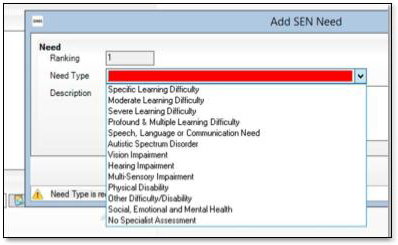
If the school suspects a child or young person has dyslexia or other specific learning difficulty, perhaps because of the results of a screener, then this may be categorised on the MIS as “Specific Learning Difficulty”. Where children have a formal professional diagnosis, this will be recorded in the Notes.
The “No Specialist Assessment” category will only be used when no assessments have yet been undertaken (either in school or externally) and so the broad area of need is not yet known.
The ‘Other’ category should only be used if the child can’t come under one of the other twelve areas.
When children are monitored for SEND, added to the SEND Register as SEN Support, or have an EHC Plan in place, their SEN Status must be updated accordingly. SENCOs are responsible for checking that the MIS has been completed correctly and reviewing this regularly.
1.2 On the school SEND Register
When adding a child to the SEND register, schools will record the primary Broad Area of Need and the DfE category. They will also add notes to the register to indicate any formal professional diagnosis that have been made, or screening that has undertaken. The school
SEND register will be shared with relevant staff on a termly basis or whenever it is updated.