SPECTACULAR – A Night at the Musicals
Tickets are on sale now!
Join us for SPECTACULAR – A Night at the Musicals on Wednesday 21 and Thursday 22 October 2026.
Featuring performances from The Greatest Showman, Mary Poppins, Little Shop of Horrors, Annie, The Lion King, Matilda, Hamilton and more.
Don’t miss what promises to be a fantastic evening of music, dance and performance.
Attendance Policy
Policy Reviewing
| Policy Status/Review Programme | Annual |
| Reviewed by SLT | February 2026 |
| Ratified by Governors | February 2026 |
| Effective from | February 2026 |
| Review scheduled for | Spring 2027 |
| Responsible Person | The Assistant Headteacher DSL and PD Lead Headteacher |
| Responsible Governor Committee | FGB |
1. Key Principles
“All students at The Blandford School, irrespective of their background or the challenges they face, have full access to the wide range of opportunities and experiences available at school.”
· Regular attendance at school is essential to each child’s academic success and life- chances.
· Attendance is a key element of safety and wellbeing.
· A culture of belonging and positive working relationships is recognised as the most effective way to improve school attendance.
· Learning in the classroom, with specialist teachers offers the best opportunity for securing good educational progress.
· We expect all children on roll to attend every day, when school is in session, as long as they are fit and healthy enough to do so.
· Securing good attendance is everyone’s business.
· Early identification, communication and action on attendance problems are critical in achieving successful outcomes.
· The barriers to accessing education are wide and complex, both within and beyond the school gates, and are often specific to individual students and families. Some children find it harder than others to attend school.
· Successfully treating the root causes of absence and removing barriers to attendance, at home, in school or more broadly, is best achieved when there is a strong culture of collaboration and partnership between The Blandford School, parents, local authorities and other partners (including the schools of any siblings) - each with clearly expressed and understood roles and responsibilities. Securing good attendance cannot be achieved by working in isolation.
· Legal action will always be the last resort. The attendance of children and young people at school is of vital importance.
2. Legislation, statutory guidance and linked policies
2.1 Parents/carers are legally required to secure full-time education for children of compulsory school age (Section 7 Education Act 1996). The education provision must be suitable to the child's age, aptitude and ability, and to any special needs the child has. This can be by regular attendance at school, alternative provision, or otherwise (e.g. elective home education). A child who is registered at school must attend regularly and punctually.
2.2 This policy complies with the legal frameworks, statutory requirements and relevant guidance laid out in the following:
- Working together to improve school attendance (applies from 19 August 2024) (publishing.service.gov.uk)
- Stat guidance template (publishing.service.gov.uk)
- Summary table of responsibilities for school attendance
- Toolkit for schools: communicating with families to support attendance The Education (Pupil Registration) (England) Regulations 2006
- Working together to safeguard children - 2018
- Supporting pupils at school with medical conditions (2015)
- Education for children with health needs who cannot attend school -GOV.UK (www.gov.uk)
- Home to school travel and transport (2014)
- School behaviour and attendance: parental responsibility measures Responsibilities where a mental health issue is affecting attendance (2023) Common Transfer File (2019)
- Securing good attendance and tackling persistent absence
- Providing remote education: guidance for schools - GOV.UK (www.gov.uk)
- What are reasonable adjustments and how do they help disabled children and young people at school? – The Education Hub (blog.gov.uk)
- Fines for parents for taking children out of school: What you need to know – The Education Hub (blog.gov.uk)
- Suspension and permanent exclusion guidance (publishing.service.gov.uk)
- Alternative provision - GOV.UK (www.gov.uk)
- Elective home education - GOV.UK (www.gov.uk)
2.3 Furthermore, this policy should be read in conjunction with the following statutory guidance and policies:
- Keeping children safe in education 2023
- Behaviour in Schools Advice for headteachers and school staff (2022)
- Behaviour and Relationships policy
- Child Protection and Safeguarding Policy
- Exclusions Policy
- Equality Information and Objectives Policy
- Supporting Children and Young People with Medical Conditions Policy
- Dorset Council Attendance Strategy 2023
- School safeguarding policies
- School establishment procedures for attendance
- Promoting Educational Attendance in Dorset 2024-2025
- Children's Services code of conduct for the issue of fixed penalty notices - Dorset Council
- How to report a child missing in education https://dorsetnexus.org.uk/Page/36523
- Physical and medical needs service (PMNS) | Dorset Nexus
2.4 The Blandford School will work with the local authority to ensure clear, consistent and timely support is provided to parents in fulfilling their legal duty including the appropriate use of legal action as set out in the statutory guidance. The processes set out in this policy will be consistently and rigorously applied with a judicious combination of support and sanctions for those parents who need it.
Where there are discrepancies because of a more recent DfE publication, the most recent legislation will take precedence over this policy, until such time as it can be updated
3. Roles and Responsibilities
3.1 This policy is designed to ensure that the monitoring and dealing with attendance issues is fair and consistent; and to ensure that our approaches to managing low/poor attendance concerns are pro-active, timely and effective. Through a coordinated, rigorous and supportive approach, schools will contribute to keeping children safe - improving their outcomes, wellbeing and future prospects.
3.2 We ask parents to:
- Ensure that their child arrives at school on time, with the correct uniform and the necessary equipment.
- Promote the importance of punctuality and good attendance at school.
- Follow the correct procedure for reporting the absence of their child on each day of absence, providing a specific reason for the absence by leaving a phone message on the school absence line.
- Avoid unnecessary absence, for example, by only making routine medical appointments outside of the school day.
- Request a leave of absence, by email in advance of any planned absence, including medical appointments, college interviews and sporting fixtures with a copy of the letter or email notification.
- Request a leave of absence for any absence you believe to be exceptional circumstances for consideration by the Headteacher. The school is unable to authorise any leave of absence for a family holiday.
- Keep the school informed of any circumstances which may affect their child’s attendance.
- Pro-actively engage with any support offered by the school, partner or local authority, to improve attendance and reduce the need for legal intervention.
3.3 Administration staff will:
- Safeguard all children by completing all day-to-day monitoring of attendance and punctuality, informing parents of those who are absent from school for the day without prior notice or have truanted a lesson.
- Contact parents by text message if a student fails to arrive at school after the register has closed and no parental contact has been received.
- Ensure the coding of the attendance register is correct and accurate (Appendix A)
- Prioritise students who are assessed as higher risk if absent from lesson. Guidance and Welfare staff will liaise with Heads of Year and Senior teachers if a safeguarding risk requires an immediate response, such as contact with parents or outside agencies, including the police.
- Use School attendance data to carefully monitor attendance alongside the Heads of year and alert parents when there is an early cause for concern.
- Alert the Local authority when a child is absent from education or receiving a different provision to most students
- To update and maintain the admissions register
- To monitor and track all students on alternative provision and make regular parental contact for those not attending The Blandford School setting whilst they remain on roll.
3.4 Tutors will:
- Establish a culture of belonging within their tutor group.
- Give a warm welcome every day.
- Praise and reward for good and improving attendance to school.
- Complete half termly review of attendance during Personal Development time.
- Have informal conversations with students on their return from absence.
- Report early attendance concerns to Head of Year and guidance and welfare, including anyone absent from school for 2 days or more and no reason for absence has been given.
- Build working relationships with parents to support school attendance.
- Support good attendance by completing attendance and punctuality logs as required.
3.5 Sixth Form Staff will:
- Reserve the right to charge students for examination entries where attendance falls below 90% or where coursework is not completed.
- The sixth form administrator will complete all day-to-day attendance monitoring and recording.
- Liaise with the Head of Year 12 and 13 and the Head of Sixth Form and maintain contact with parents on all attendance matters, as appropriate.
- Manage the 16-19 Bursary system or equivalent. Students with attendance below 96% or with unauthorised absence of more than 2% in the preceding term may have bursary payments suspended. lateness to school or lessons will result in a catch-up for the duration of total minutes late for the preceding week.
- Sixth form home study is seen as a privilege. All sixth form students should expect to attend school every day for a full teaching day. If students are granted home study they may sign out and leave the school site to work at home during non-contact periods. Students with home study are also able to use the time for driving lessons.
- If a PD period falls during a non-contact period students are expected to attend school. All PD sessions are compulsory attendance.
- If a sixth form student has a pre-planned absence from school they are expected to complete a 'pink slip' to inform their teachers of the absence and find out what work they will be missing. If appropriate the sixth form office will expect to see evidence of appointments and open day bookings.
- Sixth form students are permitted 5 days of authorised absence to attend university open days.
- Driving tests (theory and practical) will be approved absences from school but evidence of the tests must be seen and pink slips must be completed.
- If a sixth form student misses a supervised study session without completing a 'pink slip' or without good reason they will be expected to attend two additional supervised study sessions.
- Sixth form students must not take any form of paid employment during school hours, including during non-contact periods.
- Sixth form students must wear school identification lanyards during the school day. The lanyard also enables them to enter the school through the library. They must ensure the library door is closed behind them so no unauthorised person can enter the school.
3.6 The Blandford School Senior Leadership (Including Heads of Year) will:
- Establish and maintain a whole school culture that promotes the benefits of good attendance and punctuality.
- Promote a culture of belonging and positive working relationships as well as the school REAP values.
- Assign overall responsibility for championing, improving and reporting on attendance at the school, to a designated senior leader (Katherine Burrows).
- Build strong relationships with children, families and local partners that enable mutual understanding of any barriers to attendance and punctuality, and the ability to work constructively together to address these.
- Ensure all staff receive adequate and regular training on attendance, including developing an understanding of the impact of poor attendance and the reasons behind it, and that children missing education is a potential indicator of abuse or neglect.
- Ensure that staff with specific attendance responsibilities receive dedicated training in legislation, policy and procedures together with any additional training that would help support students or cohorts overcome common barriers to attendance.
- Senior Leaders will meet with Heads of Year and Guidance and Welfare Staff to ensure that monitoring is consistent across all year groups and that internal and mandatory guidance is followed in relation to Leave of absence requests, penalty notices, reports to Dorset LA and removing students from the Attendance Register.
- Ensure that effective systems to record and report attendance data are in place, including accurate completion of admission and attendance registers using an electronic management information system
- Investigate unexplained absence, initiating support and, if necessary, more formal conversations about the potential need for legal intervention in the future.
- Be alert to changes in attendance that may indicate safeguarding concerns, and work in line with our child protection and safeguarding policy to report and escalate these.
- Pro-actively monitor, review and analyse attendance and absence data to identify children or cohorts that require attendance support. Attendance data will be benchmarked against regional and national levels.
- Ensure that all children can access full-time education, putting strategies in place where this is evidence to suggest that this is not the case. This may include additional support and adjustments such as individual health care plans or pastoral support, or referral to other agencies and partners for coordinated inclusion and family support.
- Save pastoral support plans, reintegration plans and reviews to the student’s electronic record.
- Establish regular communication with parents that informs them about school expectations and the importance of attendance, as well as their own child’s attendance and absence levels.
- For students with a social worker, ensure timely communication with social care and/or the virtual school if there are any unexplained absences or concerns around attendance.
- For students with an EHCP, the Inclusion coordinator will take an additional role to promote good attendance.
- For students with a Pupil Premium indicator, the Student Achievement Champion will take an additional role to promote good attendance.
- Share information and work collaboratively with the local authority, other schools in the area and other partners including, where required, making appropriate referrals in accordance with local procedures, legislation and guidance.
3.7 The Blandford School Governing Board will:
- Monitor and regularly review attendance data (including any use of reduced timetables) - particularly for vulnerable groups.
- Provide support and challenge to school leaders to improve attendance.
- Help school leaders focus support on the students who need it.
- Take an active role in promoting the importance of attendance across the Trust.
- Ensure that schools observe and fulfil their responsibilities and statutory duties.
- Regularly review attendance data, discuss and challenge trends and help the Trust’s leaders focus improvement efforts on the individual student or cohorts who need it most.
- Ensure staff receive adequate training on attendance.
4. Registration
4.1 All schools maintain an attendance register in accordance with government regulations. This is used to record each child’s attendance at the start of the school day and again in the afternoon.
4.2 Students are expected to be on time for each registration session. At Blandford School (line up starts at 8.45 and tutors complete the daily register on return to tutor bases and before 9.15. The registration period is between 9.10 and 9.40. This will be done by electronic registration and in the case of technology failure, on paper and processed by the Guidance and Welfare office as soon as is practically possible.
4.3 The Blandford School supports the Department for Education's recommendation that schools keep the register open for up to 30 minutes after the start of the registration period. The register is marked using the national attendance and absence codes published by the Department for Education in Working together to improve school attendance
4.4 Children who arrive at line up will be marked present.
4.5 Children who arrive after 9.10 but before 9.40am will be marked as late (code L) on the register.
4.6 If a child arrives at school after registration session has ended, they must immediately go to the school office to sign in and provide a reason for the lateness. In the absence of a satisfactory explanation, the register will be marked as unauthorised late absence (code U). A ‘U code’ constitutes an unauthorised absence for the whole morning or afternoon session. Legal action may be taken for continued U code absences.
4.7 The classroom teacher and/or any other member of staff responsible for a student/group for will make an accurate entry in the electronic attendance register as soon as reasonably possible to the start of the lesson to allow the Guidance and Welfare Administrator to follow up on any unexplained absence.
4.8 Key staff will be alerted to students not marked present in any lesson. Efforts will be made to locate the student before contacting parents. If the student is found to have truanted the lesson without a valid reason, they will be subject to logical consequences as outlined in the Relationship and Behaviour policy.
4.9 Lateness for registration and for lessons will be sanctioned following the guidance outlined the Relationship and Behaviour Policy.
5. Types of Absence
5.1 For the purposes of recording attendance, each school day has two sessions, which begin at morning/afternoon registration. Absence from school is classified by the school (not the parent) as either authorised or unauthorised. Where possible, this reason should be given in writing and supported by evidence.
5.2 Authorised Absence is where the school has given approval in advance for a child to not be in attendance or has accepted an explanation offered after an unplanned absence as justification for it. The main circumstances for authorisation include illness, medical/dental appointments (which unavoidably fall within the school day), emergencies or another unavoidable cause, or religious observance.
5.3 Unauthorised Absence is where the school is not satisfied with the reasons given, or due to an overall level of concern, and/or for which no “Leave of Absence Request" has been received. Although reasons given for absence will be recorded in the register, the absence may not be authorised if the reason is not deemed appropriate, reasonable, or if there are ongoing attendance concerns. This may also include where absences for illness or other circumstances become too frequent.
5.4 Government guidance states that the Headteacher may not grant any leave of absence during term time unless there are exceptional circumstances. The Headteacher should determine the number of school days a child can be away if the leave is granted. Parents will be fined for taking their child on holiday during term time without consent from the school.
5.5 Persistent Absence (PA) is where a student misses 10% or more of their education (equivalent to 1 day or more a fortnight across a full school year) for whatever reason (authorised or unauthorised). Absence at this level may cause considerable damage to a child’s education and well-being. Any case that is at risk of moving towards becoming categorised as a Persistent Absence, is given priority and these students are tracked and monitored carefully through each school’s attendance and pastoral systems.
5.6 Severe Absence (SA) is where a student is absent from school more than they are present (those missing 50% or more of school). These severely absent students may find it more difficult to be in school or face bigger barriers to their regular attendance and as such are likely to need more intensive support across a range of partners. This may include specific support with attendance or a whole family plan, but it may also include consideration for an education, health and care plan or an alternative form of educational provision where necessary to overcome the barriers to being in school. If all avenues of support have been facilitated but severe absence for unauthorized reasons continues, it is likely to constitute neglect.
5.7 The School reports all attendance to the Department for Education daily in line with statutory guidance.
6.1 Parents and staff should refer to the Supporting Children with Medical Conditions Policy for more information and guidance, including the requirement to consider whether an Individual Healthcare Plan (IHP) is required for that child.
6.2 Where a student cannot attend school because of health needs, schools will initially follow the usual process around attendance and mark the student as ill for the purposes of the register.
6.3 Safeguarding partners should work together with appropriate relevant agencies to safeguard and promote the welfare of local children, including identifying and responding to their needs. This should mean that no student is left without educational provision.
6.4 The Blandford school will inform and work collaboratively with the local authority to support these responsibilities.
6.5 Where a parent/ carer maintains that absences are regularly the result of ill-health, yet no evidence of this is provided, the school may choose to not automatically authorise such absences unless there is medical evidence to do so.
7. Leave of Absence Requests
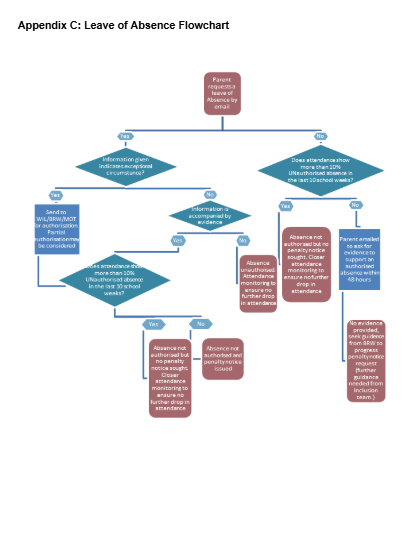
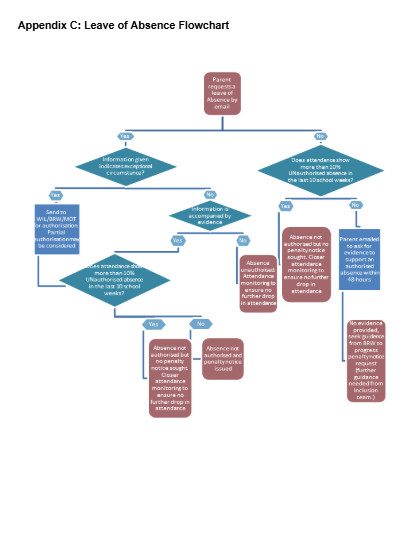
7.1 In accordance with Working Together to Improve School Attendance (2024) and subsequent Amendments, Schools are unable to authorise any period of absence unless it is for exceptional circumstances and requested in advance.
7.2 Parents are required to complete a Term Time Leave of Absence Request Form in advance of planned absence taking place. We ask that this is at least four weeks before the required absence, where possible, to enable the school to consider and respond to the request. Parents must detail and evidence the exceptional circumstance of the request.
7.3 Where a leave of absence is requested as above, the Headteacher will consider the specific facts and circumstances to determine if it meets the “exceptional
circumstances” criteria. It may be that only part of the leave is considered as exceptional and authorised. The decision will be confirmed in writing and is final.
7.5 If leave is not authorised and the parent proceeds to take their child out of school, the absence will be marked as unauthorised. Although such absence may be unauthorised, it is better that the school knows where the child is, and that they are safe rather than missing.
7.6 We recognise that children of certain faiths may need to participate in days of religious observance and that this may be a reason given for a leave of absence request. Where a day of religious observance:
- falls during school time and
- has been exclusively set apart for religious observance by the religious body to which the child belongs the absence from school will be authorised. Evidence from the religious body may be required.
7.7 When students are attending educational activities off the school site that have been approved by the school, the register will be marked to show this is the case. Common examples include an approved sporting activity or attending an Alternative Education Provider.
7.8 Where an absence is suspected of being for the purposes of leave and a request was not made, the absence will be recorded as unauthorised. It is the parent’s responsibility to disprove the suspicion by providing evidence that the absence was for an alternative exceptional reason, to re-consider the classification.
7.9 Parents may be issued with a penalty notice or be subject to prosecution by the local authority for unauthorised leaves of absence.
8. Exceptional School Closure.
8.1 Schools will record students as unable to attend due to exceptional circumstances in accordance with the DfE attendance guidance, for instance:
- The school site, or part of it, is closed due to an unavoidable closure.
- The transport provided by the school/local authority is not available and the student’s home is not within statutory walking distance. (See the DfE’s ‘Home to school travel and transport’ guidance document).
- A local or national emergency has resulted in widespread disruption to travel which has prevented the student from attending school.
9. Attendance Concerns
9.1 When a school has concerns about the attendance of a student, the school will make every effort to make the parent aware of the concerns about their child’s attendance and give them the opportunity to address this.
9.2 Attendance data will be reviewed on a weekly, termly and on a cumulative basis during the academic year. When deciding if a level of intervention is required, reference may also be made to attendance during the previous 12 months – particularly at the beginning of the academic year.
9.3 If parents have failed to ensure that their child of compulsory school age is regularly attending school and wider support in accordance with this policy is not appropriate, effective, or has not been made use of, the school may consider requesting the LA to consider issuing a penalty notice and implement legal sanctions. A penalty notice is a fine (£80 if paid within 21 days, £160 if paid within 28 days) imposed on parents by the local authority.
9.4 If the school refers a case of poor school attendance to the Local Authority for legal sanctions, it will show it has warned parent/s that they are at risk of receiving a Penalty Notice or other legal sanction.
9.5 When considering whether to request a penalty notice, the school will have regard to:
- section 6 of the Department for Education’s guidance Working together to improve school attendance
- the local authority’s Code of Conduct for issuing penalty notices.
9.6 In the event that a penalty notice is issued but is not paid within 28 days, the local authority will decide whether to proceed to prosecution. The local authority also has separate powers to prosecute parents if their child of compulsory school age fails to attend school regularly.
9.7 Penalties and Protocol relating to specific local authorities can be found here: Dorset - School attendance and absence - Dorset Council
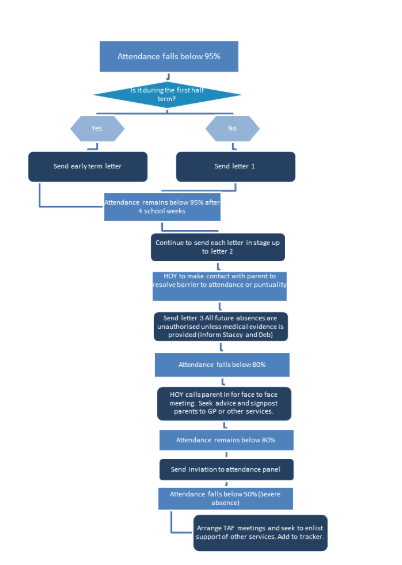
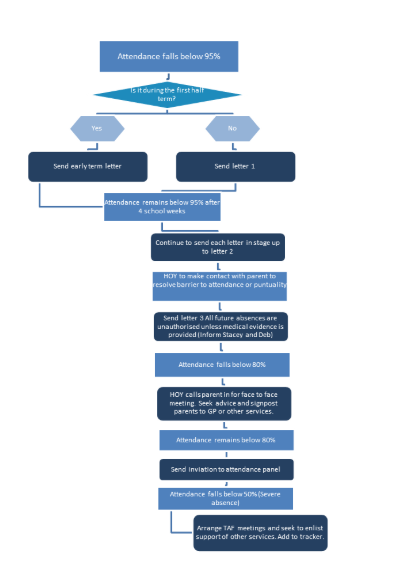
9.8 Stages of Support and Intervention for Attendance
|
Stages of Support and Intervention – Summary |
||
|
Stage |
Trigger |
Description/action |
|
1 |
Attendance falls below 95% or a pattern of broken weeks emerges. |
Informal Stage. There will be initial communication with home, via Guidance and Welfare to alert parents to an early concern. |
|
2 |
Attendance remains below 95% after 4 school weeks. |
Attendance is now projected to be below expectations for the academic year. A second communication will be sent, approved by the Head of Year to alert an increasing concern and invite the parent to contact the school for a discussion. |
|
3 |
No improvement to attendance patterns or further drop below 95% |
Attendance concerns persist. The Head of Year will make contact directly with parents by phone call or meeting to discuss the support offered to the child and family to date and its effectiveness. A further information letter (which includes a warning that parents are at risk of receiving a penalty notice), will be issued. All future absences will be marked as unauthorized unless medical evidence is provided. |
|
4 |
20 days absence (maximum projected attendance 89.5%) |
Attendance concerns have persisted, and early intervention has not addressed concerns. The child is now considered to be persistently absent. There will be a referral to the local authority attendance / Inclusion Panel and further discussions will be held between home, school and the relevant LA officers. The aim of such a meeting is to discuss the current situation and consider what additional support may be offered, in order to secure improved attendance moving forwards. This may include a parenting contract. A formal letter and action plan will be issued. |
10. Reintegration Timetables
10.2 In the case of a reintegration timetable, the school remains responsible for the education provision.
10.3 In accordance with the Equalities Act 2010, schools must never discriminate on the basis of their special educational need and/or disability, including those with social emotional and mental health difficulties. Not providing full time education is likely to amount to discrimination if the reason for it is a child’s SEND.
10.4 Schools must consider safeguarding issues and the impact this might have on a child when considering a reintegration timetable. Schools have safeguarding responsibility for all students on roll and therefore must be aware that even with parent agreement to any reintegration timetable arrangement they make, they are responsible for the safeguarding and welfare of all students on roll who are off-site during school hours. A risk assessment will be completed for all students on reintegration plans.
10.5 The school should notify the Local Authority of any student on a reintegration timetable who will consider whether the pupil is deemed to be at risk of missing education (https://dorsetnexus.org.uk/Page/36523) In addition to notifying the Local Authority:
§ If the child is looked after or previously looked after, the information should also be copied to the Head of Virtual School.
§ If the child is subject to a child protection plan or child in need plan, a copy of the reduced timetable should also be sent to the named social worker.
§ If the child has an EHCP, the relevant Local Authority 0-25 SEND team should be informed and a copy of the signed plan shared.
11. Elective Home Education
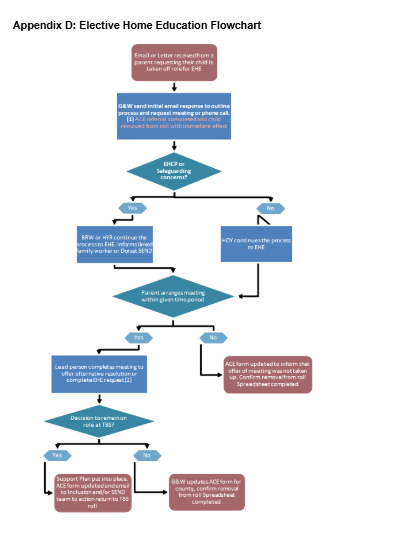
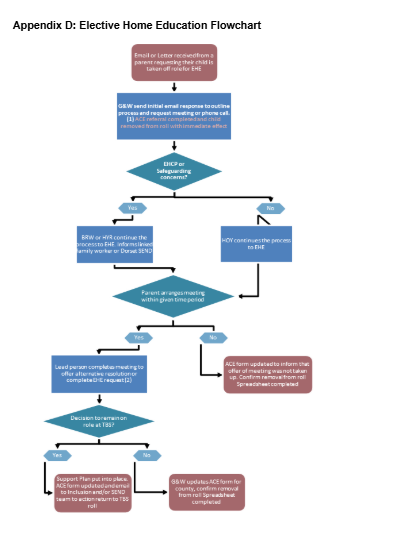
11.1 When a parent informs the Headteacher by email of their intention to electively home educate their child, The Blandford School will give all parents the opportunity to meet with the school in case there are factors impacting the decision that can be rectified or resolved. Dorset Council Inclusion team will be informed. (Appendix E)
12. Children Missing in Education
12.2 When a child is absent and the school cannot contact parents, those leading schools/responsible for attendance matters or safeguarding, will continue to try and make contact. This could include a pre-arranged or unannounced visit to the home to complete a safe and well check on the student.
12.3 Where it is suspected that a child may be missing education, reasonable enquiries to ascertain their where-abouts must be carried out by the school. If there is reason to believe a child is in immediate danger or at risk of harm, a referral should be made to children’s social care (and the police if appropriate).
12.4 After 10 days of unauthorised absence where no contact has been established with parent, a child must be reported to the Local Authority as a child missing education.
12.5 The relevant LA procedures for CME can be found here:
https://dorsetnexus.org.uk/Page/36523
13. The School Admission Register
13.1 All schools are required to notify the local authority within 5 days when a student’s name is added to the admission register at a non-standard transition point. Schools will need to provide the local authority with all the information held within the admission register.
13.2 The Blandford School will only delete names from the admission register in accordance with Section 7 of Working together to Improve School Attendance 2024
13.3 When a family elect to leave a school for a new setting, whether locally, nationally or abroad, it is imperative to ascertain the details of the new, intended school, in writing, if reasonably possible. Alternatively, the family may confirm in writing that they are electing to undertake home education. In either case, this information must be shared with the Local Authority immediately. Reasonable attempts should be made to establish that the child has arrived and commenced education at their new setting. The child should remain on roll until such time as confirmation is received from the Local Authority that they can be removed.
13.4 Should a child fail to return to school by the time that registration ends on the 20th day of absence, the school is permitted to delete the child’s name from their roll under Section 8. (1) (h), (i), (ii), (iii) of the Education (Pupil Registration) (England) Regulations 2006. This action may be taken by a school if a child has not returned by the date specified and if the following applies:
- at no time was the absence during that period authorised by the Headteacher or other authorised person in accordance with regulation 6 (2)
- the Headteacher does not have reasonable grounds to believe that the student(s) is/are unable to attend the school by reason of sickness, or any unavoidable cause;
- the Headteacher of the school, and the Local Authority have failed, after reasonable enquiry, to ascertain where the student is.
13.5 The relevant Local Authority Officer will inform the school when they can remove from roll and a copy of this email should be included on the child’s electronic records . In these circumstances, the child's Common Transfer file should be uploaded to the Department for Education secure site for the transfer of information when a student moves between schools.
13.6 In all cases of a child being removed from the roll of a school, Headteachers must ensure that the Common Transfer File (DfE) guidance on transferring student records to new settings is followed (whether to a new school via S2S, the Local Authority, or the Lost Pupils Database). Schools are expected to seek further advice and guidance from the SAST Head of Safeguarding and the relevant Local Authority Officer if they are unsure of any aspect of the registration process.
Appendix A: National Absence and Attendance Codes
|
Code |
SIMS Description |
DfE Description / Explanation |
|
|||
|
/ |
Present (AM) |
Present for school morning session |
|
|||
|
\ |
Present (PM) |
Present for school afternoon session |
|
|||
|
B |
Attending any other Approved Education Activity |
Attending any other approved educational activity. Not to be used for Virtual learning |
|
|||
|
C |
Other authorised circumstances |
Leave absence for exceptional circumstance |
|
|||
|
C1 |
Leave of absence – regulated performance |
Leave of absence for the purpose of participating in a regulated performance or undertaking regulated employment abroad. |
|
|||
|
C2 |
Leave of absence – Temporary part-time timetable |
Leave of absence for a compulsory school age pupil subject to a part-time timetable |
|
|||
|
D |
Dual registered |
Dual registered to another school |
|
|||
|
E |
Suspended or excluded without alternative provision |
Suspended or permanently excluded and no alternative provision |
|
|||
|
G |
Family holiday (not agreed) |
Unauthorised absence as pupil on a family holiday, not agreed, or is taking days more than an agreed family holiday |
|
|||
|
I |
Illness |
Illness (not medical or dental appointment) |
|
|||
|
J1 |
Leave of absence – Interview for employment or transfer to another educational institution |
Leave of absence for the purpose of attending an interview for employment or for admission to another educational institution |
|
|||
|
K |
Alternative provision provided by LA |
Attending education provision arranged by the local authority |
|
|||
|
L |
Late (before registers closed) |
Late arrival before the register closed |
|
|||
|
M |
Medical or dental appointment |
Leave of absence for the purpose of attending a medical or dental appointment |
|
|||
|
|
N |
No reason yet provided for absence |
Reason absence not yet established |
|||
|
|
O |
Absence in other or unknown circumstance |
Absence in other or unknown circumstance |
|||
|
|
P |
Participating in sports activity |
Participating in sports activity |
|||
|
|
Q |
Unable to attend – lack of access arrangements |
Unable to attend the school because of lack of access arrangements |
|||
|
|
R |
Religious observance |
Religious observance |
|||
|
|
S |
Study leave for public examination |
Study leave for public examination |
|||
|
|
T |
Traveling with parent for occupational purposes |
Traveling with parent for occupational purposes |
|||
|
|
U |
Late (after registers closed) |
Late (after registers closed) |
|||
|
|
V |
Attending an educational visit or trip |
Attending an educational visit or trip |
|||
|
|
W |
Attending work experience |
Attending work experience |
|||
|
|
X |
Not required to attend- non-compulsory school age pupil |
Not required to attend-non-compulsory school age pupil |
|||
|
|
Y1 |
Unable to attend – Transport not available |
Unable to attend due to transport normally provided not being provided |
|||
|
|
Y2 |
Unable to attend – widespread travel emergency |
Unable to attend due to widespread disruption to travel |
|||
|
|
Y3 |
Unable to attend – unavoidable partial closure |
Unable to attend due to part of the school premises being closed. |
|||
|
|
Y4 |
Unable to attend – unavoidable full closure |
Unable to attend due to the whole schools’ site being unexpectedly closed |
|||
|
|
Y5 |
Unable to attend – criminal justice detention |
Unable to attend as pupil is in criminal justice detention |
|||
|
|
Y6 |
Unable to attend – Public Health Guidance / Law |
Unable to attend in accordance with public health guidance or law |
|||