Easter Holidays are here! 🐣 School finishes on Friday 27th March 2026. We can’t wait to see all students back on Monday 13th April 2026!
SEN Information Report
The Blandford School
Special Educational Needs and Disability Information Report October 2025
2024-25 Staffing:
- Specialist English Teacher
- Specialist Maths Teacher
- Literacy Mentor x3
- Learning Support Assistant x2
- One-to-one Teaching Assistant x4
- Assistant Headteacher, DSL
Mrs Burrows - Inclusion Lead/SENDCo
Mr Hayball - Governor with responsibility for SEND
‘All students at The Blandford School, irrespective of their background or the challenges they face, have full access to the wide range of opportunities and experiences available at school.’ TBS Way
At The Blandford School (TBS), we recognise that some of our students may require additional support to reach their full potential. Every student, regardless of their starting point, is entitled to a broad and balanced curriculum that is adapted to their individual educational needs. As an inclusive school, we are committed to meeting the needs of all our students within a caring and supportive environment.
We strive to provide the best possible educational experiences for all our students, while recognising that the school environment may present greater challenges for some than for others. We place strong emphasis on the quality of classroom learning and on the adaptations we make to ensure our students can access their education. We believe that students learn best when they remain in the classroom with their primary educator—the teacher.
1. What is the local offer?
The Children and Families Act 2014 requires Local Authorities to publish information about services and provision across education, health and social care for children and young people aged 0-25 with Special Educational Needs and Disabilities (SEND). The purpose of a local offer is to enable parents and carers to see more clearly what services are available for young people with SEND in their area and how to access them. The Local Offer can be accessed via the link on our school website.
2. Definition of Special Educational Needs
According to the Special Educational Needs and Disability (SEND) Code of Practice (2014),
“A young person has special educational needs if they have a learning difficulty or disability which calls for special educational provision, namely provision different from or additional to that normally available to others of the same age.”
A child is not considered to have a learning difficulty solely because the language spoken at home differs from the language of instruction at school. However, appropriate support will be provided. If a student experiences difficulties that are not related to acquiring English as an additional language, these will be identified and addressed in line with the school’s SEND policy.
Special educational provision refers to support that is additional to, or different from, the provision generally available to other young people of the same age in mainstream academies and maintained schools (excluding special schools) within the local education authority.
Communication and interaction
Children and young people with speech, language and communication needs (SLCN) experience difficulties in communicating with others. This may be due to challenges in expressing themselves, understanding what is being said to them, or using and interpreting the social rules of communication. The profile of each child with SLCN is unique, and their needs may change over time. They may struggle with one or more aspects of speech, language, or social communication at different stages of their development.
Children and young people with autism are also likely to experience difficulties with social interaction. They may have challenges related to language, communication, and imagination, all of which can affect how they relate to and engage with others.
Cognition and Learning.
Support for learning difficulties may be necessary when children and young people learn at a slower pace than their peers, even when appropriate differentiation is in place. Learning difficulties encompass a broad spectrum of needs, including:
- Moderate Learning Difficulties (MLD) – where students may require support across the curriculum,
- Severe Learning Difficulties (SLD) – where students are likely to need significant support in all areas of learning, often alongside difficulties with mobility and communication,
- Profound and Multiple Learning Difficulties (PMLD) – where students have severe and complex learning needs, as well as physical disabilities or sensory impairments.
- Specific Learning Difficulties (SpLD) affect specific areas of learning rather than the overall ability to learn. This includes conditions such as dyslexia, dyscalculia, and dyspraxia.
Social, Emotional and Mental Health Difficulties.
Children and young people may experience a wide range of social and emotional difficulties, which can manifest in various ways. These may include becoming withdrawn or socially isolated, as well as displaying challenging, disruptive, or concerning behaviour. Such behaviours may be indicative of underlying mental health needs, including anxiety, depression, self-harm, substance misuse, eating disorders, or physical symptoms with no clear medical cause.
Other children and young people may be diagnosed with conditions such as Attention Deficit Hyperactivity Disorder (ADHD), or Attachment Disorder.
Sensory and/or Physical Needs.
Some children and young people require special educational provision because they have a disability which prevents or hinders them from making use of the educational facilities generally provided. These difficulties can be age related and may fluctuate over time. Many children and young people with vision impairment (VI), hearing impairment (HI) or a multi-sensory impairment (MSI) will require specialist support and /or equipment to access their learning. Children and young people with an MSI have a combination of vision and hearing difficulties, which makes it even more difficult for them to access the curriculum than for those with a single sensory impairment.
Some children with a physical disability (PD) require additional ongoing support and equipment to access all the opportunities available to their peers.
3. Aims and objectives
Our aim is to use our best endeavours to ensure that:
- All governors and staff have a strong awareness of SEND and receive appropriate training to develop and enhance their professional practice.
- All teachers follow TBS Way (see Appendix), ensuring classrooms provide emotionally safe environments that are responsive to individual learning needs.
- Young people with SEND are a shared responsibility across the school, in line with the SEND Code of Practice (2014) and the Teachers’ Standards (2014).
- Every student has access to a broad and balanced curriculum, adapted as needed to support maximum progress.
- A flexible, graduated structure of support is in place, aligned with the SEND Code of Practice (2014), and appropriately resourced to meet a range of SEND needs.
- Students with SEND are educated inclusively, with their needs met in the least restrictive environment, in accordance with the SEND Code of Practice (2014) and the Equality Act (2010).
- Parents and carers are recognised and engaged as key partners in their child’s education.
4. How does TBS know if a young person needs extra help and what should I do if I think my child may have a special educational need?
We continue to encourage parents and carers to contact the school via their child’s tutor or Head of Year if they have any concerns about their child’s rate of progress or potential unidentified needs.
At TBS, we work closely with our partner primary schools to identify learning needs and determine appropriate provision. This process includes classroom observations and discussions with both students and their teachers. Information from feeder schools is transferred upon entry to TBS, and any identified needs are recorded accordingly. All students in Key Stages 3 are assessed upon entry and then annually to identify any literacy and/or numeracy difficulties.
Teachers and tutors regularly monitor and assess the progress of all students. This enables us to identify those who may not be making expected progress. Indicators of concern may include progress that:
- Is significantly slower than that of peers with similar starting points,
- Does not match or exceed the student’s previous rate of progress,
- Fails to close the attainment gap between the student and their peers.
At TBS, we follow a graduated response in line with the SEND Code of Practice (2014). Our aim is to create inclusive learning environments through high-quality teaching, as outlined in TBS Way, ensuring all students have access to the curriculum.
Where a student’s progress is significantly below expectations, either in comparison to peers or relative to their own prior progress, or where the attainment gap is not closing, additional support or further assessments will be considered.
5. Communication with parents and carers
A formal assessment of each student’s progress at TBS is published annually. Additionally, a scheduled meeting with teachers takes place during the academic year, providing parents and carers with an opportunity to discuss progress and raise any concerns. In response to parental preference, Parents’ Evenings are currently held virtually.
Parents and carers are also welcome to request meetings with their child’s tutor or Head of Year. Real-time information about learning behaviours and academic progress is accessible through the SIMS Parent App.
In addition to the regular assessments, reviews, and reports that every student receives, we communicate with parents and carers through the following methods:
- Face-to-face conversations, telephone calls, or emails as needed
- Student Profiles
- Annual Reviews for students with an Education, Health and Care Plan (EHC plan)
Reports and recommendations from external agencies
6. What emotional wellbeing support is available at TBS?
- Tutor activities focusing on emotional wellbeing.
- Knowledgeable and skilled Heads of Year.
- Student Support Worker.
- Anti-bullying ambassadors.
- Anti-bullying room.
- Student mentors.
- The Academic Mentoring Room for those with emotional based school avoidance (EBSA)
- Safe spaces at break and lunch times.
- Mental Health in Schools Team (MHST)
- Referral to CAMHS or other specialist services.
7. What specialist services are available at or accessed by the school?
- Speech and Language Therapy (SALT).
- Occupational Therapy (OT).
- Child and Adolescent Mental Health Service (CAMHS).
- NHS School Nurse.
- Dorset Early Help Team.
- Dorset Hearing Support Service.
- Dorset Vision Support Service
- Social Care.
8. Staff training at TBS
During the academic year 2024-25 staff received training in the following areas:
- Assistive technology
- Emotional literacy
- ASC
- Person-centered reviews
- Social stories
- Therapeutic Thinking
- ACES - attachment difficulties
- The inclusive classroom
- ADHD
- Emotionally based school avoidance
- Vision impairment
- Literacy
- The emotionally safe classroom
This year, staff will receive additional training focused on promoting emotional safety both in the classroom and throughout the school. This training will be delivered through whole-school INSET sessions and fortnightly CPD meetings.
9. How are young people with SEND included in activities outside the classroom?
The school continues to offer a comprehensive programme of extracurricular activities and trips for all students. Detailed risk assessments are conducted for every trip, with specific arrangements made to accommodate those with additional needs. This approach ensures that all students have equal access to these opportunities. Adaptations implemented last year included additional training for PE staff, adapted PE equipment, increased staffing on school trips, modified transport, and tailored activities.
10. How accessible is the school environment?
TBS continues to enhance its facilities and working practices to accommodate all students, visitors, and staff. During the 2024-25 academic year, the school implemented several adaptations and improvements. Student toilets in Block 5 were modified to create a more emotionally safe environment. The introduction of a one-way system in Blocks 1 and 3 has helped reduce congestion and minimize the risk of accidental injuries. The majority of the school site is now wheelchair accessible, with the exception of the first floor in Block 4. Additionally, the car park was resurfaced to eliminate trip hazards for visitors and students entering through reception. Steps and edges have been painted with high-contrast colours to assist those with visual impairments.
11. How is the transition to and from TBS managed?
At TBS, we hold an Open Evening and an Information Evening for parents and carers of Year 6 children, along with a Transition Day for the students themselves. Feedback from these events has been very positive. These occasions provide parents and carers with the opportunity to ask questions and explore the school’s facilities. In addition to the standard Transition Day, students with SEND have access to enhanced transition sessions tailored to their needs.
For students transferring to TBS at other times during the school year, we conduct literacy assessments upon entry and collect relevant information from their previous school.
We provide careful guidance to all students to support a successful transition to sixth form, further education, higher education, or other schools. All SEND information is shared accordingly. A clear programme of advice and support is integrated into ongoing conversations with parents and carers of students with SEND during review meetings. For students with an Education, Health and Care Plan (EHC plan), careers advice is included as part of their transfer review.
12. How are resources allocated?
The school's resources are allocated in a variety of ways to match needs. Funding is used for a wide range of services and provisions including:
- Learning Hub staff.
- Adapted resources.
- Assistive technology
- Small group and individual specialist teaching.
- Outside agencies.
- Staff training.
13. How are parents involved in school life?
Parents and carers are encouraged to request meetings with school staff through letters, emails, or phone calls. In addition to the reports and Parents’ Evenings that all students are entitled to, we also engage with parents and carers of young people with SEND through additional methods, including:
- Conversations face-to-face, by phone or email
- Student Profiles
- Annual Reviews for young people with an EHC plan
- School events
- Parent Questionnaires
14. Complaints procedure
We hope that all concerns can be resolved promptly through open discussion and early intervention. However, if a parent or carer feels that their concern or complaint regarding their child’s care or welfare has not been addressed satisfactorily, they may request an appointment to discuss the matter with the Inclusion Lead or the Governor with Responsibility for SEND.
The school’s complaints policy is available on the website.
15. SEND data
For SEND data, please contact the school at the address below.
office@blandfordschool.org.uk
Appendix
INCLUSION TBS WAY
TEACHING AND LEARNING AT THE BLANDFORD SCHOOL
‘All students at The Blandford School, irrespective of their background or the challenges they face, have full access to the wide range of opportunities and experiences available at school.’
This guide is designed to provide you with a clear understanding of our expectations for the classroom in the school, the rationale behind them and the strategies to support them.
TBS Way is a belief that all learners can achieve in an inclusive environment, and their ability to access learning should not be assumed or dictated by prior attainment or learning need. It is understood that all learners may need additional support at times (the least confident at that moment in time) and, where this is the case, adaptations are made. Not only do they require this support, they deserve it and therefore, “an ongoing line of enquiry in any teacher’s mind should be ‘am I building confidence with the lowest attainers?” (Tom Sherrington)
This guide is designed to enhance consistency of expectations, practice and language across the school so all students feel safe and confident in every classroom, and in moving from one classroom to another.
This guide is divided into 6 key principles that we believe will drive our vision of inclusion and incorporate our REAP values.
The key principles of inclusion at TBS are:
- THE CLASSROOM IS AN EMOTIONALLY SAFE ENVIRONMENT FOR ALL
- INSTRUCTION IS CLEAR AND EXPLICIT
- TEACH TO THE TOP
- ENGAGE ALL STUDENTS IN THINKING HARD
- PROMOTE POSITIVE LEARNING BEHAVIOURS IN THE CLASSROOM
- ALL STUDENTS NEED TO BE ABLE TO READ
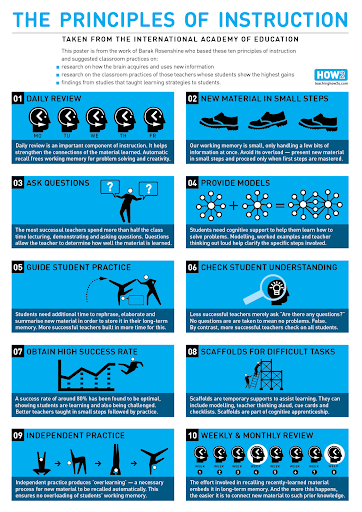
All teaching at The Blandford School is underpinned by Rosenshine’s Principles of Instruction.
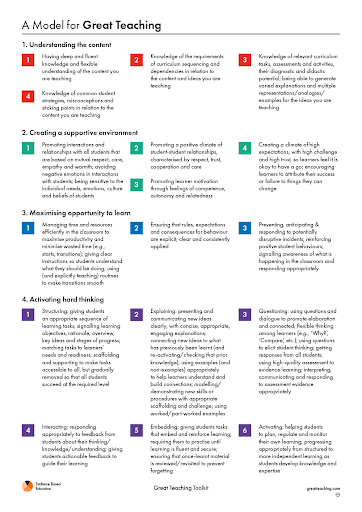
It is further supported by the Great Teaching Toolkit Evidence Review (June 2020).
PRINCIPLE 1: THE CLASSROOM IS AN EMOTIONALY SAFE ENVIRONMENT FOR ALL
Evidence and context
Studies show feelings of competence, autonomy and social-relatedness as the requirements for students to be motivated and achieve. There is evidence to suggest that when teachers work on improving the warmth and supportiveness of classrooms, student outcomes improve. There is also strong evidence that both subliminal and explicit teacher expectations can influence student attainment and become, at least to some extent, self-fulfilling prophecies.
At TBS, we will work to make the classroom an emotionally safe environment, mitigating fear of failure and replacing learned helplessness with mastery orientation. We must focus and build on what students know and can do, and avoid a validation of negative perceptions.
IN THE CLASSROOM
Routines
Establish your expectations and develop strong and consistent routines to support them
All lessons are expected to have:
- A warm greeting at the door for ALL students
- A calm and settled entry into the classroom
- Silent starter at the beginning
- Consistent, positive strategies for gaining silence and attention for instruction
- Calm and seamless transitions from instruction to task or task to task
- Consistent routines for smooth handing out of resources
- An ordered exit in which students are led into the corridor by you
Planning
The seating plan provides an emotionally safe environment for each student
- Your learning intention is clear for both students and you as the teacher
- Future events out of the ordinary are communicated in advance eg. assessments,
lesson venue change, seating plan changes
- Your subject knowledge and planning promote a safe environment for you
Avoid negative emotions
- All students will be warmly greeted at the door at the beginning of every lesson
- Strategies such as ‘positive framing’ are developed
- You model the behaviours you wish to see from students eg. respect,
punctuality, preparedness, warmth, positive attitude, patience, perseverance
- You are assertive and explain when challenging their behaviour
- You provide constructive responses to errors or misconceptions to encourage risk
Key questions
- How can you build positive relationships with all students in your classes?
- How do you foster positive relationships between students to allow all to feel safe?
- What strategies can you use to promote motivation?
- How can you create a climate of high expectations, with high challenge and high trust, so students feel confident to take risks and learn from their mistakes?
PRINCIPLE 2: INSTRUCTION IS CLEAR AND EXPLICIT
Evidence and context
Decades of research clearly demonstrate that for novices (comprising virtually all students), direct, explicit instruction is more effective than partial guidance. When teaching new content and skills, teachers are more effective when they provide explicit guidance accompanied by practice and feedback. This does not mean direct instruction all day every day. Small group and independent problems can be effective but as a means of practising recently learned content and skills.
IN THE CLASSROOM
Clarity of instruction
Instructions enable ALL students understand the task presented. Strong subject knowledge aids delivery of new information in a clear and coherent way and allows you to explain new content in a variety of ways.
Checking the quality of instruction
Generic, vague questions such as, ‘Does that make sense?’, ‘Is everybody happy?’, ‘Anyone not understand?’ are not used. You explicitly ask a wide range of students to demonstrate their understanding of a concept or the task they are about to begin.
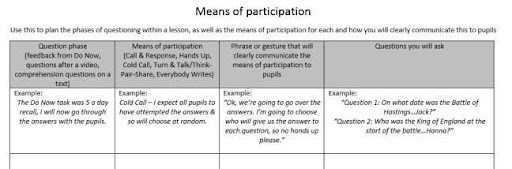
Means of participation
All students are clear what is expected of them at different stages in the lesson. Clear consideration is given to how you wish students to respond in different tasks eg. Think-Pair-Share, mini-whiteboards or silent effort in independent practice. Phrases are precise to signal to students what is expected, when and how they will participate.
Small steps
New information is provided in small chunks to prevent cognitive overload. Through this, more time is spent providing explanations, modelling and guiding practice through worked examples at each stage.
You ensure you are not delivering too much information in one go or asking students to practise too many steps at once. The least confident are encouraged to build confidence step by step.
Key questions
- What areas of your subject do you find difficult to explain to novices?
- How often do you check student understanding of a task?
- How often do you use phrases like, ‘Does that make sense?’ What issues do you see with this?
- How much consideration in your planning do you give to the amount of new information you are intending to deliver?
PRINCIPLE 3: TEACH TO THE TOP
Evidence and context
International comparisons of student achievement indicate that the highest performing educational systems have high expectations for all. Studies suggest that pitching lesson content at the ‘top end’ is beneficial for all students. This means consistently teaching higher level ideas and knowledge, making it accessible for ALL students in ALL classes. It is not an approach that prioritises the learning of a few students seen as ‘high attaining’ whilst assuming that those with lower data or assessment scores need lower level content. At TBS, ‘teach to the top’ refers to the approach of pitching lesson content at the ‘top end’ to stretch and challenge a particular group, and then supporting ALL students to reach the top end.
IN THE CLASSROOM
Subject knowledge
Strong subject knowledge allows you to feel emotionally safe in the classroom and promotes confidence in your students. Your subject knowledge goes beyond the content of your lesson and meets the curiosity of students. Your subject knowledge enables you to stretch the ‘top end’. You take responsibility to ‘know’ your subject.
Planning
You plan explicitly for the highest attaining students in your group to stretch them. Stretch and challenge is not ‘added on’ but embedded within the lesson. Challenging questions are planned to promote deeper thinking and higher order vocabulary is embedded with examples of how they are used. The support ALL students may require to access the ‘top end’ is explicit in your planning.
Support through adaptive teaching
Scaffolds provide a breakdown of the steps that students will need to follow. Detailed support is given (eg. key terms, sentence starters and diagrams) as well as overview support (eg. structure strips, partial examples and success criteria). Questions are adjusted for the least confident to check understanding and promote success.
Modelling reduces the cognitive load and provides students with a greater understanding of WHAT they are expected to produce and HOW they are expected to present it. You allow students to gain insight into the thought process of the task. You question the least confident students throughout the process to gain appreciation of their understanding of the process up to that point and next steps. Students have the opportunity to emulate the model as an independent task.
Key questions
What topics or concepts are you least confident of in your teaching?
What steps can you take to improve your subject knowledge?
How much consideration do you give to highest attaining students in your planning?
How much consideration do you give to supporting ALL students to access higher order content in your planning?
Do you provide shortcuts or scaffolds in the teaching of key concepts?
How established is the phrase, ‘I do, we do, you do’ in your teaching?
How do you adapt questions to promote success and engagement of the least confident?
PRINCIPLE 4: ENGAGE ALL STUDENTS IN THINKING HARD
Evidence and context
‘Memory is the residue of thought.’ (Willingham, 2009) To get students to remember what we teach, we need to get them to think about the meaning of new material in the context of what they already know. Key to this is reviewing each lesson plan in terms of what the student is likely to think about. This means stripping out extraneous distractions and designing tasks so students will unavoidably think about the meaning of the content, not merely observe it. This is particularly important for those with additional needs or poor attention.
At TBS, we need ALL students to be thinking deeply about the content you are teaching them. To do so, consider both the strategies and the environment that will allow thinking hard.
IN THE CLASSROOM
Clear learning intentions
Students are absolutely clear on the learning intentions of the lesson and what they are being expected to think about. It is referred to at appropriate points in the lesson.
Questioning, formative assessment and responsive teaching
A large number of questions are asked. There is no opt-out. At worst, the question is moved to another student to answer and then re-directed back.
Strategies are used to check the understanding of ALL students. Answers give feedback.
Cold-calling – questions are directed to the least confident, and the same question may be directed to a number of students or built on. There is no ‘hands-up’.
Think-Pair-Share – you pose a question to the whole class to think about in silence. They then share their thoughts with their partner. You move around the class to listen to discussions. You then cold call a number of students.
Mini-whiteboards – you pose a question and ask students to write down their answer in silence. On your signal, ALL students raise their boards at the same time. You scan the class to make sure ALL students have answered.
Choral response – you pose a question or introduce a key word. On a count, the students provide the answer as a chorus. You scan the class to make sure all students are participating and repeat until ALL are.
The means of participation for each of these strategies is explicit.
Students are expected to answer fully as they would if these answers were written. If needed, you ask them to ‘say it again better’.
Practice
Students practise retrieval of previous learnt content in the silent starter. This is a quick test of recall that ALL students can access and achieve success. Students recall previously learnt content when learning new material to provide links to form schema.
Worked examples (guided practice) aid understanding of the thought process involved in completing the learning task. Students do not move onto independent practice until you are confident ALL students understand. Students practise independently in silence.
Key questions
- How do I know everyone is thinking?
- How do I know that everyone is making meaning?
- How do I know that everyone is practising?
PRINCIPLE 5: PROMOTE POSITIVE LEARNING BEHAVIOURS IN THE CLASSROOM
Evidence and context
A large body of evidence supports the use of proactive behaviour management strategies to promote learning. Studies have presented evidence of correlations between measures of attainment and classroom management from 1,000 classrooms. For newly qualified teachers the generalisation is that there tends to be too much co-operation and a lack of assertiveness within the classroom, sometimes confusing a friendly approach with wanting to be liked. However, it is important to note that, as a generalisation, somewhere between six to ten years into teaching a number of teachers lose their sense of care and co-operation, tending towards a “blitzkrieg” approach that is too dominant and damages relationships.
IN THE CLASSROOM
Front-loading instructions
You put your means of participation at the front of your instruction, where you anticipate the point at which students might stop listening to you and start thinking about something else (like the answer to the question) and get all the important information in before that point.
Eg. “Ok, I’m going to ask a question and you are going to one [hold up a finger] write your answer on a mini whiteboard [hold up two fingers] two keep it face down and [hold up three fingers] three show me only when I say. Write down [one finger], face down [two fingers], show me [three fingers.] Ok who can say the instruction back to me….David?…Excellent. Write down, face down, show me [use the fingers again.] What is the word equation for photosynthesis?“
Gaining attention
Clear strategies are used to signal you require the attention of ALL students. The next phase of the lesson does not begin until you have full attention from ALL students.
This is achieved through different strategies although the following is most effective:
- Narrated Count down – ‘calling your attention in 3, finishing your conversations in 2, don’t be the last one, and 1’, and pause for complete silence. Be seen looking.
- You insist on SLANT, where students:
S – sit up straight
L – listen
A – ask and answer questions
N – have nothing in their hands
T – track the teacher
Maintaining consistency of language
‘One voice’ – phrase used when you are preparing to give instructions or an explanation
‘Take turns’ – phrase used when you are preparing to ask questions of the class
‘Silent effort’ – phrase used when you are preparing the class for independent practice
Key questions
How much thought do you give to the way you deliver instructions?
What key phrases do you use regularly to gain attention or set means of participation?
How do you ensure that rules, expectations and consequences for behaviour are explicit, clear and consistently applied?
How do you prevent, anticipate and respond to potentially disruptive incidents?
PRINCIPLE 6: ALL STUDENTS NEED TO BE ABLE TO READ
Evidence and context
‘Young people who leave school without good literacy skills are held back at every stage of life. Their outcomes are poorer on almost every measure, from health and wellbeing to employment and finance. The most recent estimates suggest that low levels of literacy cost the UK economy at least £20 billion a year… by attending to the literacy demands of their subjects, teachers increase their students’ chance of success in their subjects.’
At TBS, all teachers need to be able to teach reading. We need a systematic way of teaching tier 2 and 3 vocabulary and practising reading in class.
IN THE CLASSROOM
- We plan which words to teach
(tier 2 – academic vocabulary words; and tier 3 – subject-specific language) - When introducing new vocabulary, we follow the 5-step plan:
- Model Lead Teach
Model – teacher pronounces word and identifies irregular spelling patterns, if relevant
Lead – teacher choruses with class
Teach – class chorus back independently - provide synonyms, not just definitions
- teach the etymology (biography)
- give examples of correct uses
- give examples of misuses
- All teachers are trained in how to practise reading in class.
- All students track the text using a ruler.
- All students participate in reading aloud during the course of the unit.
- Teacher pauses at tier 2 and tier 3 vocabulary to ensure students fully understand the sentence they are reading.
- Teacher does not assume that all students understand tier 2 and tier 3 vocabulary.
Key questions
- How do you know that every student in your class can read?
- What strategies can you use to support students who find reading more challenging?
- How much independent reading do you expect students to complete outside of lessons?
- How do you know that they can access the texts you expect them to read independently?
- How much reading/tier 2 tuition takes place in your lesson?
- How are you meeting the reading demands of your GCSE paper in lessons?
Glossary to aid further understanding of terms used in this guide:
Learned helplessness
Where an individual feels failure is inevitable and is out of their control
Mastery orientation
Where an individual sees failure as a learning experience and success will be achieved through improvement and acquisition of new knowledge and skills
Cognitive Load (Sweller)
The amount of information that our working memory capacity can hold at one time. Therefore, instruction needs to avoid overloading it with too much information or activities/input that do not directly enhance learning.
Responsive teaching
The ‘minute-by-minute, day-by-day’ readings that we take from our students that will allow us to respond to their needs.
Adaptive teaching
Planning that provides scaffolds for those students who need support to access higher level content
Front-loading instruction
Used to provide students with explicit, predetermined guidance and reminders for applying necessary skills, strategies, and behaviours to be successful in the task.
Means of participation
The rules by which we expect students to engage in learning tasks.