Easter Holidays are here! 🐣 School finishes on Friday 27th March 2026. We can’t wait to see all students back on Monday 13th April 2026!
Pupil Premium Strategy
This statement details our school’s use of pupil premium funding to help improve the attainment of our disadvantaged pupils in 2024/2025.
It outlines our pupil premium strategy, how we intend to spend the funding in this academic year and the effect that last year’s spending of pupil premium had within our school.
Glossary of Key Terms
KS2/3/4 – Key Stage Two/Three/Four NTP – National Tutoring Programme
CPD – Continued Professional Development PP – Pupil Premium
YC – Young Carer
CLA – Looked after Children
Post CLA – Post Looked after Children SC – Service Children
SSW – Student Support Worker AMR – Academic Mentoring Room ATL – Attitude to Learning
| Detail | Data |
| School name | The Blandford School |
| Number of pupils in school (7-11) | 1145 |
| Proportion (%) of pupil premium eligible pupils | 227 (20%) |
| Academic year/years that our current pupil premium strategy plan covers | 2024-2025 |
| Date this statement was published | 23/09/2024 |
| Date on which it will be reviewed | Fortnightly Review of plan takes place |
| Statement authorised by | Hollie Lorberg & Barry Williams |
| Pupil premium lead | Hollie Lorberg & Barry Williams |
| Governor / Trustee lead | John Seal |
Funding overview
Pupil premium funding allocation this academic year
£214,200
Pupil premium funding carried forward from previous years (enter £0 if not applicable)
£0
Total budget for this academic year
(Includes PP, Service & CLA)
£270,610
Part A: Pupil premium strategy plan Statement of Intent
Our intention is that all pupils, irrespective of their background or the challenges they face, have full access to the wide range of opportunities and experiences available at school, including academic attainment across the curriculum. The focus of our pupil premium strategy is to support disadvantaged pupils to achieve that goal, including progress for those who are already high attainers.
Since 2018, we have made strong progress in raising the outcomes for our disadvantaged learners, and in 2019, this group achieved in line with other students nationally. However, our analysis during and after the partial school closures due to the Covid-19 pandemic showed an increasing attainment gap between disadvantaged students and their non-disadvantaged peers. This plan is a response to this growing gap that increased further and more significantly that we expected in 2022. In 2023 and 2024, despite the return to 2019 grading levels, we saw an improvement in disadvantaged progress.
We will consider the challenges faced by vulnerable pupils, such as those who are in care, have recently left care, young carers and service children. The activity we have outlined in this statement is intended to support their needs, regardless of whether they are disadvantaged or not. The underlying principle of this strategy is inclusion.
High-quality teaching is at the heart of our approach, with a focus on areas in which disadvantaged pupils benefit most. This is proven to have the greatest impact on closing the disadvantage attainment gap and at the same time will benefit the non-disadvantaged pupils in our school. It is the intention that non-disadvantaged pupils’ attainment will be sustained and improved alongside progress for their disadvantaged peers.
Our strategy is also integral to wider school plans for education recovery following the COVID-19 pandemic and its ongoing effects, notably in its targeted support through the National Tutoring Programme and other academic support programmes for pupils whose education has been worst affected, including non-disadvantaged pupils.
Our approach will be responsive to common challenges and individual needs, rooted in robust diagnostic assessment and monitoring, not assumptions about the impact of disadvantage. The approaches we have adopted complement each other to help pupils excel. To ensure they are effective we will adopt a whole school approach in which all staff take responsibility for disadvantaged pupils’ outcomes and raise expectations of what they can achieve. In doing so, we will ensure disadvantaged pupils are challenged in the work that they’re set and act early to intervene at the point need is identified.
Challenges
This details the key challenges to achievement that we have identified among our disadvantaged pupils.
1 Literacy
Historical analysis of national data and in-school testing alongside discussion with staff and students indicates that decoding and reading comprehension levels for disadvantaged students are lower than non-disadvantaged students.
In 2024, the average KS2 Reading score for disadvantaged students in Year 7 was 105, compared to 106 for non-disadvantaged students. 6% of disadvantaged students in Year 7 were below the national standard for reading compared to 7% of non-disadvantaged students. However, we do not take one year’s data as a barometer for all pupil premium students and continue to see this area as a barrier to progress.
2 Numeracy
Analysis of national data and in-school testing alongside discussion with staff and students indicates that procedural maths skills and understanding of maths specific language for disadvantaged students are lower than non-disadvantaged students.
In 2024, the average KS2 maths score for disadvantaged students in Year 7 was 102, whereas it was 105 for non-disadvantaged students.
24% of disadvantaged students in Year 7 were below the national standard for maths compared to 15% of non-disadvantaged students.
3 Pupil Premium attainment and progress
The school currently has a higher proportion of White-British pupils than the national average at 93% and represent one of the lowest attaining groups according to national data. Further analysis shows that White-British students in receipt of free school meals are the lowest attaining group with an Attainment 8 score of 36.1, 4.8 points below the next recognised ethnic group.
Our school population indicates that the proportion of White-British boys is greater than any other group. National data shows that White-British boys are amongst the lowest attaining groups.
(Data from government report on Attainment 8, March 2022)
4 Attitudes to Learning
Analysis of in-school data indicates that Pupil Premium students have lower attitude to learning scores than their non-Pupil Premium peers. Data shows that the average attitude to learning score for pupil premium students is low compared with non-pupil premium students. Through observations and discussions with teachers and students, it is recognised that this can result in poor behaviour for learning and low levels of resilience. The attitude to learning gap between pupil premium and non-pupil prmium scores persist during students’ time at the school.
5 Aspirations
Observations and discussions with students and families indicate that the rural nature of the town and surrounding villages restrict students’ experiences of the wider world and the level of cultural capital they possess. This, coupled with historically high employment rates/availability of employment can lead to low aspiration due to a lack of knowledge of the opportunities that exist for these students in the wider Dorset area and beyond.
6 Learning and Support
Our assessments, observations and discussions with teachers, students and families suggest that there is a continued impact on students’ learning because of the COVID-19 pandemic and the partial school closures despite many vulnerable students attending school regularly at this time.
The impact on those students who have less advantaged home learning environments and support in terms of both resource and family continues in terms of progress. This has resulted in increasing the gap between pupil premium students and their non-pupil premium peers and reversing the progress we had made prior to the partial school closures. This is supported by national data.
Discussions with pupil premium students have highlighted that the increased knowledge and skills gap has been noticed and this has affected their attitude to learning and self-esteem.
7 Attendance
In 2023/4, our attendance data for pupil premium students was 82% compared with non-pupil premium figure of 89.3%.
Where low attendance still exists, there are gaps in learning and this has been exacerbated by mental health concerns.
8 Behaviour
Although the gap between PP and their peers for the amount of reflections is closing, the number of days spent in reflection still differs, with 184 days of education lost for PP compared to 173 days of their peers. In school data shows that PP students have a lower attitude to learning score in comparison to non-PP.
9 Parental Engagement
Our analysis shows parental engagement of pupil premium students is lower than parents of non-pupil premium students. Our own analysis of parents and carers evening attendance shows fewer parents of PP students attending this event. For example, at Year 8 Parent’s and Carer’s Evening in 2024, 54% of parent of pupil premium students did not attend, compared to 11% of parents of non-pupil premium students. Attendance at other school events, such as parent and carer information evenings follow a similar pattern.
A greater proportion of parents of pupil premium students challenge the school’s policies on behaviour, uniform, attendance and homework, shown through analysis of minutes of panel meetings and email communication.
10 Supporting vulnerable students
Analysis of numbers of students accessing the school’s Student Support Worker and the Mental Health Support Team indicates that there are increasing issues around students’ mental health and well-being. Those students who are more vulnerable, such as children in care, post-looked after and an increasing number of young carers, require additional assistance, including increased access to mental health and other support to reach their potential.
Intended outcomes
This explains the outcomes we are aiming for by the end of our current strategy plan, and how we will measure whether they have been achieved.
1 Literacy
Intended outcome
Considerable progress to be achieved and evidenced in decoding, reading comprehension and writing.
Success criteria
Intervention is delivered to the appropriate students based on standardised testing.
Accelerated progress to catch up to chronological reading age by making one to two months progress per lesson or eight months for every calendar month of intervention.
Comprehension intervention shows students making ‘higher’ or better progress, using NGRT.
NTP data shows improvement based on baseline tests and school-wide data
Teachers have recognised improvement through engagement in lessons and book scrutiny.
Student voice should be more positive and highlight more confidence in lessons
2 Numeracy
Intended outcome
Considerable progress to be achieved and evidenced in procedural maths skills.
Success criteria
Intervention is delivered to the appropriate students based on standardised testing
NTP data shows improvement based on baseline tests and school-wide data
PP students make the same rate of progress as their non-PP peers
3 Pupil Premium attainment and progress
Intended outcome
Improved progress 8 score to be achieved by students eligible for Pupil Premium.
Improved attainment by students eligible for Pupil Premium.
Success criteria
Students eligible for Pupil Premium attain and make progress broadly in line with other students nationally at GCSE.
Students eligible for Pupil Premium attain English and Maths at Grade 4+ and Grade 5+ in line with their peers.
4 Attitudes to Learning
Intended outcome
Students eligible for Pupil Premium demonstrate similar attitudes to learning as their non-Pupil Premium peers
Success criteria
Analysis of teacher judgements show Pupil Premium students on average have a Good or better attitude to learning
The number of detentions received by Pupil Premium students is lower than 25% of the total number
The number of isolations and suspensions received by Pupil Premium students is lower than 25% of the total number
Observations and student voice analysis shows greater resilience demonstrated by Pupil Premium students
5 Aspirations
Intended outcome
Students eligible for Pupil Premium have greater opportunity to develop their cultural capital and increase aspirations
Success criteria
Pupil Premium students given priority on trips
Increased number of Pupil Premium students attending trips compared to previous year
Increased number of Pupil Premium students attending extra-curricular clubs
Analysis of student voice highlighting increased aspiration
All Pupil Premium students are offered a careers appointment before the op-tions process, and have an appointment in Year 10 and 11.
Destination data shows rates for Pupil Premium students to be at least 96% in work, apprenticeship or some form of education.
6 Learning and Support
Intended outcome
Pupil Premium students make similar progress to their non-pupil premium peers
Success criteria
Analysis of internal teacher assessments show progress of pupil premium students to be in line with
non-pupil premium students with similar starting points
Analysis of targeted support assessments show good progress in the specific areas identified that require improvement
Analysis of student voice shows pupil premium students are more confident in lessons
7 Attendance
Intended outcome
Students eligible for Pupil Premium attend in line with other students nationally.
Success criteria
Students eligible for Pupil Premium attend to a minimum rate of 90% this year.
8 Behaviour
Intended outcome
There are reduced behavioural sanctions for PP students including internal isolations, suspensions and permanent exclusions and
Success criteria
figures are in line with other students.
Figures for internal isolations are in line with other students
Figures for suspension for PP students are in line with other students
Figures for permanent exclusions of PP students are in line with other students
9 Parental Engagement
Intended outcome
Parents of PP students attend Parents’ Evenings and other events.
Success criteria
Attendance rates at parents’ evenings/meetings of parents of PP students improves in line with non-eligible families.
10 Supporting vulnerable students
Intended outcome
CLA and PCLA and children who are otherwise vulnerable, receive the necessary support to attend regularly and overcome any personal barriers to success in order that they can engage effectively in education. They complete their GCSEs and progress to appropriate progression pathways ready for learning and equipped with the skills they will need in later life.
Success criteria
Attendance rates are in line with other students.
Students complete their GCSEs. Progression rates evidence destinations in line with national. Case studies, including stakeholder feedback, and student voice demonstrate positive responses to support offered and received.
Activity in this academic year
Teaching (for example, CPD, recruitment and retention)
Activity
CPD
Evidence that supports this approach
See Appendix 1
Spearhead whole staff training to promote inclusion through Quality First teaching, take account of the high impact/low cost strategies recommended by the revised EEF guidance and current research.
Succeed in further embedding practice to achieve the best outcomes for pupil premium students through the 6 principles of inclusion promoted by TBS, underpinned by Principles of Instruction and GTT Evidence Review.
Forge local contacts and investigate and react to national trends and recommendations with regard to the Pupil premium strategy.
Challenge number(s) addressed
3&4
Activity
Student Achievement Champion
Evidence that supports this approach
Specific role created to increase focus on PP and YC students at TBS, as well as administrative support to regularly track and monitor performance of Pupil Premium students through the use of the inclusion dashboard and coordinate appropriate interventions.
Challenge number(s) addressed
1-9
Activity
Fast Forward Meetings
Evidence that supports this approach
Reformed meeting structure that involves the Assistant Headteacher with responsibility for Quality of Education, Student Achievement Champion, Inclusion Lead and Heads of Year that focuses on those who are the furthest behind. Continued embedding of whole-school dashboards where all key data is stored and used to inform interventions.
Challenge number(s) addressed
1-10
Activity
Student Support Worker
Evidence that supports this approach
PP Students have priority access to our SSW, this has helped greatly in ensuring that many students have been able to overcome issues in school, maintain attendance and engagement in lessons.
Challenge number(s) addressed
6, 7, 8, 9
Activity
Learning Hub
Evidence that supports this approach
The Learning Hub allows us to work more closely with students in small groups to ensure that they continue to attend lessons and make progress. The use of this room has also enabled us to reintegrate students who have had poor attendance and anxieties about returning to school. Routines have changed in 2023 to incorporate greater structure and future planning for reintegration.
Challenge number(s) addressed
1, 3, 6, 7
Activity
Alternative Provision
Evidence that supports this approach
We work with a range of institutions to ensure the educational needs of all students are able to be met.
Challenge number(s) addressed
1-7
Targeted academic support
(for example, tutoring, one-to-one support structured interventions)
Activity
Thinking Reading
Evidence that supports this approach
There is clear evidence of the successful impact of this programme (available below for 2023/24 academic year). The majority of students who access this programme are in receipt of pupil premium.
Challenge number(s) addressed
1, 2, 3
Activity
In-class targeted Maths support from qualified maths teachers
Evidence that supports this approach
Staff that have previously ran successful interventions in Maths are now supporting specific students in lessons, this allows these students to continue their progress in the lesson with their class teacher, while also being supported an additional qualified maths teacher when needed.
Challenge number(s) addressed
1, 2, 3
Activity
National Tutoring Programme
Evidence that supports this approach
The Education Endowment Foundation (EEF) published a coronavirus (COVID-19) support guide for schools with evidence-based approaches to help them direct their additional funding in the most effective way to promote Catch Up. This included small group or one-to-one tuition (particularly through the National Tutoring Programme).
There is clear evidence of the successful impact of this programme when students attend regularly and are engaged. The majority of students who access this programme are pupil premium, service children or young carers.
Challenge number(s) addressed
1, 2, 3
Activity
In Lesson – Targeted Intervention
Evidence that supports this approach
Identification of gaps and terminology required in lessons to inform use of external agencies.
Students who are ‘Below Expected Progress’ will receive a focussed approach from teachers in line with our inclusion approach. These are shared with their classroom teachers and are reviewed in a fortnightly meeting.
Historical progress data and student voice highlights the effectiveness of this intervention.
Challenge number(s) addressed
1, 2, 3
Wider strategies
(for example, related to attendance, behaviour, wellbeing)
Activity
Attendance Panels
Evidence that supports this approach
We use attendance panels to allow us to get a team of adults and professionals around the students to offer support and guidance. We are currently reviewing our attendance policy.
https://www.centreforsocialjustice.org.uk/wp-content/uploads/2021/08/CSJ-A_Level_Playing_Field.pdf
Challenge number(s) addressed
7
Activity
Aspirational Trips
Evidence that supports this approach
The application rate for university places from 18-year-olds living in the most disadvantaged areas in the UK stands at 28.8%, up from 27% in 2021 and over 10 percentage points higher than in 2013. A total of 38,300 stu-dents from the most disadvantaged areas of the country have applied to university this year.
While these figures represent a narrowing of the gap the application rate for 18-year-olds from the least deprived areas remains over
twice that rate at 59.5%.
Challenge number(s) addressed
5
Activity
Equipment Provision
Evidence that supports this approach
Some parents have told us that they find it hard to prioritise school uniform and equipment and help with this ensures that students are not negatively affected by a lack of what is required.
Challenge number(s) addressed
6, 9
Activity
Careers Support
Evidence that supports this approach
Our pupil premium students have priority access to meet with our careers advisors in school as well as being part of the
community mentoring scheme. Surveys from staff and students have indicated the positive impact of these schemes. Students have been able to attend careers-based visits as a result.
Challenge number(s) addressed
5
Activity
Rewards
Evidence that supports this approach
As a school, we are trying to raise the profile of achievement points and merits. We now use SIMS to notify parents of merits and have a parents and carers rewards assembly at the end of each year.
Challenge number(s) addressed
3, 4, 5, 7, 9
Activity
In-school student support
Evidence that supports this approach
We offer a wide range of support through our own staff (SSW and inclusion staff) as well as working with outside agencies to support our students. This is a common strategy used by schools and impact data from these support strategies is positive.
Challenge number(s) addressed
1, 2, 3, 4, 6, 10
Activity
External agency student support
Evidence that supports this approach
We work with a number of external agencies including AFC Bournemouth, MYTIME Young Carers, CAMHS to support students as much as possible.
Challenge number(s) addressed
1-10
Activity
The Dorset Boys’ Impact Hub
Evidence that supports this approach
We will be working more closely with Dr Alex Brewer and The Boys’ Impact Hub which has been specifically set up to address the low academic performance of Boys in receipt of Pupil Premium.
Challenge number(s) addressed
1, 2, 3, 4, 6, 10
Part B: Review of outcomes in the previous academic year
Pupil premium strategy outcomes
This details the impact that our pupil premium activity had on pupils in the 2023 to 2024 academic year.
1 Literacy
Intended outcome
Considerable progress to be achieved and evidenced in decoding, reading comprehension and writing.
Impact
NTP data shows that students who attend regularly and are engaged make good progress during these sessions.
11 PP students accessed Thinking Reading last year (3 in year 9; 4 in year 8; 4 in year 7):
8 of them completed TR last year (their reading age matching their chronological age).
3 of them are continuing this academic year until they complete the course.
Between them, they made an average of
4.8 years’ progress.
2 Numeracy
Intended outcome
Considerable progress to be achieved and evidenced in procedural maths skills.
Impact
NTP data shows that students who attend regularly and are engaged make good progress during these sessions.
3 Pupil Premium attainment and progress
Intended outcome
Improved progress 8 score to be achieved by students eligible for Pupil Premium.
Improved attainment by students eligible for Pupil Premium.
Impact
Progress for Pupil Premium students remained at -0.78 in 2024 from 2023. This was an improvement from -1.14 in 2022. However, when three outliers, who received extensive intervention but did not engage, are removed this figure increases to -0.59.
Attainment of Grade 4 or above in English for Pupil Premium students was 63% against a national average of 64% and our previous year’s score of 59%. Attainment of Grade 4 or above in Maths for Pupil Premium students was 57% against a national average of 61%. When the three outliers are removed, the figures rise to 67% for English at 4+ and 64% for Maths. PP students achieving a Grade 4+ in English and Maths was 44%.
Of the 6 PP students that received 1-to-1 tuition through the NTP Tutoring Programme, two students gained a Grade 4 or above in English and one student gained a Grade 4 or above in
Maths.
4 Attitudes to Learning
Intended outcome
Students eligible for Pupil Premium demonstrate similar attitudes to learning as their non-Pupil Premium peers
Impact
For Year 7, AtL score was 2.16 for Pupil Premium students compared to
1.77 for non-Pupil Premium students. For Year 8, AtL score was 2.20 for Pupil Premium students compared to
1.9 for non-Pupil Premium students. For Year 9, AtL score was 2.03 for Pupil Premium students compared to
2.01 for non-Pupil Premium students. For Year 10, AtL score was 1.92 for Pupil Premium students compared to
1.78 for non-Pupil Premium students.
27 Pupil Premium students (19%) received a suspension in the 23/24 academic year compared to 26 non-Pupil Premium students (3.1%). Of those that received suspensions, 184 days of education was impacted compared to 173 days for non-Pupil Premium students.
5 Aspirations
Intended outcome
Students eligible for Pupil Premium have greater opportunity to develop their cultural capital and increase aspirations
Impact
£4000 of Pupil Premium funding was used to support disadvantaged students to attend trips, including visits to Seville and Iceland.
31 PP students in Year 8 visited Bath University.
87 students attended workshops or trips organised by AFC Bournemouth including match day experiences, community workshops and Premier League Inspire graduation events.
All Year 10 Young Carers graduated from their employability programme, held at Bournemouth University.
In addition, PP funding was used to support subject-specific trips.
6 Learning and Support
Intended outcome
Pupil Premium students make similar progress to their non-pupil premium peers
Impact
In Year 7, 81% of PP students made expected progress compared to 91% of non-PP students. In Year 8, 82% of PP students are making expected progress, an improvement from 86% in Year 7. 88% of non-PP students in Year 8 made expected progress. In Year 9, 97% of PP students made expected progress. In Year 9, 98% of non-PP students made expected progress.
In Year 10, predicted progress was -0.58 in the summer of 2024, stable from the spring data. This is compared to -0.30 for non-PP students.
7 Attendance
Intended outcome
Students eligible for Pupil Premium attend in line with other students nationally
Impact
Average attendance of PP students was 82% compared to 93% for non-PP students. This compares to a national figure for PP students of 85.4%, where all years except Year 8 below the national figure for PP students. (Source: FFT)
8 Parental Engagement
Intended outcome
Parents of PP students attend Parents’ Evenings and other events.
Impact
The attendance of PP parents at parents evening is lower than non-PP. For example, at Year 8 Parent’s and Carer’s Evening in 2024, 54% of parent of pupil premium students did not attend, compared to 11% of parents of non-pupil premium students. Strategies are in place to support this, the move to online parents evening taken by the majority of secondary schools has impacted this figure due to limited time slots available. Parents are offered feedback on their child if they are unable to attend and contacted prior to bookings going live to allow them to plan ahead for this.
9 Supporting vulnerable students
Intended outcome
CLA and Post-CLA and children who are otherwise vulnerable, receive the necessary support to attend regularly and overcome any personal barriers to success in order that they can engage effectively in education. They complete their GCSEs and progress to appropriate progression pathways ready for learning and equipped with the skills they will need in later life.
Impact
Of 17 students in Year 11 who were Young Carers in 23/24, 6 intend to attend college or an apprenticeship and 11 intend to begin Level 2 or Level 3 courses.
Of the three students in Year 13 in 2023/24 who were PP, one achieved their predicted grades and is attending university and the second achieved 3 grades above their predicted grade with two now in employment.
A third of the students seen by our Student Support Worker were either PP, Young Carer’s, CIC or SC in July 2024. Our SSW has ensured these groups have priority and receive regular appointments.
Externally provided programmes
Please include the names of any non-DfE programmes that you purchased in the previous academic year. This will help the Department for Education identify which ones are popular in England
| Programme | Provider |
| Premier League Inspires Programme | AFC Bournemouth |
| National Tutoring Programme | Teaching Personnel |
| Mental Health Support |
NHS |
| MYTIME Young Carers | MYTIME Young Carers |
| Community Development | Service Children Support – Army Welfare Service |
| Boys Impact Hub | Arts University, Bournemouth |
Service pupil premium funding (optional)
For schools that receive this funding, you may wish to provide the following information:
Measure
How did you spend your service pupil premium allocation last academic year?
Details
We use our service premium to try to support any disadvantages that may come about due to movement between schools and lack of support available due to enforced parental absence. This premium is used to provide emotional support from our Student Support worker, provide revision guides and resources to students to support learning outside of the classroom, fund time and venue for a Community Development officer to attend school and work with service children. Service Children have priority for our Student Support Worker and those that need it attend regularly. This year we are building on liaising with the Army Welfare Service, Royal British Legion and SSAFA on a number of different projects for our young people.
Measure
What was the impact of that spending on service pupil premium eligible pupils?
Details
Service children attend well and generally make good progress across a range of subjects.
Appendix 1- Evidence base
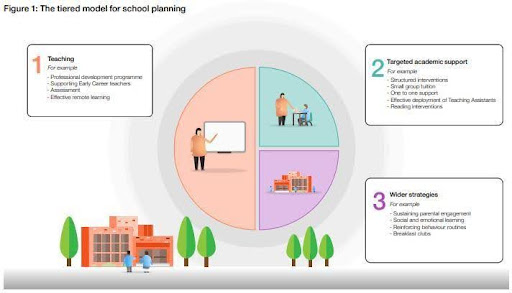
A Tiered Approach to Catch-Up
Considering a tiered planning model for the current academic year can help schools balance approaches to improving teaching, targeted academic support and wider strategies. It is recommended in the EEF’s Guide to the Pupil Premium as a way to help schools focus on a small number of strategies that are likely to make the biggest difference.
The tiered approach is a helpful heuristic that can supplement school leader decisions regarding the allocation of funding, energy, training and time.
EEF Guide to Supporting School Planning, 2021
Teaching
The best available evidence indicates that great teaching is the most important lever schools have to improve outcomes for their pupils.
Our recent review of the evidence on ‘Special Educational Needs in Mainstream Schools’ found strong evidence that explicit instruction, scaffolding, flexible grouping and cognitive and metacognitive strategies are key components of high-quality teaching and learning for pupils.
Targeted diagnostic assessments can support teachers to monitor pupils’ progress, particularly as they maintain classroom routines and recover any learning loss.
Targeted academic support
Considering how classroom teachers, teaching assistants and external partners can provide targeted academic support, including how to link structured one to one or small group intervention to classroom teaching, is likely to be a key component of effective planning for this academic year.
Wider strategies
Continuing to re-establish the routines of the classroom, and of school, will likely prove beneficial for pupils.
Supporting pupils’ social, emotional and behavioural needs, primarily as part of good teaching, is likely to prove an effective strategy to support learning.
TEACHING
High quality teaching for all
- Focus on the 6 principles of effective teaching to promote inclusion
- Support from Rosenshine’s principles and the GTT Great Teaching Review
- High quality texts in lessons and homework – Tier 2 and Tier 3 language;
- Reduced marking and more ‘live’ feedback evident;
- Focus on feed forward – anticipating misconceptions – prevention;
Effective diagnostic assessment
- Embedded frequent low-stakes quizzing of previously learnt content;
- Starters focus on methods of retrieval practice to support memorisation and pro-mote success;
- Efficient identification of issues that need addressing;
- Review of key knowledge and concepts;
Focusing on professional development
- Whole-school T&L approach on inclusion delivered;
- Introduction of Inclusion: The TBS Way
- Introduction of the 6 principles of teaching and learning to promote inclusion
- Adoption of the 90/10 model
- Focus on Rosenshine’s Principles of Instruction and GTT Great Teaching Toolkit;
- Re-setting of expectations for behaviour and learning with a focus on the emotion-ally-safe classroom;
- Use of Walkthrus as a primary support for CPD;
- Availability other supportive resources (eg. TLAC, Seneca, podcasts such as ‘Boys Don’t Try?’) and revisit of influential educators (eg. Tom Bennett, Dr Bill Rogers, John Sweller);
- Continued professional development through whole-school sessions and trios.
TARGETED ACADEMIC SUPPORT
- High quality one to one and small group tuition
- Teaching assistants and targeted support
- Academic tutoring
- Planning for pupils with Special Educational Needs and Disabilities (SEND)
WIDER STRATEGIES
- Supporting pupils’ social, emotional and behavioural needs Planning carefully for adopting a SEL curriculum
- Sequenced activities that lead in a coordinated and connected way to skill devel-opment.
- Active forms of learning that enable young people to practise and master new skills.
- Focused time in the school day/classroom (or in more ‘blended’ models) spent de-veloping one or more social and emotional skills.
- Explicitly define and target specific skills.
Communicating with and supporting parents
https://educationendowmentfoundation.org.uk/public/files/Publications/Covid-19_Resources/The_EEF_guide_to_supporting_school_planning_- _A_tiered_approach_to_2021.pdfhttps://educationendowmentfoundation.org.uk/public/files/Publications/Covid-19_Resources/The_EEF_guide_to_supporting_school_planning_- _A_tiered_approach_to_2021.pdf